| Advanced Dungeons & Dragons | - | Dragon 139 | - | Dragon |
| The Book of Black Circles | - | - | - | Laeyndar's Book of Metamorphoses |
The value of these books is, perhaps,
only exceeded by the potential power they
will give to PCs. Many of the spells in
these
books are of high level, and the DM should
carefully consider the effect of allowing
the players to get their hands on these
spells before they obtain the books. It
is
perfectly acceptable to omit one or more
of the spells that are supposed to be in
a
book if deemed best for the campaign.
It should be obvious that many characters
will want to get their hands on these
books, as demonstrated by the history of
these tomes. But it is quite possible that
a
PC's problems will only begin when he
acquires one of these books, for any use
of
a unique spell will attract attention?
perhaps much more than the spell-caster
bargained for. Thus, the use of these volumes
is not a free lunch.
As the spells detailed herein are unique,
not all details on their effects may be
available to the characters, even within
the books in which such spells are found.
There is no need for the DM to reveal
everything about a spell to the players?
let them find out themselves? the hard
way, if necessary. That is where the fun
is.
Finally, the history of each volume may
be adjusted to fit the nations, personalities,
and circumstances of a DM's particular
campaign world with little difficulty.
Otherwise,
the lands and personages
referred to may be assumed
to lie outside the usual
campaign area.
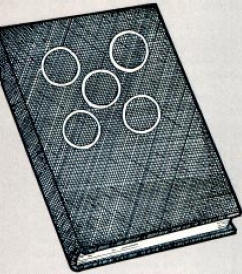
Appearance: The Book of Black Circles
is
a finely crafted book 2' high, 1' wide,
and
4" thick. The cover is made of soft black
leather taken from the throat of a black
dragon
and wrapped around a wooden
frame. The interior pages are fashioned
from the finest vellum and are bound to
the spine of the book with threads of
black silk. The cover of the book is blank
except for the inscription of five silver
circles in the upper half of the cover;
four
are arranged in a square, with the fifth
in
the center of the square thus formed. The
book's name is thought to refer to its
creators
or its innate powers rather than to its
cover design.
History and description: Whether
The
Book of Black Circles was designed as a
single work, of which copies have
appeared repeatedly over the history of
Tikkun Shalom in widely disparate locations,
or was designed as several works,
each with roughly the same power (which
seems more likely), is currently a matter
of some contention among the sages
of
Shalom. Whatever the case, it is indisputable
that this tome and copies of it have
been found in the strongholds of many of
the organizations of evil magi found in
Shalom. This was particularly true of the
Black Circle (which is thought to have
created the work) after the Circle was
brought low following its attempted
takeover of Shalom hundreds of years ago.
Copies have also been discovered in the
redoubts of the Hand of Destiny and the
Htiaf. As these groups still wield considerable
power in Shalom, however, it is
uncertain where such information could
be accurately obtained, and it must therefore
be treated with some skepticism.
No copies of this book exist in any of the
various libraries of Shalom at present,
nor
do any mages who do not belong to the
organizations mentioned above claim to
have access to such copies, with the sole
exception of the dark elf Arch-Mage,
Rathe. Information can be gleaned from
various sources, though Rathe is unwilling
to reveal any details concerning The Book
of Black Circles. What little is known
follows.
It is generally recognized that The Book
of Black Circles is used to train
young
magic-users in the dark arts, especially
those who wish to join a cult or organization
with evil intentions. It is apparent that
the book contains a few powerful and
unique spells used to test young mages
and to determine their worthiness to
advance through the ranks. It also contains
a few less-powerful common spells
used to train young mages. (It should be
noted that the use of these spells, while
not intrinsically evil, is largely limited
to
the holders of these books; however, there
are persistent if unfounded rumors that
several groups of good mages have used
similar spells to both locate and train
their
adepts.) In addition to the spells it contains,
The Book of Black Circles details
the process of the advancement of
mages and the methods of their instruction
in the dark arts, as well as showing
the proper construction of magic circles.
The only other information available on
The Book of Black Circles comes
from a
page of parchment that the renowned
thief Vadour stole from the Arch-Mage
Rathe several decades ago, when the mage
was of considerably less power. The
parchment is now kept in the Library of
the Imperial University in Sestar. If this
manuscript is to be believed, then other
powers may also be attributed to Rathe's
book and perhaps others like it.
Game information: Each of the silver
circles inscribed on the cover of the book
triggers a continual darkness spell (at
a
maximum of once per week per circle,
performed at the 18th level of spell use)
if
touched by any being who is not lawful
evil. This spell is centered on the toucher,
who may escape the effects with a saving
throw vs. spells (in which case the spell
centers on the book). Any lawful-evil being
may see through this darkness with ease.
Several magical protections are also
attributed to the copy of the book in
Rathe?s possession, which may be either
standard to such a book or unique to
Rathe?s copy as the DM chooses. The protections
on the book may be designed by
the DM and should probably take the form
of at least one symbol ? possibly several.
The specific types of symbols employed
are not revealed in the parchment stolen
from Rathe. Few if any copies of these
books have mundane protections such as
locks, traps, or the like.
The spells set down in The Book of Black
Circles are written in standard
form and
may be found in an appendix at the end
of
the book. They include block advancement
(unique spell), charm
person, conquer self
(unique spell), discern (unique spell),
feeblemind, geas, and hold person. The
Book of Black Circles contains all
the information
on magical circles found in the
Dungeon Masters Guide and
Unearthed
Arcana. <protection
circles, d56>
The three unique spells found in the
book are as follows:
Discern (Divination)
Level: 7
Range: Touch
Duration: Perm.
Components: V, S, M
CT: 1 turn
ST: None
AE: 1"
A magic-user
who casts a discern spell is provided (or
provides another) with the ability to determine
if a person has the potential to
become a powerful magic-user. Once cast,
the discern spell is permanent (though
subject to a dispel magic spell) and functions
continuously, without concentration
by the recipient of the spell. The spell
may
be cast by any magic-user of the necessary
level, though the recipient of the spell
must be a magic-user of at least 5th level;
the spell may also be applied to the spellcaster.
Discern is used primarily as a
recruiting device for various magical
orders and schools of every sort of alignment
and ethic.
Once cast, discern confers upon the
recipient the ability to magically determine
if a person has the potential to become
a
powerful mage simply by being within 10?
of that person and interacting in a normal
fashion with the candidate for two rounds.
The recipient of the spell perceives the
potential for magic-use in a candidate
as a
dim aura surrounding the subject. The
aura is invisible by any other means,
including true sight, true seeing, infravision,
or other types of magical or normal
vision, and is so dim that it cannot be
perceived in bright light (such as direct
sunlight). The aura is of constant strength,
regardless of the potential of the candidate.
For game purposes, a human, elf, or
half-elf scanned by this spell registers
favorably if he has an intelligence of
14 or
greater and scores of 6 or better in all
other characteristics. A variation of this
spell may exist that is more selective
and
detects only those who have the potential
to become great illusionists as well (thus
including gnomes among the races affected,
but detecting only those persons with
intelligence scores of 15 or better and
dexterity scores of 16 or better).
Even if a positive result is obtained, the
spell in no way guarantees that the person
will become a great mage (or even a mage
at all); it simply indicates ability based
on
intelligence, aptitude, and the will to
achieve. The Book of Black Circles
stresses
the fact that the spell is no more than
a
prediction; even if a person has the ability,
he may opt not to become a mage, quit
before he reaches a high level, or die
before achieving greatness. The DM
should use his judgment regarding who is
highlighted by this spell's use.
The material component of the spell is a
gem
of seeing or a similar magical device
(such as eyes of minute seeing) which
allows for a special type of vision. The
material component is consumed when
the spell is cast.
Block
Advancement (Abjuration/Charm)
Level: 8
Range: Touch
Duration: Perm.
Components: V, S, M
CT: 1 turn
ST: Neg.
AE: 1 person
When a block
advancement spell is successfully
cast
upon an individual, it instantly strips
him
of the ability to advance in levels of
spellcasting
ability until the recipient successfully
survives the ordeal induced by a
conquer self
spell (q.v., as follows). The
spell affects only a single magic-user
of no
less than 5th level, no greater than 15th
level, and of an alignment identical to
the
caster. Block advancement cannot be
removed otherwise except by the use of
a
wish spell.
The recipient of the spell is allowed a
saving throw vs. spells (which is forfeited
by a willing subject), and the spell does
not
come into effect if the saving throw is
successful. Because the spell was designed
to stop the advancement of any magic-user
deemed not worthy of power until such
time as he proved himself worthy, the
original researcher of the spell (most
likely
a member of the Black Circle) assumed
that the recipient would be willing to
receive the spell (the alternative was
death). However, if the spell is applied
to
an unwilling subject and he makes a successful
saving throw, he suffers damage in
hit points equal to twice the number of
levels possessed by the caster but is otherwise
unaffected.
Once block advancement comes into
effect, the recipient cannot learn any
new
spells (though he may record new spells
in
his spell books) nor may he cast any spells
of a level above the highest level that
he
was able to use before being blocked. He
may, however, gain more spells of the
levels he currently possesses. Thus, if
cast
upon a 5th-level mage, block advancement
would prohibit the mage from casting
fourth-level spells until the spell was
removed (but would not stop him from
gaining additional third-level spells).
A
block advancement spell does not prevent
a mage from gaining experience points
while it remains in effect, nor does it
prohibit the mage from gaining new weapon
and nonweapon proficiencies and
additional hit points when enough experience
is gained to advance in level.
Advancement in levels occurs as it normally
would. Thus, the net effect of the spell
is only to limit a mage to his current
level
of spell-casting ability. Once the spell
is
removed, the recipient immediately gains
all of the normal spell-casting abilities
appropriate to his level.
The material component of the spell is a
small jade statue of the recipient of the
spell, upon which a feeblemind spell has
been cast prior to the casting of the block
advancement spell. The statue is not consumed
by the spell, but may only be used
for one person. Once the block advancement
spell has been removed from the
recipient, the statue shatters.
Conquer Self
(Abjuration/Alteration)
Level: 9
Range: Touch
Duration: 6 hours
Components: V, S, M
CT: 1 round
ST: See below
AE: 1 person
Upon the
completion of this spell, the recipient
of a
block advancement
spell begins a great
personal ordeal which either results in
his
death or in the removal of the block
advancement spell and the gaining of an
experience-point bonus, if the mage is
deemed worthy by the power of the conquer
self spell. The spell is useless for any
other purpose. If cast upon an individual
not under the effects of a block advancement
spell, conquer self vanishes from the
spell-caster?s memory with no effect. Conquer
self must be cast by a mage of the
same alignment as the recipient.
Once cast, the recipient undergoes a sixhour
ordeal during which he is rendered
helpless by wrenching pains and powerful
hallucinatory visions ? hence the recipient
is usually placed in a special area
where he is relatively safe from attack.
(Interestingly, The Book of Black Circles
reports that the visions experienced during
the ordeal are occasionally prophetic
or based on actual events or areas that
the
recipient may not have witnessed.) The
outcome of the ordeal is dependent upon
the actions of the recipient since he
received the block advancement spell.
Although the recipient is automatically
affected by this spell if he meets the
previous
requirements, the final outcome of
the spell is dependent upon a successful
saving throw of 20. This saving throw roll
is modified by several conditions, most
of
which are dependent on the actions and
performance of the recipient. No form of
magic affects this saving throw (including
items such as a luckstone), and all other
saving-throw modifiers from which the
mage would normally benefit are similarly
ineffective. The modifiers apply only from
the time of the application of the block
advancement spell. They are as follows:
| +1 | Per 100,000 xp gained: |
| +3 | Perfect alignment performance |
| +1 | Average alignment performance: |
| -1 | Poor alignment performance |
| +4 | Every successful (major) quest performed
for organization |
| +1 | Each point of intelligence above 12 |
| 1 = +2; 2 = +1;
3 = -1; 4 = -2 |
Average of scores
obtained during level
advancements used for determining training costs between levels (see DMG, page 86) |
| -3 to +3 | Evaluation of recipient by caster of conquer
self spell (mediated by DM), based on recipient?s ability, ambition, heroic actions, etc. |
If the recipient successfully makes his
saving throw, he comes out of his trance
after six hours. At this time, he regains
the
spell-casting ability appropriate to his
present level and gains a 10% experiencepoint
bonus for all experience earned
since block advancement was cast upon
him. If the recipient fails the saving
throw,
he dies at the end of the six hours; he
may
be raised or resurrected in the usual manner,
though he will still suffer from the
effects of the block advancement spell.
The saving-throw roll is always failed
if
the result of the roll is a 1, regardless
of
modifiers to the roll. The material component
of the spell is the jade statue which
was used when the block advancement
spell was originally applied to the recipient;
at the conclusion of the conquer self
spell, the statue shatters.
Laeyndar's Book of Metamorphoses
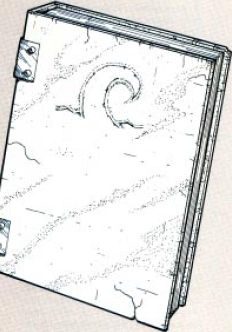
Appearance: The value of this enormous
compendium of lore is only enhanced by
the valuable materials from which it is
fashioned -- and the monetary value of
the spells found within it is certainly
huge.
The work is contained between two thin
slabs of deep-blue lapis lazuli (each 1/8"
thick) that are 2' tall and 1½'
wide. The
spine is also formed from lapis lazuli
and
is bound to the covers by platinum hinges.
Ten sheets of thin mithral rest between
the covers but are not bound to the spine.
The lapis lazuli thus forms more of a folder
for the mithral pages than actual book
covers. On the front cover is Laeyndar's
symbol, also the symbol of water in many
areas, engraved with a wizard
mark.
History & and description: That
this book
originally belonged to the mage Laeyndar,
titled ?The Lame,? is obvious, for its
cover
bears a golden wizard mark in the form
which Laeyndar chose as his sign ? that
of a wave, symbolizing the fluidity of
water and mutability of form. Laeyndar,
the lame mage from the famed waterfall
city of Escatlar, lived over 700 years
ago.
Although born with a club foot and
hunchback, he did not let this deter him
from the life of magic-use. Laeyndar rose
to extreme power but was turned away
from the White Circle because of his
deformities. Thereafter, he became
obsessed with the study of transformations
of form. The Book of Metamorphoses
was evidently created many years later,
for it contains numerous spells of high
level which appear to be the result of
his
researches into the subject of alterations
of form, including some spells even enabling
mental transformation. Unfortunately,
Laeyndar?s obsession evidently
twisted his mind as well as his body, and
he apparently never utilized the marvelous
results of his research to better his
own appearance, as he originally intended.
After he was denied entry into the White
Circle, he vanished from sight. His sole
apprentice, Moytaire, recorded in his
diary that he always knew his master as
deformed.
Upon his death, Laeyndar passed the
book on to Moytaire, who learned of the
book?s powerful curse shortly thereafter
but was tragically unable to avoid it.
The
one time he appeared in public in later
years, Moytaire had already begun his
transformation into a crippled kuo-toa.
Moytaire was grief-stricken at his change,
and shortly before it was complete he
went into absolute isolation. At an
unknown later time, Moytaire died, and
the book remained in his lonely tomb for
many years as tomb robbers were apparently
reluctant to chance entry into his
demesne on the off chance that the wizard
had become a lich
(despite his neutral
stance) or had secretly warded his tomb.
That the tomb was eventually plundered
is evident, for some 330 years after the
beginning of Moytaire?s isolation the book
was examined by the master of the mages?
college in Sestar, Illkeda, who also fell
under its curse but hid the book so that
it
could not exercise its fell powers again.
The book?s location once again remained
unknown for another 200 years until it
was uncovered and again worked its twisted
magic, this time upon the mage-king of
the Kingdom of the Coral Throne. The fall
of the so-called Aqua Kingdom was the
result, as the mage-king, Plautes, betrayed
his subjects to their enemies, the kuo-toa.
The Book of Metamorphoses has not been
seen since, and certainly there is no
record of it transforming any other in
the
interim. Thus, although its whereabouts
remain uncertain, the sage Needram
asserts that it remains in the ruined palace
of Plautes, untouched even after the
resumption of the Kingdom of the Coral
Throne from its present-day capitol.
Game information: The writings of
Illkeda
provide the only clues as to the contents
of the book. Illkeda claims that the
book contains the following spells, one
per
page, in standard form: change form
(unique spell), clone,
enlarge, graft (unique
spell), massmorph, polymorph any object,
polymorph other, polymorph self, shape
change, and statue. The book?s curse
affects any creature the first time it
opens
the tome, causing the being to change
form into a kuo-toa with a club foot and
a
hunched back, as per the change form
spell herein. A saving throw vs. polymorph
is allowed, however.
The two unique spells found in the book
are as follows:
Graft (Alteration)
Level: 6
Range: Touch
Duration: Perm.
Components: V, S, M
CT: 1 turn
ST: See below
AE: Recipient
When a spellcaster
invokes a graft spell, he may attach
an appendage of another creature in place
of a missing limb on the recipient's body,
who may be either the caster or another
being. The appendage must take place
of a lost limb -- e.g., the caster cannot
place the arm of another creature onto a
body which had no such limb before, nor
add an extra arm in the middle of his
chest. Additionally, the limb to be grafted
must also perform roughly the same function
as the old one; consequently, a mage
may not attach a foot to an arm stump.
The appendage may be of any size, but the
recipient of the limb must be able to
manipulate it with his current strength. If
the limb is overly cumbersome or exceptionally
different from the original, the
limb may inhibit movement or limit spellcasting
ability. The appendage to be
replaced may be anywhere on the body,
i.e., arms, legs, feet, hands, or parts
thereof, but it cannot be the head. The
replacement may also be of any form, thus
a demon's claws, a bear's forepaw, or
another human hand could take the place
of a lost hand, claw, or paw.
The appendage to be grafted must have
been alive within the hour before the spell
is cast, or the graft will not take. The
member to be grafted may be successfully
joined provided that the recipient of the
limb makes a successful system-shock roll
upon completion of the casting. A failed
roll indicates that the graft does not
take,
and the limb withers and dies in one day.
If the graft does take, then the new
member will remain in place and function
normally. Furthermore, the recipient even
receives all the strength and dexterity
bonuses or penalties the limb had previously.
The grafted appendage also has all
the immunities and weaknesses, including
armor class and damage ability, that the
appendage had previously, so long as such
bonuses and penalties did not result from
special characteristics of the limb?s original
body (thus, innate spell-casting abilities,
psionic ability, magic resistance, and
strength bonuses do not apply). For example,
if a magic-user were to graft on the
hand of an arcanadaemon, his new hand
would be AC -2, would take only half
damage from cold, and would cause 1-4 hp
clawing damage. The hand would, however,
no longer be magic resistant (as is an
arcanadaemon?s hand). If a magic-user
were to graft on the forefoot of a lizard,
though the mage may gain an improved
armor class for that hand, he would probably
not be able to cast spells due to the
low potential dexterity of a lizard?s claw.
The hand of an ogre (the largest-size
humanlike being whose limbs may be so
used) would allow for a grasping strength
equal to an 18 (nonpercentile) strength;
however, the magic-user could not lift
weights at the same strength level as only
his hand has this ability, unless the magicuser
previously had an 18 strength.
The material components of the spell are
the appendage to be grafted and a mixture
made up of the blood of the being to
which the member originally belonged,
the blood of the caster, a potion of polymorphing,
a potion
of extra-healing, and at
least 10,000 gp worth of powdered moonstone.
The components are consumed
(except for the appendage, of course)
when the spell is cast.
Change Form
(Alteration)
Level: 8
Range: Touch
Duration: Perm.
Components: V, S, M
CT: 8 segments
ST: Neg.
AE: Recipient
When the
change form spell is evoked, the
caster
begins a process which will eventually
end
with the complete metamorphosis of the
recipient into an entirely new creature.
The change induced by the spell is total
in
every respect and occurs regardless of
the
size of the recipient and the size of the
creature chosen by the caster.
An initial saving throw vs. polymorph is
allowed to negate the effects of change
form, but if this is failed, only a wish
can
stop the transformation. Furthermore, a
wish can only stop the process, not
reverse it, once the physical phase of
the
transformation is complete. A second wish
can be used to reverse the process so that
the victim will return to normal at the
same rate as the initial change occurs.
A
third wish speeds up the rate of ?backward
change? so that it takes but one day.
The ultimate form of the recipient is chosen
by the caster but cannot have more hit
dice than the recipient presently possesses
and must be a native of the Prime Material
plane (thus demons,
undead, devils, elemental
creatures, and other unique entities
are not possible choices).
Immediately after the spell is completed,
all characteristics of the target, including
ability scores, alignment, form, armor
class, hit dice, etc., move one place toward
those of the end creature; for every 10
days following the spell?s casting, they
change one further position. Size is altered
at the rate of 1? and 10 lbs. of gain or
loss
per day. For example, an 8th-level fighter
who began to change form into a pech
would immediately gain a natural armor
class of nine; 10 days later he gains AC
8;
20 days later he gains AC 7; and 40 days
after that, AC 3. During this time, the
fighter would have lost four of his hit
dice,
become neutral good, and otherwise
assumed the appearance, size, form, and
general characteristics of an average pech.
The DM must arbitrate these changes as
he sees fit.
When all mundane statistics have conformed
to those of the new form, the
recipient loses all class abilities he
possessed
previously. Thus, if we assume that
our fighter?s change is complete on the
70th day, he then loses his fighting ability
and now attacks as a 4-HD monster. One
week after this phase of the transformation
is complete, the subject loses all previous
memories (except for rudimentary
facts about himself, such as his name,
place of birth, and so forth) and other
functions associated with his previous
form such as racial abilities. Instead,
he
gains all the special abilities (such as
magic
resistance, special attacks, special defenses,
etc.) of his new form, becoming in
every respect a member of his new race.
However, in some cases, even the change
form spell is not totally efficacious
in this
respect, as memories and other mental
functions, such as intelligence and psionics,
may be retained in the being?s new
form if the new form is basically the same
as the old form (e.g., humanoid to humanoid,
avian to avian, etc.).
Once the metamorphosis is complete,
the recipient grows and ages normally,
as
would any other member of his new race.
He is able to use all natural abilities
of his
new form, such as flight and other special
movements, as if he were born to them,
though he may not be able to speak the
language of his new form.
The material component of the spell is a
vial of acid, in which at least 5,000 gp
worth of powdered moonstone has been
dissolved during a full moon. The vial
must be broken upon the recipient within
one round of the completion of the spell.
The acid will cause no damage to the
recipient of the spell, unless he successfully
makes his saving throw, in which case
he takes 2-8 hp damage.
NOVEMBER 1988