| - | - | Closing notes | - | - |
| 1st Edition AD&D | Dragon magazine | - | Equipment (AD&D) | Dragon #169 |
Most players in AD&D® 1st
Edition campaigns
own copies of the 1st Edition Players
Handbook and Unearthed
Arcana. These
two books allow players access to the statistics
of every weapon
imaginable--almost.
Wouldn't it be refreshing for the Dungeon
Master to surprise the local party with
a
few entirely new blades, crossbows, and
similar instruments of orc-felling? The
following weapons are intended for use
by
DMs who wish to add extra spice to their
fantasy battles.
Table 1
New Weapons: Power and Size +
Table 2 New Weapons: Armor <Type>
Adjustments & Ranges
| Weapon | Damage (S-M/L) | Length | Space required | Speed factor (FR: fire rate) | Weight (libs.) | Cost (gp) | 0 | 1 | 2 | 3 | 4 | 5 | 6 | 7 | 8 | 9 | 10 | Small | Medium | Large |
| Basilard | 2-5/2-7 | 1 3/4' | 3/4' | 2.5 | 3 | 7 | -4 | -2 | -3 | -2 | -2 | -1 | - | - | +1 | +1 | +2 | - | - | - |
| Claymore, dwarven | 2-8/2-12 | 4 1/4' | 4 1/2' | 7 | 11 | * | -1 | - | - | +1 | +1 | +2 | +2 | +2 | +1 | +1 | - | - | - | - |
| Club, dwarven war | 2-8/2-7 | 3 3/4' | 4' | 6 | 12 | - | +2 | +2 | +1 | +1 | 0 | 0 | 0 | +1 | 0 | +2 | 0 | - | - | - |
| Crossbow, disk | ** | **** | **** | FR: 1/2 | 10 | 175 | -5 | -4 | -3 | -2 | -2 | - | - | +2 | +3 | +4 | +4 | - | - | - |
| Crossbow, doubled | 1-4 x3 | - | - | FR 1 or 2 | 8 | 60 | -3 | -2 | -2 | -1 | - | - | - | +1 | +2 | +3 | +3 | 6 | 11 | 17 |
| Disk (for crossbow) | 2-7/1-6 | 5' | - | - | .3 | 5 | - | - | - | - | - | - | - | - | - | - | - | - | - | - |
| Mace, great | 2-9/2-8 | 5' | 5 1/2' | 10 | 20 | 20 | +3 | +3 | +2 | +2 | +1 | +1 | 0 | 0 | -1 | 0 | -1 | - | - | - |
| Morning star, double-balled | 2-5 x 2 / 1-4 x 2 | 4' | 5' | 8 | 16 | 35 | -1 | - | - | - | +1 | +1 | +1 | +1 | +1 | +1 | +2 | - | - | - |
| Spear, hook-tailed (hook end) | 1-6/1-8 | 6'-14'+ | 3' | 7 | 5-7 | 8 | -3 | -3 | -2 | -2 | -1 | -1 | 0 | 0 | 0 | -1 | -1 | - | - | - |
| Spear, hook-tailed (spearhead) | "" | "" | "" | "" | "" | "" | -2 | -2 | -2 | -1 | -1 | -1 | 0 | 0 | 0 | 0 | 0 | - | - | - |
| Sword, flamberge | 2-9/2-16 | 5 1/2' | 5' | 9 | 21 | 30 | - | +1 | +2 | +3 | +3 | +3 | +3 | +2 | +2 | +1 | - | - | - | - |
| Sword, mariner's | 1-8/1-8 | 3' | 2' | 4 | 4.5 | 9 | -4 | -3 | -2 | -2 | -1 | - | - | - | +1 | +1 | +2 | - | - | - |
| Sword, piercer | 2-7/1-8 | 3 1/4' | 1 1/2' | 3 | 3 | 12 | -1 | -1 | - | +1 | +1 | +1 | +1 | +2 | +2 | +2 | +3 | - | - | - |
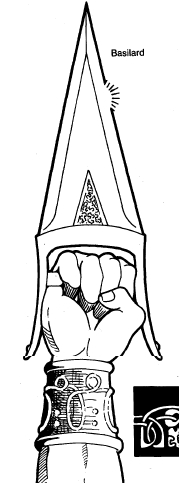
Basilard:
The basilard is derived from
a short, bladed weapon of the same name
employed between the 12th and 15th
centuries in medieval battle. The basilard
differs to a small but significant degree
from a short sword in balance and shape.
The hilt of a basilard has a lopsided Hshape,
with the crosspiece of the letter
being the weapon?s handle and the upper
legs of the H being placed as the blade?s
hand guards. The weapon?s blade is a slim,
perfect V-shape from point to hilt with
no
expanse of metal formed by parallel edges,
as is usual with most swords. Due to its
shape, the basilard is an exceptional stabbing
and thrusting weapon that can function
as a chopping device if necessary.
The basilard's speed factor of 2.5 places
it between a short sword and a dagger in
quickness. If a basilard-armed fighter
is in
combat with an opponent wielding a short
sword, and both combatants rolled the
same number for initiative, the fighter
with the basilard would strike first in
that
melee round. DMs may allow thieves
and
assassins, as well as fighters and rangers,
to gain proficiency with the basilard.
Claymore, dwarven:
This sword is
similar to the two-handed sword of humankind,
being about the size of a bastard
sword. The heavy blades of dwarven
claymores are made of the highest-quality
metals and are kept razor sharp, allowing
the weapon to be nearly as useful against
armor as a human two-handed sword.
Newly sharpened nonmagical swords of
this type have a + 1 bonus to hit that
lasts
for the first six melee strikes.
Dwarves
have fewer reservations about
allowing nondwarves to gain possession
of
their claymores than they do about giving
up their cherished war clubs. However,
few nondwarves desire to employ such
weapons, because the dwarven style of
forging their claymores yields a blade
with
a weight imbalance beneficial to wielders
with a low center of gravity, but feeling
quite odd and fatiguing to taller and less
stocky warriors. In game terms, this peculiarity
can be handled by requiring the use
of two proficiency slots when any taller
race gains proficiency with the dwarven
claymore. Halflings cannot employ the
dwarven claymore, and only the largest
and most able of gnomes (both surface and
deep) would use the weapon, although
gnomes suffer no penalty when learning
to use it. No nondwarf can gain weapon
specialization with the dwarven claymore,
in any event.
For a dwarf, a dwarven claymore would
cost about 22 gp. The price would, in all
likelihood, be significantly higher for
a
member of another race.
Club, dwarven war:
This is a fairly
common weapon among the older houses
of the bearded
folk, but it is not often
found in the use of other races. A massive
weapon in anyone?s hands, the dwarven
war club is a large, steel-reinforced weapon
appearing much like a mace, doubly
thick at the striking end than at the tail.
It
is used by dwarven priests and warriors.
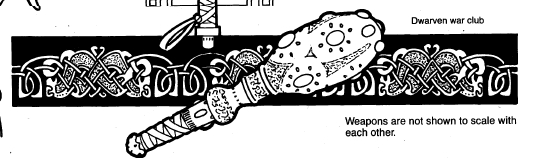
War clubs are made from heavy wood
with an iron or lead core, inlaid with
round or slightly pointed studs of steel.
These projecting studs add a great deal
of
bludgeoning weight to the war club, making
the weapon very effective against
heavy armors that absorb the shock of
lighter blows, but less effective against
light armor that allows the wearer to
avoid such attacks. This club is a twohanded
weapon for dwarves and all other
beings of human size or less, but it can
be
wielded one-handed by larger folk such
as
gnolls and ogres. A dwarven war club,
because of its size and bulkiness, cannot
be used by halflings and gnomes.
Dwarves do not commonly offer such
weapons for sale, though members of their
own race may purchase an unadorned war
club for 10 gp. The bestowing of a dwarven
war club upon a nondwarf is an honor
similar to the giving of elven chain mail
to an
outsider by elves. Only those deemed worthy
by dwarven standards might be given a
chance to take possession of a war club.
If
an honorable dwarf sees a member of another
race bearing a war club obviously
taken from a fallen dwarf, his reaction
will
surely be one of disgust, if not violence.
Dwarves of moderate to high status have
war clubs ornately carved and decorated
so that the value of these weapons may
be
significantly higher than their base price.
Such carvings often are written lineages
dating from the first clan member who
employed the war club and lived to pass
it
on to another of his kin. Despite its
worked appearance, there is no such thing
as a ?dress war club? that exists purely
for
show; all are true weapons.

Crossbow,
disk: This rare form of
heavy crossbow fires an extremely thin
steel disk from a horizontal shaft. The
weapon is decidedly more effective than
other crossbows or bows against lightly
armored targets at close range, and can
inflict severe wounds against them. However,
the disk crossbow is not nearly as
deadly against well-armored foes.
The disk-firing crossbow resembles a
heavy crossbow. A wood block with a slit
parallel to the crossbow?s handle and the
absence of a bolt shaft on top of the crossbow
reveals the weapon for what it truly
is. Fighters and rangers are the classes
most prone to using it.
As with the doubled crossbow, but to an
extreme degree, this weapon should be
encountered rarely and only in expert
militia or mercenary units unless the disk
crossbow is added to the list of what characters
can purchase at the beginning of a
campaign. The fact that the disk crossbow
fires a projectile of carefully forged
and
sharpened metal is a factor that contributes
to its rarity, limiting its manufacture
to humans, dwarves,
and elves.
Crossbow,
doubled: The doubled
crossbow is essentially two light crossbows
joined with the same stock and
handle. Two separate triggers, side by
side, are included along with two separate
bolt shafts and strings, one over the other.
The design considerably decreases the
crossbow?s range in comparison to that
of
the standard light crossbow, although the
light crossbow and the doubled crossbow
fire exactly the same type of bolt. Both
strings of this odd but useful weapon can
be cranked back with a single hook, making
this a rapid-firing weapon (by AD&D
game standards) that can fire two bolts
per melee round in the hands of someone
who has proficiency with this weapon. A
warrior employing the doubled crossbow
without having a proficiency with it can
fire only one bolt per round until he has
a
chance to stop firing for one round to
reload both parts of the two-fold weapon.
Someone with standard light or heavy
crossbow proficiency would still be treated
as having no proficiency with a doubled
crossbow.
A fighter
or ranger who gained weapon
specialization with a doubled crossbow
would get the standard crossbow specialization
bonuses, except that additional
attacks would not be gained until 13th
level. At 13th level and above, the specialist
can fire two bolts in the first round and
have the weapon cocked and loaded by
the end of the round; at the start of the
second round, he may fire the two loaded
bolts, then have the weapon cocked and
loaded again to fire two bolts at the
rounds end. This rate of fire (two, four,
two, four, etc.) continues thereafter.
These
crossbows are almost exclusively employed
by expert missile troops because so
few crossbow makers have the skill or
knowledge to craft these devices. Humans
and dwarves are the races most favoring
their use.
Mace, great:
The great mace is a larger
version of the basic footman's
mace. Its
huge, awkward head, when properly
wielded, deals crushing blows hindered
little by armor of any type. The great
mace appears as a standard (if oversized)
spiked or studded steel head atop a long,
heavy length of wood that is often reinforced
with bands of steel that help to
prevent the haft from breaking or cracking
under the strain of a blow. The limitations
of the great mace, like so many
heavy melee weapons, are its unwieldy
size, great weight, and sheer bulkiness.
However, the great mace is not nearly as
expensive or difficult to repair as such
weapons as the two-handed sword and is
therefore more accessible to groups of
non-noble warriors. Troops employing
great maces in large numbers are almost
always of an elite and physically powerful
type (minimum strength 9) in order to
wield their armor-rending weapons.
Morning
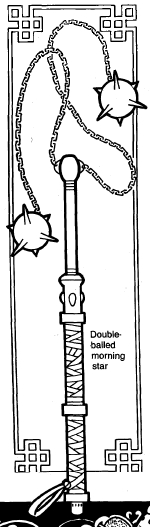
star, double-balled: This
two-handed weapon is quite similar to the
normal morning star except that, as its
name implies, two separate chains and
spiked balls are affixed to the weapon's
haft. This weapon of human design is
generally effective against any armor and
is exceptionally useful against lightly
armored
opponents. In combat, to-hit and
damage rolls are made separately for each
ball of the weapon. The two balls are
smaller than the one on a single-balled
morning star, to avoid making the weapon
too heavy and clumsy to handle.
A three-balled morning star can be made
with even smaller spiked balls (doing
1-4 ×3/1-3 ×3 damage), sharing
all characteristics
of the two-balled weapon including
separate rolls for each ball to hit.
Beyond this three-ball limit, however,
the
weapon becomes ineffective because of
tangling, clumsiness, and the light weight
of the spiked balls.
Spear,
hook-tailed: This variant combination
polearm is a thrusting weapon,
not balanced for throwing, with a steel
hook affixed to the butt end. The point
is
used as a normal spear with the standard
armor-class adjustments, while the butt
end is used to fell mounted opponents
much like a guisarme
or bill hook. If a
dismounting attack is successful, minor
damage from falling from the horse is
caused (1-6 hp, with dexterity check on
4d6 for half damage); and any further
attacks that round on the individual who
was knocked down are at +4 to hit (as is
usual vs. prone opponents).
Obviously, only one end of the spear
may be used at a time, so at the beginning
of each round a user of the hook-tailed
spear must state which end he is going
to
employ. When an individual wielding this
spear opts to employ the opposite end of
the spear, he must accept a + 1 penalty
on
that rounds initiative roll. Due to the
time
and space required to change weapon
ends, groups of warriors armed with
hook-tailed spears often have half of their
number use the hook end of their weapon
to knock opponents to the ground, where
the remainder of the troop can fall upon
the unfortunate victims with the spear
points of their weapons, thereby disposing
of enemy warriors quickly and relatively
easily. However, whichever end of this
weapon is not being used is bound to get
in the way of the wielder and those close
to him, possibly causing injuries (15%
chance per round of a nonproficient user
making an unintentional attack against
anyone standing within range; reduce this
to 1% per round for proficient user). In
a
fairly short time, troops using hook-tailed
spears switch to using glaive-guisarmes,
on
which the hooks are mounted behind the
spearheads.
Proficiency with a hook-tailed spear
takes one proficiency slot. The hook-tailed
spear requires special consideration when
applying the weapon specialization rules
found in Unearthed Arcana. A fighter
specialized with a hook-tailed spear should
be allowed the normal melee-weapon hit
and damage bonuses but should not gain
three attacks every two rounds until 7th
level. The maximum number of attacks
per round a hook-tailed spear specialist
could gain would be two, at 13th level
(usually hooking a victim, then spearing
him). Note that the specialist does not
have
to abide by the changing/initiative penalty
rules outlined here.
Like most spearlike weapons, the hooktailed
spear does double normal damage
(with its point) on a hit against a charging
opponent, if the weapon?s butt has been
set to receive the attack. A hit with the
hook end of the spear against a charging
opponent takes advantage of the -1
armor-class penalty taken by the charger.
Only humans use this clumsy weapon (and
they rarely use it for long).
Sword, flamberge:
The flamberge is
based vaguely on a medieval sword. It is
a
long, two-handed weapon with a broad,
wavy blade, useful against armors such
as
splinted, banded, scale, chain, and plate.
Cavaliers,
paladins, nobles, and knights
would logically have armor-penetrating
weapons such as the piercer and flamberge
swords. These types of warriors
traditionally engage in conflicts against
other rich warriors who in all likelihood
would invest in good suits of armor.
Sword, mariner's:
The maranim was
a stout human
race in my AD&D campaign
that lacked height but sailed expertly.
They developed a midlength blade as
wide as a broad sword, the result being
an
effective close-combat chopping weapon,
perfect for land as well as shipboard use.
On the mainland, the "maranim sword"
became the "mariner's sword? and, later,
the ?guard?s sword? to the common folk.
The mariner?s sword has a double-edged
blade between a short sword and long
sword in length, sharply tapering only
at the point. It is a one-handed sword
used largely by humans and elves.
Sword, piercer:
This fantasy blade is
based on the thin but quick and accurate
swords employed by warriors in the 15th
century when full suits of plate were in
widespread use. These thrusting swords
were designed to pierce the numerous
cracks and joints of heavy armor. The
piercer sword, however, is less useful
in
parrying any weapon heavier than itself
unless made of the strongest alloys in
perfect balance (-4 penalty to save as
hard metal vs. normal or crushing blows
if
used to parry). The piercer sword has
long, slim blade tapering down its entire
length, with a standard hilt and crosspiece
to protect the user. It is used one-handed,
largely by humans
and elves.
Closing notes
The use of these new weapons need not
include them being wielded by player
characters. A perfect use for them is to
arm groups of unusual or previously unknown
beings. For example, a party, lost in
an unexplored mountain range, is suddenly
surrounded a group of gray-skinned
dwarves mounted on huge
black mountain
goats.
Encounters such as this are made
even better with the addition of strange
weapons, so each dwarf bears a strange,
metal-studded club covered with runes
and gems.
It would be unfair for a DM to deny a
character possession of a new type of
weapon outright, but finding a teacher
to
aid the character in becoming proficient
with his new weapon could become an
adventure in itself. Unless the DM
has a
practice of allowing proficiency with any
sword, polearm, and bow characters can
lay their hands on, hunting for techers
is
unavoidable.
Except as noted in the previous descriptions,
profciciencies and specializations
gained lawfully with the aforementioned
weapons are treated normally, with the
usual restsrictions and bonuses.
Assume
that any of these new weapons that does
not have information included on its origin
was developed in the author's AD&D
campaign.
THE FORUM
There was an article in DRAGON
issue #169,
entitled "New Weapons for
Old," written by
Jordan Clarke Hayes. In this
article, Mr. Hayes
has made a mistake. The basilard
that he describes
is in no way a basilard except
in its
length. The weapon to which
he is referring is
the katar. The katar was
a Hindu thrusting
dagger with the H-shaped
handle that Mr. Hayes
credits to the basilard.
The katar had a straight,
short, broad, 12" (rarely
27") double-edged
blade that was either ribbed
or fullered
(grooved). The point of this
blade was slightly
thick and very sharp, so
as to pierce chain mail.
This blade was made in India
in the 18th and
19th centuries and was never
found in Europe.
As a result, characters in
D&D and AD&D
games should find this weapon
very hard to get
and slightly on the expensive
side at 100 gp.
The basilard, on the other
hand, was quite
common in Europe and should
be easy to find
and buy at 50 gp each; it
was made throughout
the Middle Ages from the
13th to 15th centuries.
It had an I-shaped handle
that varied from
country to country. In Italy,
the pommel and
guard were both made the
same length and
straight across; in other
European countries, the
guard and pommel were different,
the guard
being markedly more curved
and longer than
the pommel. The basilard
was first made in the
town of Basel. Its length
was between that of a
short sword and a dagger.
I recommend The Complete
Encyclopedia of
Arms and Weapons,
published by Bonanza
Books and distributed by
Crown Publishers Inc.
(copyright 1979). Thank you
for listening.
Marcus Wagner
Long Valley NJ
(Dragon #178)