(WG: Dwur)
<Homofaber>
(Norse Dwarves)
-
-
| Monster Manual | Dwarven Military Organization | - | - | - |
| Dwarf, Hill (PC race) | Dwarf, Mountain (PC race) | Dwarf, Grey (PC race) | - | AD&&D |
FREQUENCY: Common
FREQUENCY:
Common
NO. APPEARING: 40-400 <Tomb
Tappers> <(BATTLESYSTEM)>
ARMOR CLASS: 4 <chain
& shield.small>
MOVE: 6"
HIT DICE: 1
% IN LAIR: 50% <(see Dungeon #2 for
an example of a dwarf lair)>
TREASURE TYPE: individuals M
(x 5); [G], [Q] (x 20), [R] <in lair>
NO. OF ATTACKS: 1
DAMAGE/ATTACK: By weapon or 1-8
SPECIAL ATTACKS: See below
SPECIAL DEFENSES: Save at 4 levels higher
(See below)
MAGIC RESISTANCE: As above
STRENGTH: 13-14
INTELLIGENCE: Very <(11-12)>
ALIGNMENT: Lawful Good <G was capitalized>
SIZE: S (4' + tall)
PSlONlC ABILITY: Nil*
Attack/Defense Modes:
Nil
DEITY: Moradin,
Reorx.
*possible to exist in unusual characters
Rocky hills
are the favorite abode of these sturdy creatures. Dwarves
typically band together in clans which
are not mutually exclusive or hostile
but are competitive. These creatures are
able to operate in two or more
classes simultaneously, so fighter/clerics,
for example, are possible. Note
also that the level of proficiency may
vary between the two or more
classes one of these creatures is capable
of performing in.
If encountered in their lair (home) there
will be in addition from
2-12 fighters of from
2nd to 5th level, <(F2, F3, F4, F5)>
from 2-8 fighter/clerics
of from 2nd to 4th level (each category),
and females &&
young equal to 50% and 25% respectively of the number of adult males.
A dwarven lair is always an underground
complex in solid rock.
Dwarves are 60% likely
to have tamed animals to serve as guards in their
lair: 5-20 wolves
(25%) or 2-8 brown bears (75%).
Dwarves are typically
armored with chainmail and shield.
They have the following typical weaponing:
<>
| 01-15 | Sword & light crossbow | 15% |
| 16-25 | Sword & pole arm | 10% |
| 26-45 | Sword & spear | 20% |
| 46-55 | Axe & heavy crossbow | 10% |
| 56-80 | Axe & hammer | 25% |
| 81-90 | Axe & mace | 10% |
| 91-00 | Hammer & pick | 10% |
<Note: there are
two kinds of military picks:
footmans
(c. 4' long) and horsemans(c.
2' long)>
<Note: there are
two kinds of axes: battleaxes
& hand/throwing axes> <note
1h or 2h for battleaxes>
<>
Higher level fighters && fighter/clerics
have a 10% chance per level of
having magic
armor and/or weapons. For fighter/clerics also check at 10%
per clerical level for 1-4 additional
items (potion, clerical scroll, ring,
wand/staff/rod, misc. magic) usable by
clerics. All dwarves above normal
level will have plate
armor and shield.
Due to their great hatred of goblins,
orcs,
and hobgoblins, all dwarves gain
a bonus of +1 on their dice rolls to hit
these opponents. When dwarves are
in melee with ogres,
trolls
and giants, these monsters must deduct 4 from
their dice rolls to hit their dwarven
opponents due to the size and skill of
the latter in combatting these huge creatures.
All dwarves are resistant to both magic
and poison; they therefore make
saving throws at 4 levels above their
actual level. Dwarves can see in the
dark (infravision) noting monsters at
a distance of 60'. Because of their
mining skills, dwarves are good (50% to
75% likely) at detecting passages
which slope upwards or downwards, sliding
or shifting walls or rooms,
new construction, approximate depth, or
unusual stonework.
Dwarves speak their
own tongue and those of gnomes, goblins, kobolds,
and orcs. It is 75% likely that dwarves
will also speak the common
language.
Description: Dwarves
are typically deep tan to light brown of skin,
with
ruddy cheeks and bright eyes (almost never
blue). Their hair is brown,
black or
gray.
They favor earth tones with small bits of bright color in their
clothing. Although only 4 or so feet tall,
they weigh no less than 150
pounds due to their stocky muscular build.
They live for no less than 350
years on the average.
FREQUENCY:
Common ([Cold Civilized Hills]), ([Cold Wilderness Hills])
FREQUENCY:
Rare ([Cold Civilized Mountains], [Cold Civilized Forest], [Cold Civilized
Plains], [Cold Civilized Desert])
FREQUENCY: Rare ([Cold Wilderness Mountains], [Cold Wilderness Forest], [Cold Wilderness Plains], [Cold Wilderness Desert])
FREQUENCY: Common ([Temperate Civilized
Hills], [Temperate Wilderness Hills])
FREQUENCY: Rare ([Temperate
Civilized Mountains], [Temperate Civilized Forest], [Temperate Civilized
Plains], [Temperate Civilized Desert])
FREQUENCY: Rare ([Temperate Wilderness Mountains], [Temperate Wilderness Forest], [Temperate Wilderness Plains], [Temperate Wilderness Desert])
FREQUENCY: Common
([Tropical Civilized Hills])
FREQUENCY: Rare
([Tropical Civilized Mountains], [Tropical Civilized Forest], [Tropical
Civilized Plains], [Tropical Civilized Desert])
FREQUENCY: Common
([Tropical Wilderness Hills])
FREQUENCY: Rare
([Tropical Wilderness Mountains], [Tropical Wilderness Forest], [Tropical
Wilderness Plains])
FREQUENCY: Common ([Dungeon Level I])
BATTLESYSTEM ROSTERS
|
|
|
|
|
|
|
|
|
|
|
|
PLAYER NAME:
ARMY:
BRIGADE:
UNIT NAME: Sword & light crossbow
UNIT TYPE:
AC:
#FIG:
UNIT COMMANDER/DEPUTY:
HD/fig:
RATIO:
LEVEL/RACE/CLASS:
MV:
SIZE:
MR%:
PPD:
P/P:
RSW:
BW:
SP
AR:
AR Modifiers:
ML:
ML Modifiers:
DL:
Wpn/Dmg:
SPECIAL ABILITIES AND LIMITATIONS:
2. Army Roster
Sheet
PLAYER NAME:
ARMY:
BRIGADE:
UNIT NAME: Sword & pole arm
UNIT TYPE:
AC:
#FIG:
UNIT COMMANDER/DEPUTY:
HD/fig:
RATIO:
LEVEL/RACE/CLASS:
MV:
SIZE:
MR%:
PPD:
P/P:
RSW:
BW:
SP
AR:
AR Modifiers:
ML:
ML Modifiers:
DL:
Wpn/Dmg:
SPECIAL ABILITIES AND LIMITATIONS:
3. Army Roster
Sheet
PLAYER NAME:
ARMY:
BRIGADE:
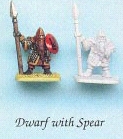
UNIT NAME: Sword & spear
UNIT TYPE:
AC:
#FIG:
UNIT COMMANDER/DEPUTY:
HD/fig:
RATIO:
LEVEL/RACE/CLASS:
MV:
SIZE:
MR%:
PPD:
P/P:
RSW:
BW:
SP
AR:
AR Modifiers:
ML:
ML Modifiers:
DL:
Wpn/Dmg:
SPECIAL ABILITIES AND LIMITATIONS:
4. Army Roster
Sheet
PLAYER NAME:
ARMY:
BRIGADE:
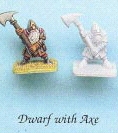
UNIT NAME: Axe & heavy crossbow
UNIT TYPE:
AC:
#FIG:
UNIT COMMANDER/DEPUTY:
HD/fig:
RATIO:
LEVEL/RACE/CLASS:
MV:
SIZE:
MR%:
PPD:
P/P:
RSW:
BW:
SP
AR:
AR Modifiers:
ML:
ML Modifiers:
DL:
Wpn/Dmg:
SPECIAL ABILITIES AND LIMITATIONS:
5. Army Roster
Sheet
PLAYER NAME:
ARMY:
BRIGADE:
UNIT NAME: Axe & hammer
UNIT TYPE:
AC:
#FIG:
UNIT COMMANDER/DEPUTY:
HD/fig:
RATIO:
LEVEL/RACE/CLASS:
MV:
SIZE:
MR%:
PPD:
P/P:
RSW:
BW:
SP
AR:
AR Modifiers:
ML:
ML Modifiers:
DL:
Wpn/Dmg:
SPECIAL ABILITIES AND LIMITATIONS:
6. Army Roster
Sheet
PLAYER NAME:
ARMY:
BRIGADE:
UNIT NAME: Axe & mace
UNIT TYPE:
AC:
#FIG:
UNIT COMMANDER/DEPUTY:
HD/fig:
RATIO:
LEVEL/RACE/CLASS:
MV:
SIZE:
MR%:
PPD:
P/P:
RSW:
BW:
SP
AR:
AR Modifiers:
ML:
ML Modifiers:
DL:
Wpn/Dmg:
SPECIAL ABILITIES AND LIMITATIONS:
7. Army Roster
Sheet
PLAYER NAME:
ARMY:
BRIGADE:
UNIT NAME: Hammer & pick
UNIT TYPE:
AC:
#FIG:
UNIT COMMANDER/DEPUTY:
HD/fig:
RATIO:
LEVEL/RACE/CLASS:
MV:
SIZE:
MR%:
PPD:
P/P:
RSW:
BW:
SP
AR:
AR Modifiers:
ML:
ML Modifiers:
DL:
Wpn/Dmg:
SPECIAL ABILITIES AND LIMITATIONS:

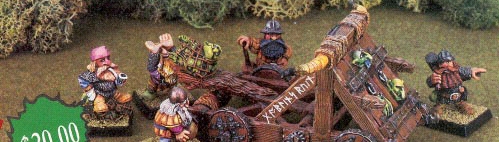
GOB-LOBBER (Dwarf Onager) (Games Workshop)
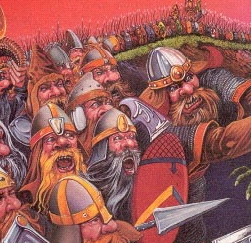
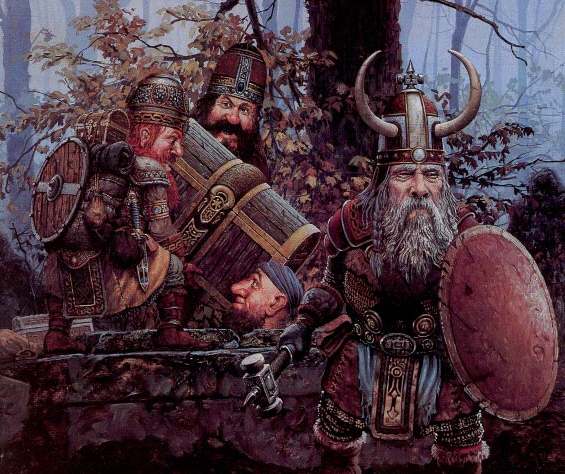
FREQUENCY: Common
FREQUENCY: Common ([Dungeon Level I])
FREQUENCY: Common
([Cold Civilized Mountains], [Cold Wilderness Mountains])
FREQUENCY:
Rare ([Cold Civilized Hills], [Cold Civilized Forest], [Cold Civilized
Plains], [Cold Civilized Desert]), ([Cold Civilized Hills])
FREQUENCY:
Rare ([Cold Wilderness Hills], [Cold Wilderness Forest], [Cold Wilderness
Plains], [Cold Wilderness Desert])
FREQUENCY: Common ([Temperate Civilized
Mountains], [Temperate Wilderness Mountains])
FREQUENCY: Rare ([Temperate
Civilized Hills], [Temperate Civilized Forest], [Temperate Civilized Plains],
[Temperate Civilized Desert])
FREQUENCY: Rare ([Temperate
Wilderness Hills], [Temperate Wilderness Forest], [Temperate Wilderness
Plains], [Temperate Wilderness Desert])
% IN LAIR: 50% (8 Dwarves: mountainous, TPL4-8:1st incl. at least one dwarf character, REF4.51)
These creatures are similar to their cousins,
the hill dwarves, detailed above.
The only differences are size (4½’+
tall), HD (1 + 1), and coloration (typically lighter with brown
hair).
They employ fewer crossbows (20% maximum)
and more spears (30%).
<>
| 0-10 | Sword & light crossbow | 10% |
| 11-20 | Sword & pole arm | 10% |
| 21-50 | Sword & spear | 30% |
| 51-60 | Axe & heavy crossbow | 10% |
| 61-80 | Axe & hammer | 20% |
| 81-90 | Axe & mace | 10% |
| 91-00 | Hammer & pick | 10% |
<Axes: there are
two kinds of axes: battleaxes
& hand/throwing axes> <note
1h or 2h for battleaxes>
<Military Picks:
there are two kinds of military picks:
footmans
(c. 4' long) and horsemans
(c. 2' long)>
<Maces: there are
two kinds of maces:
footmans
(c. 4' long) and horsemans
(c. 2' long)>
<Swords: 65% of swords are longswords,
20% (66-85) are broadswords,
5% (86-90) are falchion swords,
5% (91-95) are short (small) swords, 4% (96-99) are bastard swords,
and 1% (00) are two-handed swords, unless the description of a specific
item indicates otherwise. - UA.89, % numbers added>
<note that dwarves will not be able to use all of the above weapons.
note which they can and cannot use>
<>
Mountain dwarves with 16
strength can work up to 7th level, with 17
strength to 8th level, and with 18
strength to 9th level. (Level Limits)
<>
Mountain dwarves have a life span of 400
or more years.
Dwarf, Hill (AC 4; MV 6"; HD 1-4; hp V; #AT 1; DMG 1-8, or by weapon; SA Yes; SD Yes; AL LG; THACO V) - this slight variant (HD = 1-4) is from DL4.
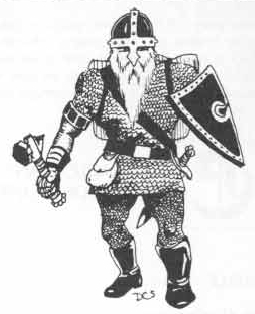
Dwarf, Mountain (AC 4; MV 6"; HD 1+1/4+1;
hp V; #AT 1, DMG 1-8, or by weapon; SA Yes; SD Yes; AL LG; THACO V) - this
slight variant (HD = 1-4) is from DL4.
As a note, DL4 provides an excellent set
of templates/geomorphs for dwarven lairs, even if one does not use the
Dragonlance setting.
<check DSG to see if the DL4 geomorphs
are reprinted there>
LEVEL LIMITS:
RACIAL PREFERENCES:
AGE, STARTING:
AGE, CATEGORIES:
HEIGHT:
WEIGHT:
PERSONALITY:
Lance Harrop
| Dragon | - | AD&&D | - | The Dragon 27 |
| Painting Dwarves | Gaming Dwarves | - | - | Using the Chart |
When the Editor told me that he was, in his words,
a dwarvophile,
it made me start thinking about how Dwarvish armies would
be organized, which resulted in this article.
dwarves2.alexkallend
Organization must begin with a background. While as fantasy
this can be anything, it is better to use a universally recognized
one. I
can call to mind only 4 literary backgrounds for dwarves; Norse
Mythology, Brooks Sword of Shannara,
C.S. Lewis’ Chronicles of
Narnia, and the Tolkien
Trilogy. Norse Mythology does not put
dwarves into a good light, nor
is the dwarvish kingdom well organized
for a fantasy wargame. Terry Brooks dwarves do not even live
in caves anymore, having only hid there after a great destructive war.
They live in great forests in the east and fear to go underground.
Lewis’ dwarfs (the spelling is intentional) come in 2 varieties, red
haired and black
haired, but they both have been subservient to the
powers struggling to rule Narnia and never were nations unto themselves.
Only Tolkien gives us a universally known and accepted
background. Tolkien is recognized as the authority in many cases of
fantasy interpretation, especially with dwarves,
elves,
orcs,
and, of
course, hobbits.
dwarves3.alexkallend
There are 7 kindreds of Dwarves, and 7 High Kings, but
often there are more than 1 kingdom for each kindred. At one time
in Middle Earth the Line of Durin ruled the Lonely Mountain, the Iron
Hills, and the upper halls of Moria, each
a separate kingdom at some
time. Using Larry Smith’s article
on dwarves in the Dragon #3, there
would be 7 Dwarf Kings (9th Levels) and many Dwarf Lords (8th
Levels) under them. Each, Lord and King would have a separate
army.
dwarves.alexkallend
Also, in addition to the part of Mr. Smith’s article on Dwarf
Clerics,
there is this: there is 1 religion for all dwarves and 1 supreme
Pontiff (8th Level) of the church. He usually resides in the foremost
kingdom of Durin’s Line and is one of Durin’s Folk, but in times of
trouble other Lines receive the Pontiff. There are 7 Archbishops
(7th Levels), 1 for each Kindred, and there are a number of
Bishops (6th Levels), 1 for every major dwarf
holding. These
Bishops and Archbishops would control small armies of Acolytes,
and the Pontiff would probably command a very large one,
with <sentinel> units, that could
be as large as a small kingdom’s army.
So now that we know who has armies, how are they organized?
First of all, dwarves do not have large standing armies, though they
do have units that protect the gates and guard units. Dwarves mobilize
their populace in times of trouble, which they can do easily, since,
being mostly miners and masons, their
work can be interrupted
without the results that farmers would suffer. The units are formed
almost on the spot where they work. For instance, everybody mining
a lode would be in a division made up of those miners; the more
skilled ones would also be better fighters and thus more heavily
armed. The foremen and supervisors would become the officers.
The reason for this is very simple. Dwarves fight 2 kinds of warfare,
that above ground and that below. When fighting below ground they
fight in small detachments rather than in one huge array. These
detachments have to be able to move through a section of caverns in
communication with each other, even though they are divided by
yards of rock. They do this by drum beat/rock hammered code which
they developed while mining a lode. Each lode has a different code
and there is no single army code for the enemy to break, though
there is a single code among the army for dispatches. This way,
small units can communicate with a divisional commander, who, in
turn, can control the taking of a section of caverns. The divisional
commander also knows the abilities of his subcommanders and thus
knows how they will react. The King or Lord would also know these
commanders well.
Masons, those dwarves who make the used up mines livable,
would be organized much like the miners, but would be less well
armed and armoured. Even with that, they would have more engineers
and be better at seige work.
Craftsmen are usually very
well armed and armoured, and are
the heavy units of the army. The size of the units usually vary with
the
importance of the particular craft. These units are led by the craftmasters
or their designers.
There are some craftsmen whose work is so fine that they work
outside of any particular craft and its rules. These dwarves are
usually exempt from the army mobilization. Dwarves have no Corps
of Engineers, but organize companies of engineers at the divisional
level.
The Dwarvish merchant class organizes
into 2 types of units. If a
particular merchant is very rich he may raise a company on his own,
out of loose dwarves from the kingdom or mercenary types from the
other kingdoms of the same kindred; he would pay for arming and
armouring the unit and receive the honor for its conduct in battle.
These mercenary units would tend to be more loyal than most
mercenary types. The other merchants would organize into units of
what would be called guides, as these merchants have travelled
more than other dwarves, their services would be very useful. If a
dwarf is ever found in battle riding a pony,
it would be one of these
guides, who occasionally learn to ride while on trading trips.
These units of Miners, masons, Craftsmen, Guides and Mercenary
merchants are grouped in Corps under the command of Cham-
pions (7th Levels) who are usually
men taken from the King’s personal
GUARD whom the King or Lord knows
and trusts. The standing
army units (the type that guard gates) are attached to these Corps
as
elites or grouped with the King’s or Lord’s personal Guard in the
Army’s 1st Corps.
This 1st Corps is very important, for it is the vanguard of the
army and when a battle is fought above ground it is this unit that
drives toward the enemy’s supreme commander and tries to kill him,
as happened in the Battle of Azanulbizar and the Battle of 5
Armies. Units that perform exceptionally well in the war are allowed
into the 1st Corps; the mercenary bands raised by the rich merchants
try very hard to get in. The Divisions also like to send units to
the 1st Corps, so they put their very best <dwarves> into one company,
in
the hope that it will perform well and honor the division. Units that
are
taken into the 1st Corps often remain as standing units after the
war, rather than disbanding.
There are 2 kinds of Clerical unit; one is composed of clerics
from religious fighting orders, which answer to a bishop, archbishop,
or the Pontiff. These units are usually well armed and armoured.
Then there are the guard units that are super elites, especially those
of the Pontiff.
If and how these units are used in the army depends on how the
church feels about the war; the church would send none if dwarf were
fighting dwarf.
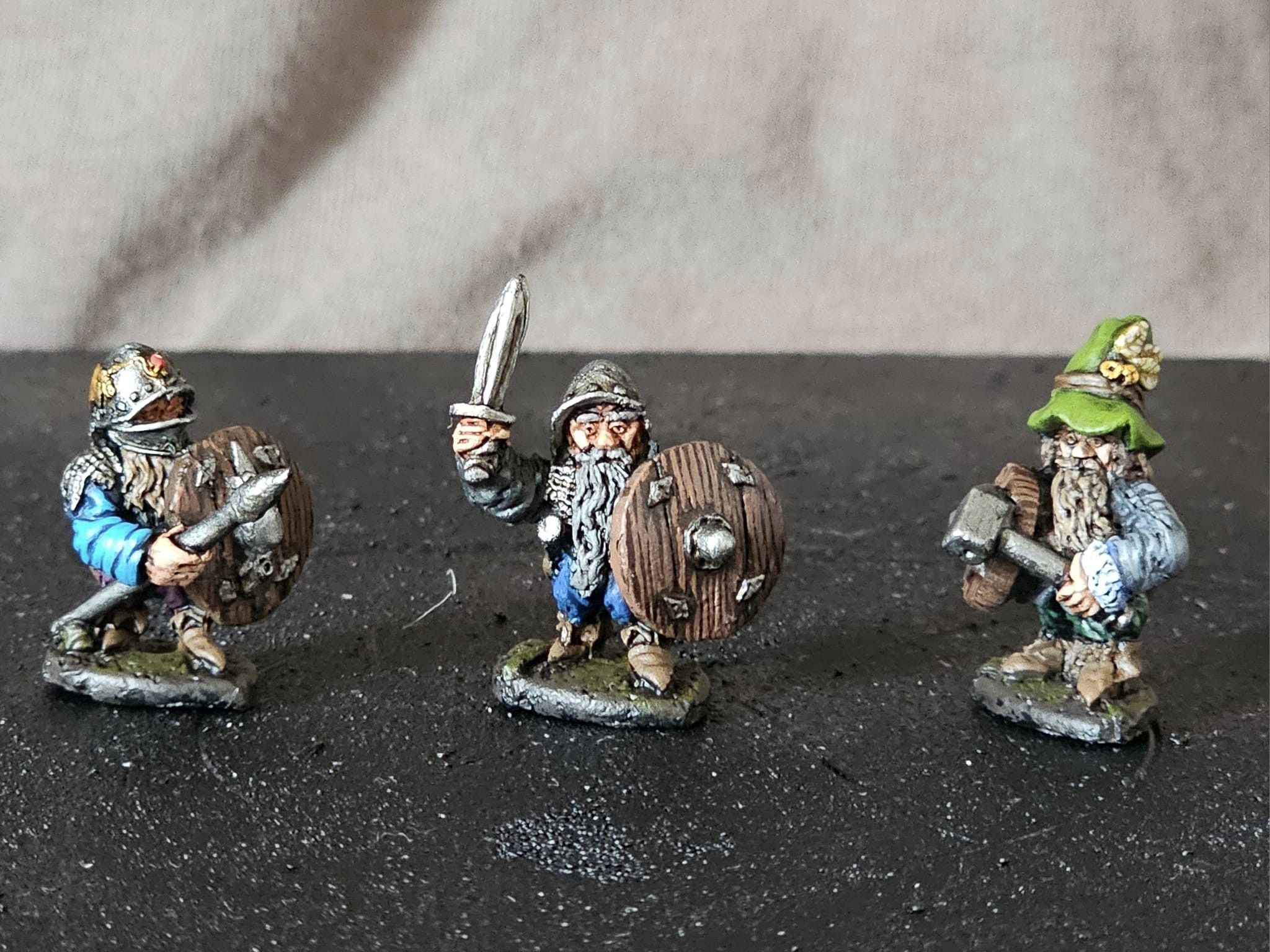
Painting Dwarves
As I did for the orcs, I’d like to share with
you some tips on painting
dwarves.
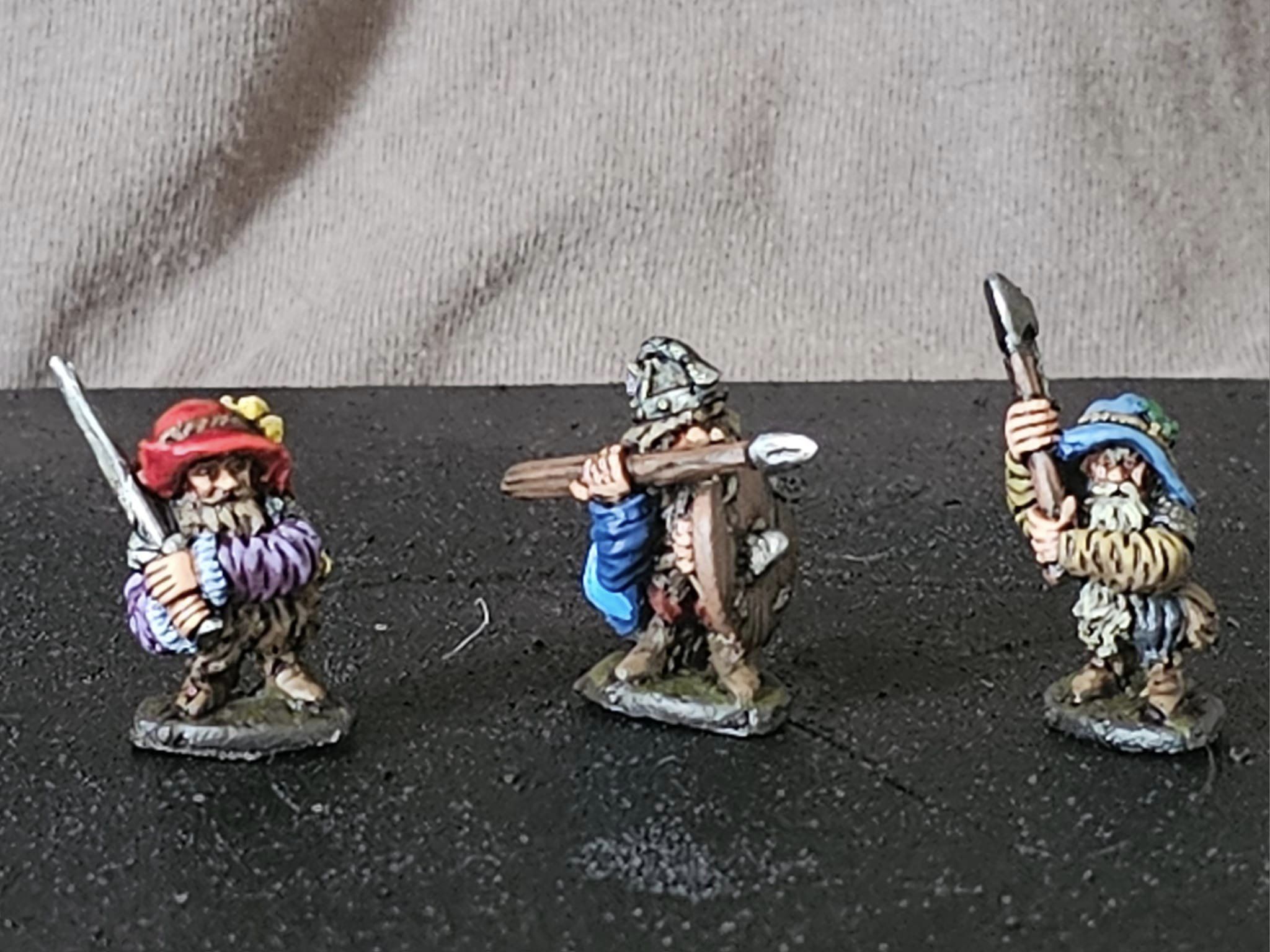
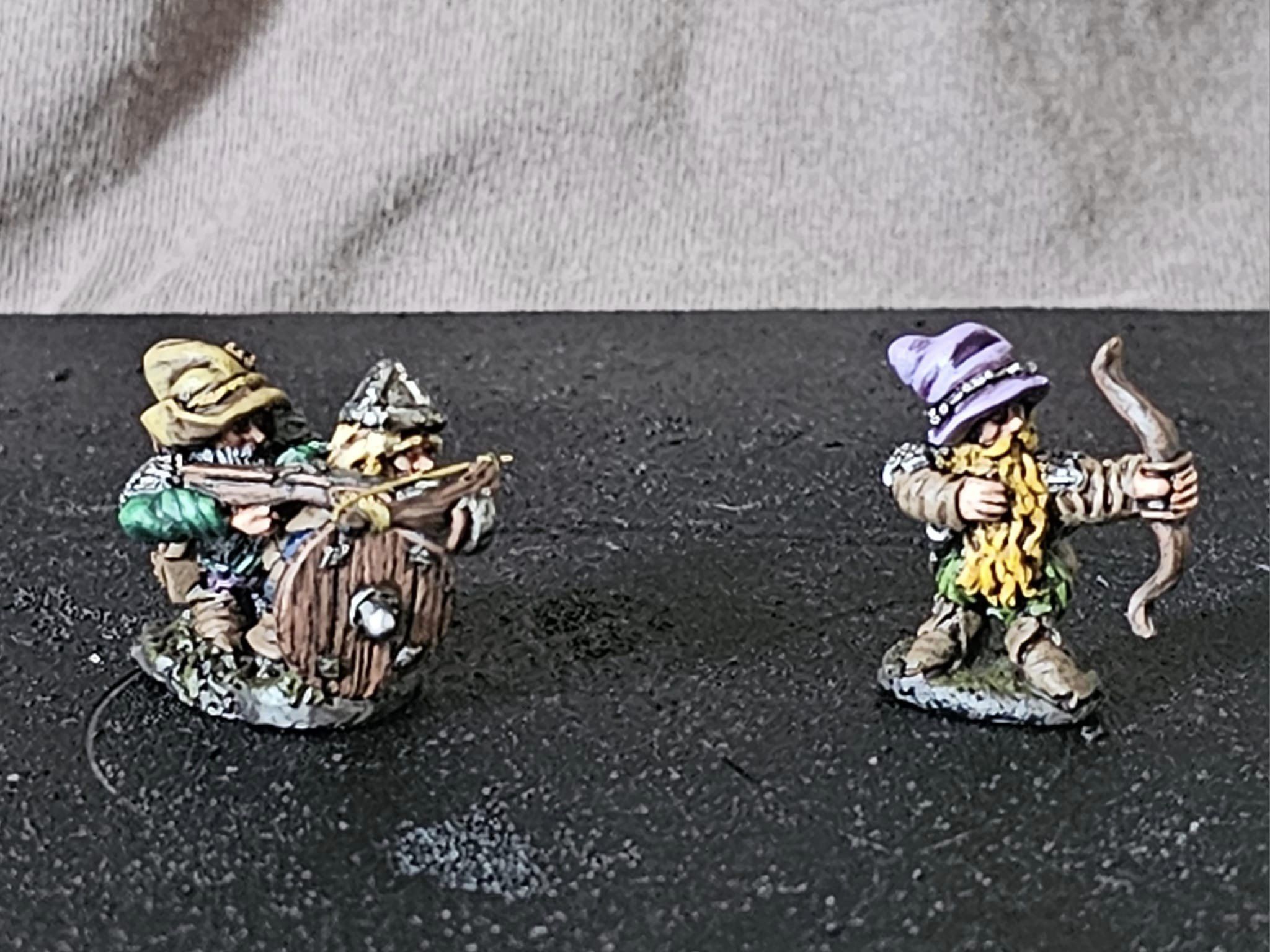
1. Elite units of dwarves should have white beards,
while the
younger units would have brown, dark
red or black beards.
2. Dwarvish armour would be shiny and of mixed types of metal, to
give it contrast. The best armour is made of Mithril,
a silvery metal.
3. Dwarves don’t seem to have national colours, but rather use
colour to identify individuals, use of cloth colour seems unrestricted,
but I would suggest that guard and
standing divisions, mercenary
companies, and divisions of miners,
masons, and crafts each have
distinctive colours.
4. Whatever you do, don’t make your dwarves too gaudy.
Gaming Dwarves
I could write another whole article about dwarvish tactics, but
here are some simple points.
1 Dwarvish vanguards always drive toward the enemy commander
2 Dwarves simply hate orcs and goblins, and love to tear into them.
3 Dwarvish morale is very slow to break.
4 Dwarves have been known to leave the field if their leader is
killed, but they do not rout under these circumstances, they walk off
very slowly carrying the leader’s body and everybody has the good
sense to leave them alone.
Good Wargaming, and may your army of Durin’s Folk be larger
than everybody else’s, so you can claim to have the real one.
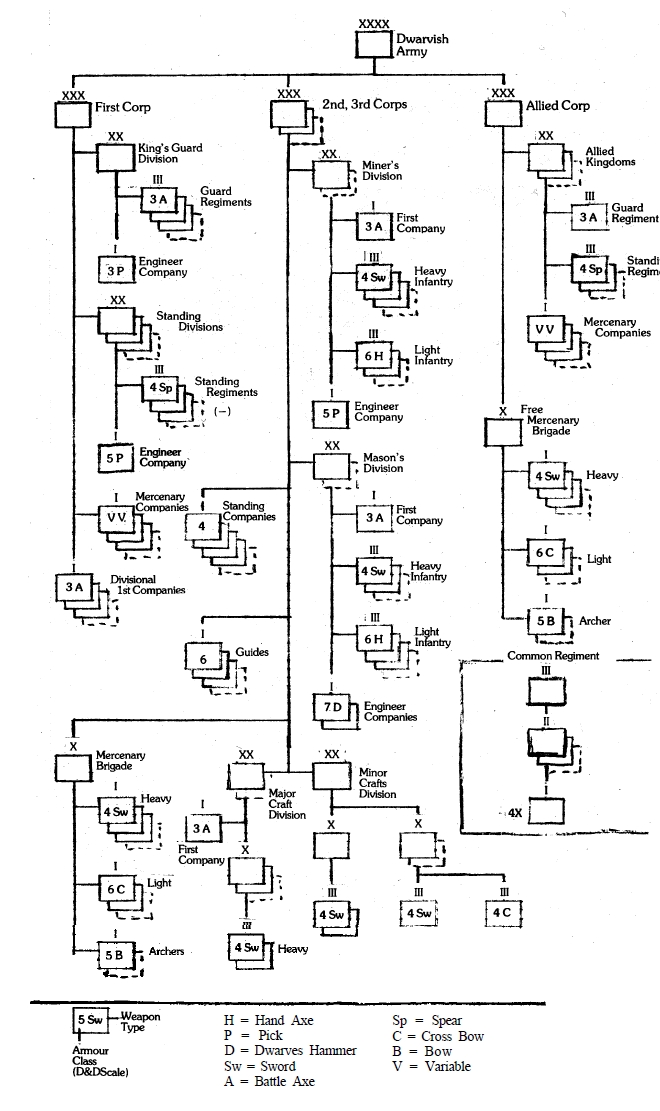
Using the Chart
This chart shows the organization of a major Dwarvish
Army. The
1st Corps is composed of the King's or Lord's Guard and many
Divisions of standing units, of which some companies have been
detached to other Corps. Each division has its own Engineer Company,
which does siege work. There are also mercenary companies
and divisional 1st companies attached.
The 2nd, and other, Corps have 1 or more Miner
Divisions
and one or more Mason Divisions
and some have Draft Divisions,
which can be composite units of more than 1 crafts forces. A
brigade of merc companies, a number of standing companies
and some guides are attached.
The Allied Corps is composed of Divisions
sent by other Dwarvish
nations as a token of support and of free merc companies
grouped in a single brigade. Human allies
could also be in this Corps.
The chart shows a rather hefty army to build, and
most people
won't try making one this large; but it does suggest ratios of forces
that can be used, instead of making all your dwarves the King of
Dunn's Line's Personal Guard.
Dwarvish armies would generally tend to follow this organization,
but sometimes dwarves work for people other than their Kings or
Lords; then, almost any organization would be possible. Also, mercenary
companies don't always disband after a war, but pursue an
active military life.
Dwarvish kingdoms are usually economically allied
with a kingdom
of men for their food,
and in many cases can persuade these
allies to JOIN them in a war, thus reducing the problems caused by
a
lack of cavalry and archers.
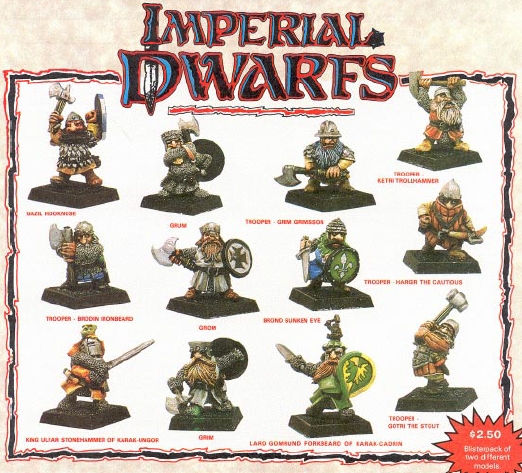
With the large number of brands of dwarf figures, it is sensible to
use each line as a kindred or kingdom, thus making each easily
identifiable. I have 5 different makes in my fantasy army, and could
easily have 7 with the lines available.