| 1st Edition AD&D | - | Dragon #152 | - | Dragon |
| The duergar's world | Duergar professions | Duergar life | Relations with others | Conclusion |
Despite what you'd think, duergar and
surface dwarves have much in common in
AD&D campaigns, more than do drow
&& surface elves but less than svirfneblin
&& surface gnomes. This is partially because
the duergar lifestyle is not as radically
different from surface dwarven life
as drow life is from other elves. The basic
dwarven nature both <sub>races share dictate
many similarities.
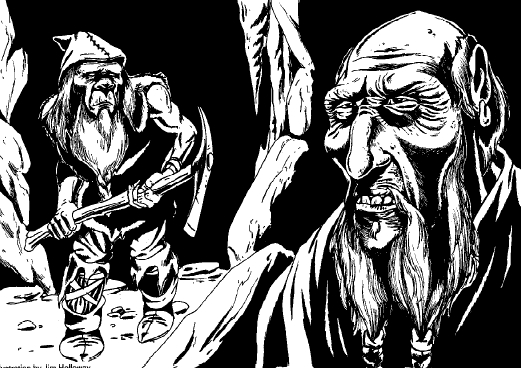
The physical differences between dwarf
&& duergar, however, are easily spotted.
The duergar is pale, with a distinct gray
undertone to its skin (unlike the ruddy hill
or mountain dwarf), leading to the nick-name
"gray dwarf." This lack of coloration
is the result of untold centuries spent far
from the light of The Sun, in greater isolation
than their better-known cousins experience.
The relative emaciation ov duergar
results from the relative lack of food in
the underworld--and the quality ov what
food they do eat, consisting of subterranean
beasts and fungi. Then, too, the
hostile environment of the Underdark
does not allow a fat, slow, clumsy duergar
to survive for long.
Ages of living under these conditions
have made duergar tougher in stamina
than their surface cousins. Duergar are
able to resist hte effects of poison and
paralysis as a result. Their great skills at
surprising foes and resisting illusions come
from ages of Life within the twisting labyrinths
ov the Underdark, which has sharpened
their senses of hearing, vision, and
smell to xceptional levels. The magickal
abilities to enlarge themselves or go invisible
are suspected as being gifts of Abbathor,
their patron deity (see Unearthed
Arcana, page 111).
The psychological differences between
dwarves && duergar are considerable.
Accustomed to lives of hardship and deprivation,
duergar scorn the values of surface
races and of other dwarves. They are
believers in the absolute control of all
resources to benefit themselves, at whatever
cost to other other races and beings. They
thus have a penchant for slave labor and
mount many raids to secure more slaves.
In these raids, any beings not currently
allied with the duergar are fair game, and
resistance is overcome with skill and fury.
The fate of these slaves is not enviable;
any duergar slaveowner will treat rebellious
and useless slaves with utter ruthlessness.
Indeed, there are those who say
that duergar have more in common with
orcs than with other dwarves.
Similarities between dwarves and
duergar, however, are so widespread that
former duergar slaves generally find
themselves quite uncomfortable among
surface dwarves. Under circumstances
where dwarves and duergar must get
along, as when they are both slaves of
some other race, they generally find that
they have much more in common with
each other than with nondwarven fellow
slaves, and cooperation between them?
however forced and temporary?is remarkably
smooth and effective.
One cultural trait shared by duergar and
dwarf is their attitude toward the beard,
though this is not universally shared by all
duergar. To those who care, the beard is a
symbol of status and a source of pride.
Cutting or shaving the beard is a mark of
great shame, while burning the beard off
with a coal or candle is reserved for those
who have utterly disgraced themselves or
their clan. As do surface dwarves, duergar
plait their beards and braid them, using
dull-colored strips of leather to indicate
status and profession. These decorations
follow a system, but the systems differ
enough that a duergar and surface dwarf
cannot ?read? each others? beards, except
in the vaguest way. The closest analogy to
this is the widely varying systems of indicating
rank and status used by human
armies; most soldiers can tell an officer
from an enlisted man in an unfamiliar
army, but finer distinctions are difficult to
make.
As noted, not all duergar share this
pride in the beard: Those who do not are
often regarded as uncivilized and the least
worthy of favorable attention?i.e., other
duergar clans will raid those ?prideless?
clans without hesitation.
Another similarity between surface
dwarves and duergar concerns an appreciation
for craftsmanship, Duergar craftsmen
make many of the finest tools, armor,
and weapons available to the underground
races and take great pride in them. Even
the dark elves and deep gnomes, no mean
craftsmen in their own rights, admire the
duergar?s solid, unadorned, but highly
effective creations: As is the case with
surface dwarves, many duergar are so
immersed in their crafts that they have no
desire to marry. However, duergar are
almost exclusively concerned with craftwork
of a hard, practical, military nature,
involving the construction of fortifications
and the smithing of weapons, armor,
traps, and the like. Artistic endeavors are
rarely practiced and tend to be crude,
though even these have a peculiar, harsh
strength in artistic terms.
The duergars' world
Duergar society is highly structured.
The basic unit is the clan, an extended
family of duergar. Most clans are so ancient
that the actual kinship between most
living members is quite remote. A duergar
is highly loyal to his or her clan and will
not willingly betray or weaken it. Duergar
adventurers have great difficulty in transferring
this attitude to their comrades,
seeing them always as "outsiders." Given
considerable time and reason for respect,
however, duergar may become quite loyal
to their companions once their comradeship
is won, especially if dwarves or
gnomes of similar alignment and attitudes
are present.
The clan itself is supported by the priesthood
of the duergar community, which is
almost always in the service of Abbathor,
the much-feared dwarven god whose
greed is his hallmark. Little attention is
given to the other major dwarven gods,
and services and offerings to them are
often so minimal as to be insulting.
The clan is also supported by its internal
security force, in some ways a combination
of police, thieves? guild, and assassins?
guild. These carefully trained duergar
rogues and warriors operate under the
direct command of the leaders of a
duergar colony and form the leaders?
intelligence system, warning of danger
outside and dissension within the colony.
Dissident duergar and enemy leaders are
quietly put out of the way.
Duergar professions
Young duergar are put through intensive
testing when they reach adolescence. This
testing, which may prove fatal, has 2
purposes. The main purpose is to identify
professions for which a youngster is
suited. The dangerous tests, the duergar
say, also have the side effect of weeding
out weaklings before they can harm the
community.
When the testing is completed, the
youths are sent to rigorous training in a
particular profession. This training is
carefully designed to foster qualities such
as ruthlessness, a racial self-centeredness,
and a disregard for life, mercy, and other
beings.
Duergar priests call themselves the
servants of Abbathor, whose symbol is the
jewelled dagger, and they are permitted to
use daggers as normal weapons (learning
to use them at 1st level). They use their
spells to improve the duergar community
in general: first to aid their own clans,
then to aid any other duergar, then the
priests themselves, then any allies their
clans may have.
The majority of the youth pass through
the hands of the best warriors in the community,
who drill them in the skills of
underground and surface warfare. This
training is considered supremely important,
and many of the best minds the
duergar have are devoted to improving it.
To be selected as a "trainer of the young"
is one of the highest honors a duergar
warrior can aspire to. The first part of the
training course is spent determining
which students are best with which weapons.
The second part of the course is
devoted to perfecting the students' skills,
and the last part, which is considered the
most important of all, is spent honing the
ruthless attitude of the young warriors.
Ruthlessness, in truth, is the specialty of
the duergar. They make war with ferocity
and duplicity, cheerfully sacrificing allies if
necessary to secure a victory. They will act
cautiously in the presence of powerful
enemies, but they will attack with reckless
courage if a chance of victory is seen.
Their few allies, such as the drow, recognize
that the duergar are prone to
treachery?but treachery is an art among
the drow, who regard the duergar as
narrow-minded and predictable.
Duergar youth with unusual intelligence
and dexterity are usually apprenticed to
local rogues--the spies, assassins, and
scouts of the clan. Besides their functions
as a combined secret police and intelligence
service for the rulers of the community,
duergar thieves are useful to their
community for their skills with locks and
traps (thus gaining the treasures of their
foes). Their climbing skills come in handy
on expeditions into new areas of the underworld.
In some duergar communities,
assassins must be carefully watched because
of the power and skills (and political
pretensions) they have acquired.
Since most duergar have the ability to be
multiclassed, a youth can easily pass
through several courses of instruction,
one after the other. When a youth?s education
has ended, he returns to his clan,
marries if at all so inclined, and is considered
an adult. The clan marks this occasion
with celebration, climaxed by the
initiation of the newest member into full
clan membership.
Duergar life
The various clans composing a duergar
community often do not much like each
other. Their relationships range from
warm friendship to armed neutrality to ill-suppressed
hostility. The priests do their
best to keep matters under control, but
many interclan hatreds run so strong that
usually the clerics merely suppress open
warfare. In these "cold wars," assassination
comes onto its own. Accordingly, assassins
?are as highly esteemed among the duergar
as among the drow. When open fighting
between duergar clans occurs, it is often
by arrangement and takes place in a deserted
cavern cleared for the purpose.
This way, the feuding clans can have it out
without endangering the community in
general (not that this always works).
Within a clan, duergar usually plot and
scheme endlessly for advancement. Assassination
of a fellow clan member is
strongly tabooed, but manipulating one?s
?enemy into a situation that is bound to be
fatal is a skill that is much admired. For all
their rough exterior, the duergar are plotters
of incredible subtlety and skill. The
only persons a duergar can usually trust
are a spouse, parents, and children.
Duergar families work closely together,
though they lack affection. Often a husband,
wife, and their adult children will go
adventuring together; the demanding
environment of the underworld, they feel,
is no place for finicky considerations
about keeping ones’ family out of all danger.
There are no safe places.
Clans that are not riven with internal
rivalry still see extremely intense competition
for higher status. In many clans, this
takes the form of ever-more daring mercantile
expeditions to garner greater
wealth. A duergar who has successfully
traded with peoples whom his friends
considered unreachable will be honored
but will soon find those same friends
outfitting expeditions to share the riches
to be had. Trade in the underworld is a
dangerous business. In the depths of the
earth, duergar merchants must be able to
deal with kuo-toa, mind flayers, and creatures
that most surface-dwellers cannot
even imagine. The duergar feel that the
profits make all the risks worthwhile, and
add that the perils of the underworld
merely weed out the incompetent.
Relations with others
As is well known, duergar and other
dwarves regard each other with antipathy,
mostly because of their deep cultural
differences on such issues as slavery.
Their feud is not as bitter as the elf-drow
vendetta but is very real nonetheless. The
duergar call surface dwarves cowards,
weaklings, and “half-dwarves” (as they live
near the surface instead of deep inside the
earth).
Duergar and gnomes do not get along
at
all. To the duergar, gnomes are bumptious
little creatures without proper dignity,
who just want to steal treasure. To surface
gnomes, duergar are a greater danger
than orcs because of their intelligence and
skills. Deep gnomes and duergar have
feuded for centuries over living space,
ores, gems, and duergar slave raids. Despite
their smaller size, the svirfneblin
have done well in this feud.
Duergar and elves have mixed relations.
The drow are often the closest allies the
duergar have, and unless two communities
of these races are actually at war, they will
trade materials and information, particularly
on the doings of the more alien underground
races, such as the aboleth,
cloakers, or mind flayers. As if to compensate,
the duergar find surface elves even
more worthless and irritating than do
other dwarves, and they are prone to
torture or slay elves out of hand.
The duergar hardly know halflings exist.
When duergar and halflings cross paths
(which is rare enough), the gray dwarves
often make the mistake of not taking the
halflings seriously, considering the latter
to make poor slaves at best.
One noteworthy area of difference
between surface dwarves and duergar
regards their attitudes toward humanoid
races such as orcs, kobolds, goblins, and
the like. Duergar regard these races as
inferior but useful as fodder if manipulated
properly. Some half-orcs have even
been seen working within duergar communities
as mercenaries (though poorly
trusted ones). Humanoids are also seen as
potential reservoirs of slaves, particularly
when cheap, expendable laborers are
needed. The humanoids’ craftsmanship is
crude, their fighting skill is relatively low,
and they have no claim on duergar
respect—particularly for their lives.
Duergar regard humans with mixed
emotions. On one side, they grudgingly
admire humans with greater skills than
duergar can attain, or with abilities such
as spell-casting that they lack entirely. The
gray dwarves will hire (and closely monitor)
such humans when their services are
needed. At the same time, they fear and
are jealous of humans and have few compunctions
about enslaving or raiding them.
Conclusion
“Strive to survive, and survive to strive”
is a duergar truism. Whether as grim
warriors, crafty thieves, subtle assassins,
or clan-proud clerics, duergar take their
lives very seriously. Duergar of all walks
of life usually exhibit incredible tenacity
and single-mindedness, for which they are
valued by allies—but for which they are
often cursed and never trusted. Theirs is a
spare and unforgiving existence; though
they have no love for it, they have come to
accept it as their fate and will make the
most of it.
[More information on the duergar is
found in the AD&D® 1st Edition Monster
Manual II (page 61),
Unearthed Arcana
(page 10), and in the AD&D
2nd Edition
Monstrous Compendium ("Dwarf,
Duergar").]