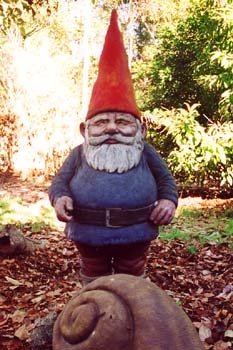
Gnomes:
(WG:
Noniz)
-
|
|
|
|
|
|
ABILITY SCORE MODIFIERS:
RACIAL LIMITATIONS:
STRENGTH: 6/18
INTELLIGENCE: 7/18
WISDOM: 3/18
DEXTERITY: 7/19
CONSTITUTION: 8/18
CHARISMA: 3/18
RACIAL PREFERENCES:
STARTING AGE: Cleric (300+3d12), Fighter
(60+5d4), Magic-User (100+5d12), Thief (80+5d4)
AGE CATEGORIES: Teenager (), Mature (),
Middle-Aged (), Old (), Ancient ()
RACIAL TENDENCIES:
HEIGHT:
WEIGHT:
NPC ABILITY SCORE MODIFIERS:
A gnome's preferred habitation
is an area of rolling, rocky hills, well
wooded
and uninhabited by humans.
Details of the race are found in
AD?D,
MM.
Summary of Gnomish Racial Abilities:

Permitted Class Options:
A character of the gnome race can select to be a fighter
(max. of 6th
level), an illusionist
(max. of 7th level), a thief, or an assassin
(max. of 8th level).
| Ability Score | Cleric (All) | Fighter (All) | Illusionist (All) | Thief (All) | Assassin (All) |
| 15 | 7 | 5 | 6 | U | 8 |
| 16 | 8 | 5 | 6 | U | 8 |
| 17 | 9 | 5 | 6 | U | 8 |
| 18 | 10 | 5 | 7 | U | 8 |
| 18/50 | - | 6 | - | - | 91 |
| 18/75 | - | 7 | - | - | 102 |
| 18/99 | - | 8 | - | - | 102 |
| 19 | 12 | 9 | 8 | U | 102 |
| 20 | 14 | 9 | 10 | U | 102 |
| 21 | 14 | 9 | 13 | U | 102 |
1: Intelligence 18 and dexterity 18 also
required
2: Intelligence 19 and dexterity 19 also
required

Multi-Class Restrictions:
It is also possible for a gnome character to be two
classes at the some time
(a fighter/illusionist, a fighter/thief, or an
illusionist/thief, for example).
In the latter case, the character is restricted
to the wearing of leather
armor, regardless of which class combination he
or she has chosen, unless
only fighting is performed by the character. As
with any such multi-class
character, gnomes with two character classes
must always divide earned
experience equally between levels, even
though it might no longer
be possible to advance upwards in level in one
of the classes. (See CHARACTER
CLASSES for more information regarding
this subject.) ?See The
Multi-Classed Character>
Similar to their cousins,
the dwarves, gnomes are highly magic resistant.
A
gnome player character gains
a bonus of +1 for every 31/2
points of
constitution ability score,
just as dwarven Characters do. A constitution of 4
gains a +1, 7 gains a +2,
11 gains a +3, 14 gains a +4. and 18 gains a
+5 bonus to saving throws
versus magic wands, staves, rods, and spells.
Languages:
Gnome characters are able to speak the following languages in addition
to their alignment
language (q.v.) and the "common tongue" of
humanity: dwarvish, gnome,
halfling, goblin, kobold, and they can also
communicate with any burrowing
mammal (such as moles, badgers,
ground squirrels, etc.).
Gnomes are unable to learn more than two
languages in addition to
those noted above, regardless of how high their
intelligence score is.
Infravision: Gnomes
have infravision, the ability to see into the
infra-red spectrum, so
a gnome character is able
to see up to 60' in the dark, noting varying heat
radiation.
Being
miners
of exceptional merit, gnomes are able to detect the ?Free miner skill for
gnomes?>
following facts when within
10' of the area to be examined, or at any time
with respect to determination
of their approximate depth underground:
| Detect grade or slope in passage upwards or downwards | 80% probability (d10, score 1-8) |
| Detect unsafe walls, ceilings, or floors | 70% probability (d10, score 1-7) |
| Determine approximate depth underground | 60% probability (d10, score 1-6) |
| Determine direction of travel underground | 50% probability (dANY, score any half) |
It is important to note that
the gnome must be actively seeking to
determine the matter in question.
The phenomenon does not otherwise
become apparent to the character,
for he or she must concentrate on the
subiect to get some form
of answer.
Combat Bonuses:

In melee combat, gnome characters
add 1 to their dice rolls to hit
opponents who are kobolds
or goblins. When being attacked by gnolls,
bugbears, ogres, trolls,
ogre magi, giants, and/or titans, gnome characters
subtract 4 from their opponents'
"to hit" dice rolls because of the gnomes'
small size and their combat
skill against these much bigger creatures.
| WEAPON | GNOMES |
| Dagger | 1-2/1-2 |
| Poinard | 1-3/1-2 |
| Short Sword | 1-3/1-4 |
| Rapier | 1-4/1-3 |
| Scimitar | 1-4/1-4 |
| Broadsword | 1-4/1-4 |
| Bastard Sword | 1-4/1-8 |
| Great Sword | 1-5/2-9 |
| Small Axe | 1-3/1-2 |
| Battle Axe | 1-41-4 |
| Great Axe | 1-6/2-12 |
| 8' Spear | 1-3/1-4 |
| 12' Spear | 1-3/1-5 |
| 16' Pike | 1-3/1-6 |
| Halberd | 1-5/1-6 |
| Warhammer/Small Mace | 1-3/1-2 |
| Large Mace | 1-4/1-3 |
| 2-Handed Mace | 1-5/1-4 |
| Military Pick | 1-3/1-4 |
| Flail | 1-3/1-4 |
| Morning Star | 1-4/1-3 |
| Javelin | 1-3/1-3 |
| Throwing Axe | 1-3/1-2 |
| Sling Stone | 1-2/1-2 |
| Self Bow Arrow | 1-3/1-3 |
The Gnomish Point of View
by Roger E. Moore
| Dragon | Races | - | Best of Dragon, Vol. III | Dragon 61 |
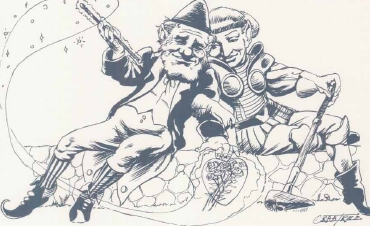
Gnomes are small demi-humans
closely related to dwarves. They average about
3’6” in height and 80 Ibs.
weight; their
skin tones range from brown
to dark tan
to grayish brown, and they
have gray or
white hair. Gnomish males
are bearded
but females are not. Despite
their small
size, gnomes have an average
strength
equal to most humans. Though
most
people tend to think of gnomes
as just
smaller dwarves, they have
different capabilities and a much different outlook
on life, and are certainly
worthy of consideration as a race unto themselves.
Gnomes are perhaps the rarest
of all
demi-humans, though halflings
in some
areas are tied with them
for the distinction. Only 5% or less of any adventuring
types of human or demi-human
origin
are gnomes. They prefer living
in temperate climates in rough and hilly terrain.
Gnomish communities are composed
of elaborate underground
tunnel complexes much like those dwarves inhabit,
and all such communities
maintain a
network of mines for metals
and gemstones. However, gnomish complexes
do not go as deep into the
earth as
dwarven tunnel systems do,
and tend to
be spread out over a wider
area. Though
gnomes enjoy their mines
and their close
association with the earth,
they also appreciate the world above ground, and
love the beauty of the wilderness
and of
living creatures.
Gnomes seem to have struck
a happy
medium between the attitudes
of dwarves
and elves in this respect.
Dwarves seek
mastery over their environment,
treating
it as a thing to be shaped
and governed;
elves seek union with their
sylvan environments, making themselves at one
with nature. Gnomes, splitting
the difference, look upon their environment
and the creatures within
it as separate
but equal to them, as friends
and helpers.
For this reason they have
learned to
speak with all other burrowing
mammals
and often have working relationships
with local groups of badgers,
groundhogs, and so forth for food-gathering
and mutual defense. Gnomes
sometimes
have such creatures as companions;
they
treat their animal friends
as partners and
not like pets. Certainly
it does not hurt
such relationships that gnomes
are small
enough to see “eye to eye”
with these
small mammals.
Communities of gnomes are
closely
knit, and tend to engage
in much friendly
competition with other such
communities. The major trades include jewelcraft,
mining, metalworking (including
armor
and weapons manufacturing),
a minor
amount of farming (a skill
almost unheard of among dwarves), hunting, and
involvement with the local
military as
scouts and community militia.
Trade
with other gnomish communities
and
demi-human villages and towns
is brisk,
though few gnomes leave their
homes to
become traveling merchants.
In general,
humans trade with gnomes
less frequent-
y than do elves, halflings,
or dwarves,
due to some mutual distrust
and avoidance, but some human areas are quite
friendly with gnomish folk,
sending them
clothing, foodstuffs and
spices in exchange for ores, gems and jewels, and
worked metal products (weapons,
tools,
armor).
Humor is very important to
the gnomish personality. Gnomes go for practical
jokes, especially the sorts
that are directed against larger creatures and enemies. When directed against
other
gnomes, these jokes tend
to be friendly,
with no harm intended. But
against humans and other large races (including
humanoids), gnomes’ humor
is more of a
weapon, and takes on a darker
aspect. A
good practical joke played
on an enemy
(like substituting a Necklace
of Strangulation for a Necklace of Missiles in a halforc’s pocket) will
win immense status for
the responsible gnome.
Those whom gnomes do not
trust are
dealt with carefully; they
may find themselves perplexed, led around in circles,
and kept unsure of just what
is going on.
The gnomish brand of humor
is demoralizing to enemies of the gnomes, who
may find themselves constantly
subject
to booby-traps of every conceivable
sort.
Humans have found it helpful
to develop
a manner of humility and
respect when
passing through a community
of these
small folk. Those who are
earnestly
friendly and supportive of
gnomes may
soon find them to be close
friends.
Gnomish mercenaries will
assist non-
gnomes fighting directly for
gnomish
causes; their service may
also be given in
other, non-critical (to a
gnome) situations, but they won’t take things quite as
seriously in such instances,
and won’t
necessarily stop their practical
jokes
(though they will become
more friendly
and harmless).
Gnome Warrior
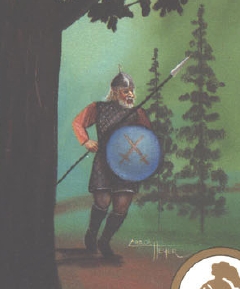
The lawful good orientation
of most
gnomes comes from their sense
of
community spirit and cooperation
with
one another and other allied
beings. This
is muted to some extent by
a more neutral, nature-loving concern that includes
a tolerance for other alignments
and a
desire to maintain the balance
of nature.
Though gnomes may not like
chaotic
evil beings, there is still
the feeling
among most gnomes that such
creatures
are necessary in some way
to maintain a
balance with other alignments.
Neutrally
aligned gnomes are not often
prone to
be closely involved with
other races, with
the possible exception of
sylvan elves
and rare communities of tallfellow
halflings of neutral alignment.
Perhaps because of their
close association with the earth, gnomes are tough
when it comes to constitution
and related matters. They are resistant to many
poisons and magic spells;
as with halflings and dwarves, certain magic items
(i.e., rings) may malfunction
when used
by gnomes, because of this
resistance.
Gnomes are also able to consume
large
quantities of alcoholic beverages
and
not be as affected as a human
might be;
gnomes drink as much as dwarves
do,
but whereas a drunken dwarf
becomes
(generally speaking) more
obnoxious
and gruff, with a tendency
to fight everything that moves, a drunken gnome becomes euphoric, laughs
at everything,
and joyfully insults anyone
or anything
larger than himself or herself.
Gnomes are rarely on good
terms with
any evil humanoid race, but
their most
hated enemies are the kobolds.
Both races compete for the same sort of living
space and materials, and
their deities
have long warred with one
another. Garl
Glittergold (the major gnomish
god)
once caused Kurtulmak’s most
elaborate and richly decorated throne room to
develop a structural defect
in the ceiling,
making it collapse at an
untimely moment when the kobold god was entertaining one of the major arch-devils.
The
latter believed the ceiling
collapse was
an assassination attempt,
and in vengeance hung Kurtulmak by his tail over
an active volcano for six
weeks. The kobold god has since devoted all his energies to the destruction
of all gnomes, but
his efforts seem to have
only made the
gnomes tougher on the whole.
All in all,
it was a grand joke indeed.
Goblins also hate gnomes,
though not
with the single-minded fury
that kobolds
have for them. Gnomes, in
turn, hate
these races to the point
where they will
attack them in preference
to any other
race of enemies, and gain
a bonus to hit
them as well. Because gnomes
are small
enough to dodge between the
legs of
larger opponents and evade
blows, humanoid beings of gnoll size or larger
have a very tough time scoring
any hits
on them.
The physical senses of gnomes
are
very well developed. Eyesight
is good
and includes infravision
out to 60’ or so.
Gnomes have the most sensitive
hearing
of any demi-human race, and
their communities are unusually quiet compared
to those of other races as
a result. Some
gnomes prefer walking some
distance
ahead or behind groups of
noisier (usually meaning human) races. Gnomes
also have a more highly developed
sense
of taste and smell than other
races, and
have larger noses that some
people find
quite amusing.
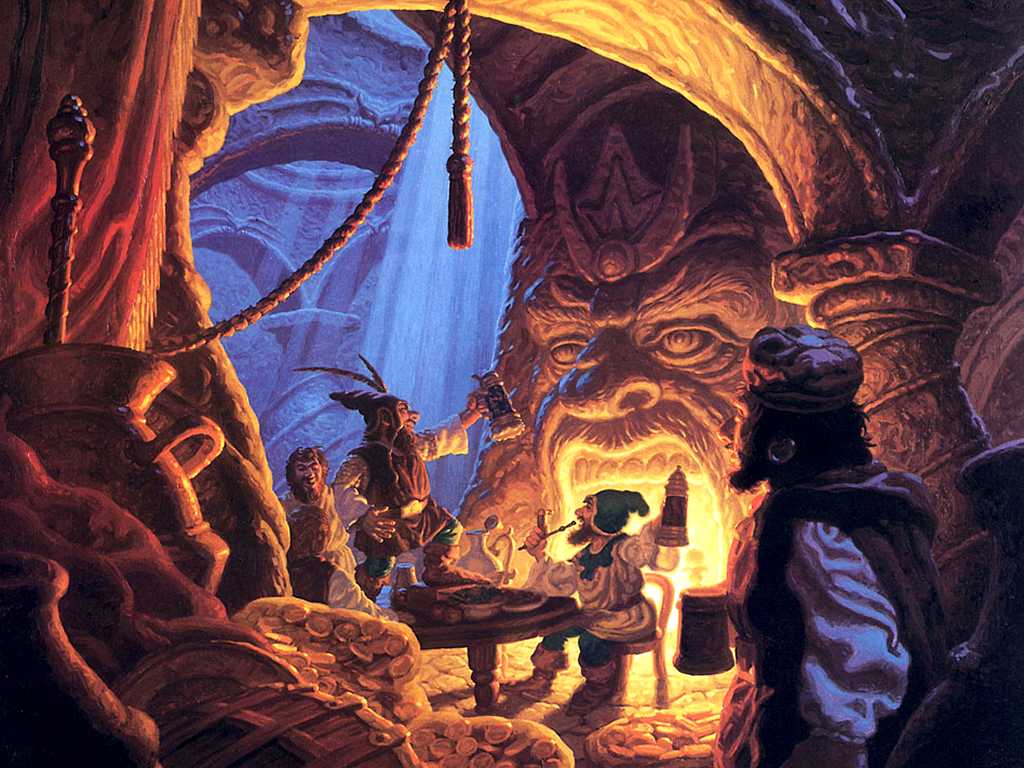
Gnomes go adventuring for
various
reasons; many such adventurers
are
multiclassed. Gnomes are
able to learn
the skills of the fighter,
thief, illusionist,
and assassin and are better
able to mix
classes than either dwarves
or halflings.
Gnomish thieves and illusionists,
for
obvious reasons, are especially
able to
use their talents to pull
jokes on other
beings. The feeling that
gnomes have
been slighted by many other
races without cause (a claim not without substantial evidence) makes the
fighting and
thieving lives most attractive,
as a way of
evening up the imbalance.
Assassins are
motivated by a similar “get
‘em back”
philosophy, and enjoy taking
vengeance
on their enemies with macabre
humor.
Illusionist gnomes are rare,
but highly
respected in their home communities
for
their powers; learning illusionist
powers
takes a great deal of time
and practice
compared to learning fighting
skills or
thieving. Gnomish adventurers
of any
sort often think of themselves
favorably
as “giant killers” (“giant”
here meaning
anything larger than 5 feet
tall).
Aside from elves, gnomes
are the longest-lived race among humans and demihumans, reaching a maximum
age of
over 750 years. As with the
elven folk,
this has to some extent changed
the
gnomes’ concept of time.
Gnomes are
not usually prone to hurry
with tasks,
and are good at making up
a variety of
amusements with which to
occupy their
time. Joke-playing and other
humor is
very useful in this respect.
Gem and metal crafts take up much of a gnome’s time
in later life when adventuring
begins to
pale, and community service
is a popular
option. Mining, of course,
can be done at
any age, and frequently is.
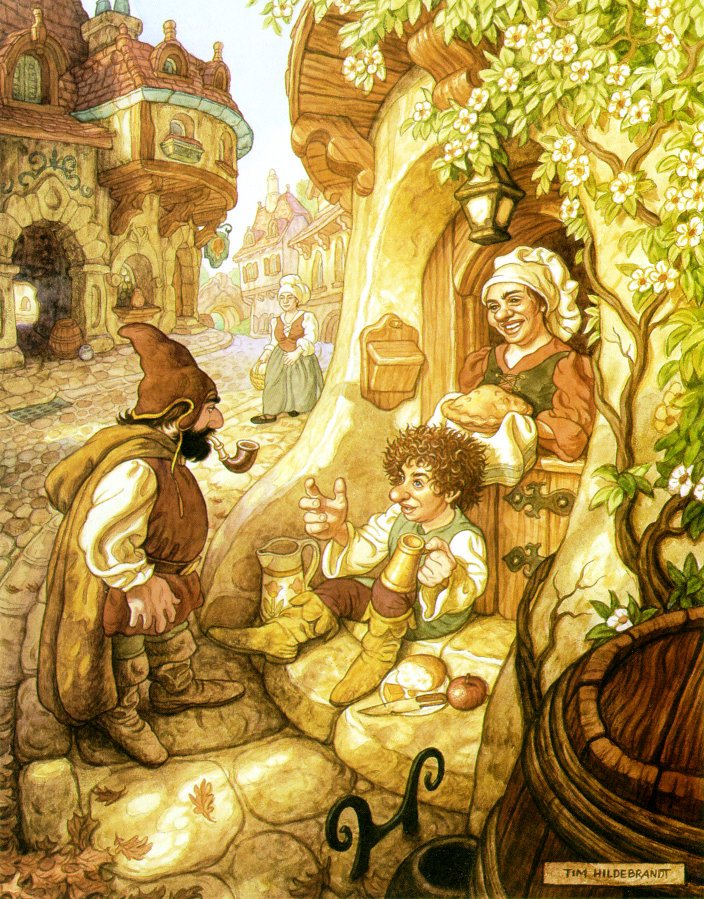
As a race, gnomes are quite
adaptable.
Though they do not particularly
like the
sea or other large bodies
of water, they
are more willing than dwarves
to live in
such areas. Undersea communities
of
gnomes, with tunnels leading
from great
air-filled caverns beneath
the waves to
rockier ground on the shore,
have been
reported. These complexes
would be extremely rare, since most gnomes do not
know how to swim. Other colonies
of
gnomes have been reported
in arctic
areas, clustered near geothermal
springs
or places with mild volcanic
activity.
Recently, a purely subterranean
subspecies of gnomes was discovered;
known as “deep
gnomes” (see AD&D™
Module D2, The Shrine of
the Kuo-Toa),
these beings are on close
terms with
many sorts of earth elementals,
just as
surface gnomes associate
with burrowing mammals. They possess an innate
magic resistance and spells
of illusion;
their language is a modified
form of the
surface gnome tongue. Gnomes
seem to
be turning up in the most
unexpected
places — perhaps their way
of having a
little joke on all the other
races.
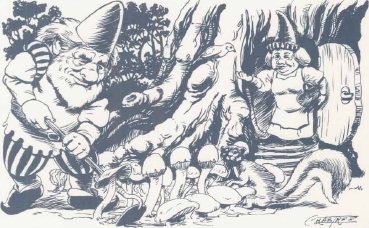
The gnomish personality is
well represented by their chief deity, Garl Glittergold.
Garl is mischievous, courageous,
witty, and strongly drawn to the adventuring life. His great axe is actually
his companion; Arumdina is
quite intelligent, and has the power to cut stone
and heal Garl as desired.
It is interesting
to compare Arumdina (as Garl’s
companion) to Moradin’s hammer (which is
non-intelligent and his personal
tool)
and to Corellon Larethian’s
sword (which
is an extension of the elven
god, virtually
a part of him). Gnomes have
a number of
other gods, but Garl is the
best representative of gnomes as a whole. His everchanging gemstone eyes
seem to fit well
into his unpredictable (though
still lawful) nature.
Like dwarves, gnomes have
a distinct
sexual imbalance in numbers
(two males
for every female), and this
does have an
effect on their society.
Gnomes, however, do not have the rigid sexual and marital mores dwarves
have. Expressions of
love and caring are shown
more freely,
and courting is a popular
pastime among
gnomes. Since most gnomes
do not
marry early in life, this
means very long
courtships, some lasting
several hundred
years (making for some particularly
amusing tales and jokes).
Those males who choose not
to be
married become more immersed
in their
crafts, and develop close,
non-sexual relationships with friends who are either
other male gnomes, humans
or demihumans of either sex, or animals. These
relationships are looked
upon by married and unmarried gnomes alike as being as valuable and important
as a marriage relationship, though humans and
other races might be hard
pressed to see
things that way. Gnomes will
go to great
lengths to aid those they
become attached to, and will feel a strong sense of
responsibility for them.
As presented in the AD&D
rule books
and played in AD&D
campaigns, gnomes
at times seem a little too
much like
dwarves. The two races share
some characteristics; yet, in order for each to remain a separate and distinct
character
type, differences should
be present. It
might be worth discussing
ways in which
gnomes could be made a little
more unlike other character races; it is suggested
that the sexual ratio of
males to females
be evened up, perhaps nearer
seven
males for five females. It
is odd, too, that
while dwarves are said to
be unable to
cast magical spells (excluding
the clerical sorts possible to many races) due to
their magical resistance
from their constitutions, gnomes gain the same magic
resistance andare allowed
to become
illusionists. Further discussion
of this
matter and other possible
changes might
be worthwhile in making the
AD&D system more logical and reasonable.
Material for this article
was gleaned
from the AD&D
Players Handbook, Monster Manual,
Dungeon
Masters Guide,
and the DEITIES
& DEMIGODS™ Cyclopedia. In addition, the novels Three
Hearts and Three Lions,
by Poul Anderson, and Enchanted Pilgrimage, by Clifford D. Simak,
provided some additional
details on various matters.
AT A GLANCE:
The gnomes are a small, friendly race of
humanoid creatures common in most regions of the Realms.
They are smaller and less-stocky than dwarves,
and are thought distant relatives (though only Gnomish men have beards).
ELMINSTER'S
GNOTES:
The faces of Gnomes, regardless of age,
are lined with centuries of smiles nad frowns, and it appears that these
creatures are carved from wood.
Their natural coloring, from light ash
and maple to that of varnished and buffed oak increases the tendency to
think of Gnomes as woods-folk, when they are thought of at all.
The Gnomes are called the Forgotten Folk
of the Forgotten Realms, for despite the fact they
seem an everyday sight in major cities, and have good-sized communities
of their own, they seem unbothered by the world and similarly only rarely
become involved with it.
Gnomes have no history beyond the memory
of the eldest clan-member and the songs of legend.
They have never developed their own written
tongue, rather acquiring the languages around them for everyday use.
Unlike the elves they have no millenial
heritage and unlike the dwarves no deathknell tomorrow.
As a result, they tend to take life as
it comes, one day at a time.
Gnomes are among the most common-sense beings
of a world filled with all manner of magical things.
Their natural tendency toward illusion-craft,
instead of making them more crafty, has given them a wisdom to look beyond
the fancy trappings of speech and appearance to find out what is really
there.
Gnomes value their families first, then
whatever other relatives they encounter, then other gnomes, then the world,
in that order.
GAME INFORMATION:
The above description for gnomes is in
general, and need not apply to individual PCs as a law that "ALL GNOMES
ARE WISE".
Individuals vary within a race, and it
is as possible to find an impulsive Gnome as it is to find a trustworthy
halfling.

-
| 01-02 | Bissel |
| 03 | Bone March |
| 04-05 | Celene |
| 06-07 | Dyvers |
| 08-09 | Furyondy |
| 10-11 | Geoff |
| 12-13 | Gran March |
| 14-15 | Great Kingdom |
| 16-17 | Greyhawk |
| 18-19 | Highfolk |
| 20-21 | Idee |
| 22-25 | Irongate |
| 26-27 | Irongate |
| 28-29 | Nyrond |
| 30-31 | Theocracy of the Pale |
| 32-33 | Perrenland |
| 34-37 | Ratik |
| 38 | Shield Lands |
| 39-40 | Spindrift Isles |
| 41-42 | Sterich |
| 43-45 | Sunndi |
| 46-47 | Tenh |
| 48-52 | County of Ulek |
| 53-54 | Duchy of Ulek |
| 55-56 | Principality of Ulek |
| 57 | County of Urnst |
| 58-61 | Duchy of Urnst |
| 62-63 | Valley of the Mage |
| 64-68 | Veluna |
| 69-73 | Verbobonc |
| 74-78 | Wild Coast |
| 79-80 | Dreadwood |
| 81-84 | Gamboge Forest |
| 85-88 | Gnarley Forest |
| 89-90 | Grandwood Forest |
| 91-95 | Vesve Forest |
| 96-00 | Welkwood |
Gnomish Clothing
(Greyhawk):
Gnomes & hobbits dress in a similar
fashion, often
replacing their trousers with knee-length
britches.
The gnomes favor more stolid colors --
brown
breeks, a tan blouse, green boots and belt,
with a dark
brown jacket or coat. A halfling in the
same garb
might have a yellow shirt and top off with
a cap of
green with a bright yellow feather in it.
Both races
will often wear striped clothing. When
hunting or at
war, they likewise favor garb of a curiously
mottled
sort, with greens and browns intermixed.