|
|
|
|
|
|
ABILITY SCORE MODIFIERS:
RACIAL LIMITATIONS:
STRENGTH: 3/18
INTELLIGENCE: 4/18
WISDOM: 3/18
DEXTERITY: 6/18
CONSTITUTION: 6/18
CHARISMA: 3/18
RACIAL PREFERENCES:
STARTING AGE: Cleric (40+2d4), Fighter
(22+3d4), Magic-User (30+2d8), Thief (22+3d8)
AGE CATEGORIES: Young adult (24-40), Mature
(41-100), Middle aged (101-175), Old (176-250), Venerable (251-325)
RACIAL TENDENCIES:
HEIGHT:
WEIGHT:
NPC ABILITY SCORE MODIFIERS:
Half-elves do not form a race
unto themselves, but rather they can be
found amongst both elvenkind
and men. For details of the typical half-elf
see AD&D,
MM
under the
heading Elf.
<(Half-elf)>
Permitted Class Options:
A character of half-elven race can play as a cleric
(maximum of 5th level),
druid,
fighter
(max. of 8th level), ranger (max. of 8th level),
magic-user
(max. of 8th level), thief, or assassin
(max. of 11th
level).
| Ability Score | Cleric | Druid | Fighter | Ranger | M-U | Thief (All) | Assassin |
| 15 | 5 | U | 6 | 6 | 7 | U | 11 |
| 16 | 6 | U | 6 | 6 | 7 | U | 11 |
| 17 | 7 | U | 7 | 7 | 7 | U | 11 |
| 18 | 8 | U | 7 | 8 | 8 | U | 11 |
| 18/90 | - | - | 8 | 91 | - | - | 11 |
| 18/99 | - | - | 9 | 101 | - | - | 11 |
| 18/00 | - | - | 10 | 112 | - | - | 11 |
| 19 | 10 | U | 11 | 153 | 8 | U | 11 |
| 20 | 12 | U | 13 | 153 | 8 | U | 11 |
1: Intelligence 18, wisdom
18, and constitution 18 also required.
2: Intelligence 18, wisdom
18, and constitution 18 also required.
If both wisdom and constitution
are greater than 18, the character can attain 12th level.
If both are greater than
19, the character can attain 14th level.
3: Intelligence 19, wisdom
19, and constitution 19 also required.
Multi-class Restrictions:
A character of half-elven race can also opt to become a multiclassed
individual, i.e. cleric/fighter,
cleric/ranger,
cleric/magic-user,
fighter/magic-user, fighte/thief,
magic-user/thief, cleric/fighter/magicuser,
or a fighter/magic-user/thief.
Half-elven characters who choose the
cleric as one of their multi-classes
aren't limited by that class' proscriptions
upon weapons usable, but
they are quite restricted in level. Half-elven
characters who choose the
thief class as one of their multi-roles are limited
to the weaponry and armor
of that class when operating as a thief. All
earned experience is always
divided evenly between the classes of the
multi-classed character,
even though the character is no longer able to
gain levels in one or more
of the classes. (See CHARACTER CLASSES, and
consult the various classes
for more detailed information pertaining to
half-elven characters operating
within the stated classes.)
Resistances: Half-elven
characters have a 30% resistance to sleep
and charm spells (if
the spells are cast upon
them, a percentile dice roll of 31% or better is
required to allow the magic
any chance of having an effect, and even then
the saving throw against
spells is allowed versus the charm spell).
Languages:
All half-elven characters are able to speak the "common tongue" of men,
their alignment
language (q.v.), and the following: elvish, gnome,
halfling, goblin, hobgoblin,
orcish, and gnoll. Half-elven characters of
above 16 intelligence are
able to learn one additional language for every
point of intelligence above
16, so that a 17 intelligence indicates the
character can learn one additional
language, and an 18 intelligence
indicates two languages can
be learned in addition to those listed above.
* Infravision:
Half-elves have the ability to see into the infra-red spectrum, so they
are
able to see up to 60' in
darkness, noting varying degrees of heat radiation.
* Secret Doors: Secret
or concealed doors are difficult to hide from half-elves, just as they
are noticeable by elves.
Merely passing within 10' of a concealed door
gives the half-elven character
a 1 in 6 chance (16 2/3%) chance of spotting
it. If the character is actively
seeking to discover such doors, he or she has
a 2 in 6 chance (33 1/3%)
of spotting a secret door and a 3 in 6 chance
(50%) of locating a concealed
door.
The Half-Elven Point of View
by Roger E. Moore
| Dragon | - | Races | - | Dragon 60 |
Half-elves, the children of
human-elf unions, are not in them
selves a true race. Such
individuals are found throughout hu
man and elven societies,
though not in any great numbers.
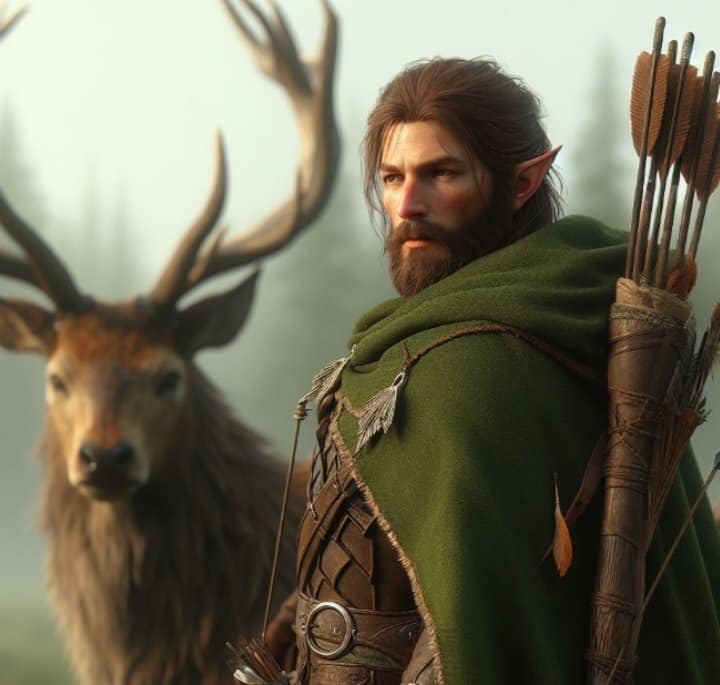
In appearance half-elves,
male and female, tend to stand
apart from their contemporaries
of either race. They are larger
han elves and smaller than
humans, with the coordination and
mental sharpness of the former
and the physical might and
oughness of the latter. Their
facial features (ears in particular)
end to carry a strong elvish
influence, though hair color, skin
color and texture, and eye
color are largely derived from the
human parent.
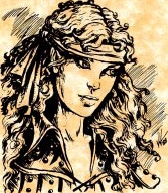
Belanna Telmister (Shayanna)
Despite these differences,
most half
elves see themselves as gifted
and not
“strange.” They are proud
of their heri
age and their abilities,
and are widely
accepted in most societies.
If there were
ever people who could make
a claim to
having the best of two worlds,
half-elves
would be the ones.
Even the inner nature of the
half-elves
shows a confluence of human
and elven
elements. A strong love of
natural beauty
and the outdoors is usually
picked up
from the elven parent, along
with a strong
hint of chaotic variability.
Whereas elves
are by comparison rather
clannish and
avoid contact with non-elven
races, half
elves are very outgoing and
make friends
easily, perhaps a result
of mixing the af
finity elves feel for all
living creatures
with the adaptability of
humans.
Half-elves appear very versatile,
and
manage to fit into a fairly
wide range of
social environments. They
have a wider
range of possible character
classes and
class combinations than any
other race
or being. Because they possess
souls,
half-elves may become normal
clerics and druids; although the
former class offers a rather
limited career, as druids half-elves
may achieve great power and
influence. It would appear that
half-elves have not as much
capability for (or love of) magic as
either humans or elves have,
but they may reach reasonable
evels of skill nonetheless.
Their druid-like abilities also help
make half-elves good at operating
in the ranger and bard
classes.
The most profitable career
that some half-elves may turn to
s, of course, thieving, in
which they are marginally better over
all than even humans. Half-elves
seem to be exceptionally good
at picking pockets; some
believe this is because they present
such a friendly appearance
that people don’t mind having them
near, and some say it is
a function of their exceptional curiosity.
Evil half-elves make very
good assassins, being able to pass
through elven or human society
and disguise themselves as
members of either race. Only
humans and half-orcs have
enough taste for such a career
so as to do better at assassinstyle killing than half-elves.
Though long-lived, half-elves
are not extraordinarily so.
They tend to share the faster-paced
human view of time than
the all-the-time-in-the-world
elven view. Still, with an average
lifespan of 250 years, they
tend to feel that they need not rush to
do most things. They do seem
to try to keep fairly active, and
many half-elves are drawn
to a vagabond, adventuring sort of
life. Perhaps many of them
feel some degree of separateness
from the lives of humans
and elves, not completely at home in
either case even if otherwise
welcome.
Individually, half-elves
are quite varied
in personality. Some have
more elven
traits than human and others
vice versa.
A few manage to achieve a
reasonable
balance between the two ways
of seeing
things, mixing a deep respect
for nature
and life with the generally
human desire
to build and alter the environment,
and
interact with other peoples
on a more
frequent basis.
In religious matters, half-elves
may
adopt either human or elven
deities;
there doesn’t seem to be
any particular
preference in either direction,
though
the society in which the
half-elf was
raised is usually the determining
factor.
Most people think of half-elves
only in
terms of those who are the
first-generation descendants of humans and elves;
yet, such half-elves are
fertile, and may
have children by other humans,
elves, or
half-elves. Second-generation
and further descendants will possess more of
the characteristics of whichever
bloodline is predominant. It is not unusual for
otherwise normal humans on
rare occasion to have infravision out to a range of several tens of feet,
or
pointed ears, or a light
build, to remind them of an elven ancestor; in a similar manner, there
are elves who may be stronger
than normal, or have reduced
resistance to sleep and charm
spells, or a broader build,
passed on by a human ancestor. It
might have been more appropriate
in the AD&D™ rules for
half-elves to have had such
variable qualities, to better reflect
the unpredictability of genetics
and heredity.
It is interesting to note
that humans are apparently not the
only beings that elves can
intermix with. Tallfellow halflings
bear distinct resemblances
to their elven neighbors, for good
reason. Since halflings are
closely related to humans in many
respects, this is not surprising.
Half-elves of other racial mixtures are virtually unknown. Elves and orcs
cannot interbreed,
which is interesting since
both races can breed with humanity.
AT A GLANCE:
Half-elves are a
mixture of man and elf, and
occupy the middle ground between the two.
They are stockier than elves and lack the
pointed ears, though they still have slender and finely chiseled facial
features of the elven faces.
It is possible for a Half-elf to "pass"
as a man or elf for brief periods, but usu. such duplicity is discovered.
ELMINSTER'S
NOTES:
Half-elves are not a true race, but rather
the product of the union of man and elf, and as such have no national or
racial heritage other than that of the area they have been brought up in.
A Half-elf that had been raised in the
Elven Court thinks like an elf; one from Aglarond
thinks as a man, for the elven people have been long bred into the general
population.
Half-elves appear as men, tending to be
slenderer than most but not matching the thinness of the elves themselves.
Half-elves tend to take on some of the
features of their Elvish sub-race:
* Moon Half-elves tend
to be pale with just a touch of blue around
the ears and at the chin.
* Gold Half-elves tend
to be bronzed of skin.
* Wild Half-elves are
very rare and tend to have
bronzed skin touched
with green.
* Sea Half-elves tend
to be a blend of the fleshtones of human and elven parent.
A child of a Lantan merchant and a Great Sea Elf will appear a like green.
* Drow Half-elves are
very rare and tend to be dusky-colored with white
hair.
Half-elves may mate and breed, but will
always produce the offspring of the other parent (a Half-elf/elf pairing
will produce elven children, while a Half-elf/human pairing will result
in human children).
Second generation Half-elves only result
if two Half-elves marry (as is the case in Aglarond).
GAME INFORMATION:
Half-elf PCs have the limitations and advantages
set down for Half-elves in the PH and DMG,
regardless of the sub-race of the elven parent.
A drow Half-elf, in other words, would
not gain all of the drowish abilities, and would be considered N'Tel'Quess
by his people as well.

Here we go again
Dear Editor,
Page 11 of Unearthed Arcana says
that ?no
instances are known of half-elves descended
from
grugach stock.? However, in the article
Arcana
update in issue #103, it says on
page 12 that ?A
half-elf of wild descent cannot become
a cleric, a
ranger, or a magic-user.?
Based on this evidence, either (a) The rule
on
half-elves of wild descent from Unearthed
Arcana
is removed; (b) An error was made in issue
#103;
or (c) Wild elves can toss humans a long
way.
Which is it?
Nicholas Leahy
Boise, Idaho
(Dragon
#105)
Thanks, Nicholas. I love multiple-choice
tests,
and I love making corrections to an
article about
corrections. . . . The answer, of course,
is (b). I
used the offending sentence in issue
#103 as an
example to illustrate how certain classes
were
prohibited to certain half-elves, and
I didn't stop
to think that no half-elves can be "of
wild elf
descent" in the first place.
Technically, the statement is accurate
— there
is no such thing as a half-grugach cleric,
or
ranger, or magic-user. What it doesn't
say is that
there is also no such thing as a half-grugach
fighter, or thief, or illusionist, or
. . . . — KM