| Cobra dragon | Obsidian dragon | Gray dragon | Rainbow dragon | Draken |
| - | - | Minidragon | - | - |
| Advanced Dungeons & Dragons | - | Dragon #146 | - | Dragon magazine |
It is becoming
a tradition for us to
offer new types
of dragons in our anniversary
issues (this being
the second
year we’ve done
it). The following
dragons are offered
in the format for
the AD&D®
1st Edition game. Unless
otherwise stated,
these dragons share
the same size
categories, life stages,
infravision ranges,
breath-weapon damage
statistics, abilities
to detect hidden
or invisible creatures,
fear auras, treasure
amounts based
on age, and saving-throw
bonuses that dragons
in the
Monster Manual
have (see pages 29-31).
Notes on sleeping
dragons, subduing
dragons, and so
on are also applicable,
again unless stated
otherwise. These
dragons make terrible
pets, but they
make wonderful
opponents.
Cobra Dragon
Created by: Randy Johns
FREQUENCY: Rare
NO. APPEARING: 1-4
ARMOR CLASS: 1
MOVE: 12"/24" (MC: D)
HIT DICE: 10-12
% IN LAIR: 45%
TREASURE TYPE: B, R
NO. OF ATTACKS: 2 claws, 1 bite, and 1
tail strike
DAMAGE/ATTACK: See Table 1
SPECIAL ATTACKS: Major breath weapon,
poisonous bite, exceptional damage
from bite, four attacks per round, to-hit
bonus with age, smoke cloud
SPECIAL DEFENSES: Magic resistance,
immune to fire, high intelligence,
detects hidden/invisible beings, fear
aura, saving-throw bonus with age
MAGIC RESISTANCE: See Table 1
INTELLIGENCE: High
ALIGNMENT. Lawful evil
SIZE: See Table 1
PSIONIC ABILITY: Nil
CHANCE OF:
Speaking: 95%
Magic Use: Nil
Sleeping: 35%
LEVEL/XP VALUE: 10 HD: IX/6,900 + 14
per hit point; 11-12 HD: X/10,000 + 16
per hit point
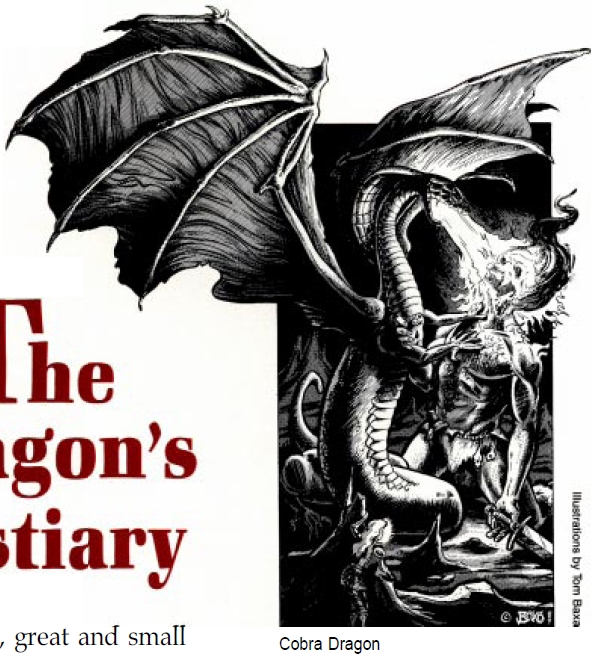
A cobra dragon is
gloss black, with an
orange underbelly.
On either side of its
neck is a large hood
of skin that resembles
that of a king cobra.
Legend holds that
certain king cobras
of great age transform
into cobra dragons.
Evil reptiles of the
Orient, these monsters
rival western
dragons in greed
and aggressiveness.
Cobra dragons do
not use magic; in fact,
they are highly resistant
to it. Instead,
they rely on their
natural abilities to
destroy their enemies.
A cobra dragon attacks by slashing with
its claws and whipping with its tail. Due
to
great strength and skill, a cobra dragon
gains a bonus to hit per age category (see
Table 1). From the dragon’s
mouth extend
two 13” fangs that inject a deadly venom.
A victim bitten by the dragon immediately
becomes weak (reduce strength score by
half) and dizzy (- 3 on all to-hit rolls),
and
suffers frequent periods of nausea (+4
bonus to be hit by opponents). Every
round thereafter, the victim suffers 1
hp
damage from extensive bleeding under the
skin. All of these effects continue for
10
rounds; at this time, if the individual
is
successful in making a saving throw vs.
poison, he returns to his normal level
of
function. A failed saving throw indicates
the victim falls into shock. When in shock,
the victim is unconscious, pale, and covered
in sweat. Unless the individual is
magically cured of the poison within the
next five rounds, the victim dies. Those
bitten by a cobra dragon cannot ingest
solids or liquids (due to nausea) until
the
effects of the poison have subsided.
Three times per day, a cobra dragon can
breathe a cone of fire 90’ long with a
30’
base diameter. Optionally, the dragon can
breathe its breath weapon directly under
its body. The force of the fiery breath
striking the ground forms a 40’-diameter
circle of flame (similar in nature to a
wall
of fire spell) that surrounds the dragon,
burning all within its area of effect.
This
tactic is quite effective when the cobra
dragon is surrounded by multiple opponents.
Cobra dragons are not affected by
their own breath weapons, as well as all
other fire- and heat-based attacks, magical
or mundane, but take +2 hp/HD of cold
damage. Other elemental attacks (based
on
water, air, or earth) affect them normally.
When the dragon's fire breath is
expelled, a stationary, black smoke cloud is
released from its nostrils in a 90'-diameter
circle around the dragon. All those within
the cloud (except the dragon) suffer from
coughing, nausea, and irritated eyes,
resulting in a -2 to hit for as long as the
opponents remain within the cloud. The
smoke cloud lasts 4-16 rounds before
breaking up. Strong winds move the
smoke cloud but do not aid in dispersing
it. Effects from several smoke clouds are
cumulative. Thus, two clouds released in
the same area would result in a -4 to hit;
three clouds would result in -6 to hit.
Table 1
Cobra Dragon Age Categories
| Age category | Length | Magic resistance | Hit bonus | Damage by claws/bite/tail |
| Very young | 6' | 15% | - | 1-4/1-10/1-2 |
| Young | 15' | 30% | +1 | 1-6/1-10/1-4 |
| Subadult | 29' | 45% | +2 | 2-8/2-20/1-6 |
| Young adult | 37' | 60% | +2 | 2-8/2-20/1-6 |
| Adult | 40' | 65% | +3 | 2-12/3-30/2-8 |
| Old | 41' | 70% | +3 | 2-16/3-10/2-12 |
| Very old | 42' | 75% | +4 | |
| Ancient | 43' | 80% | <> |
Cobra dragons live in caves and underground
caverns in tropical and subtropical
environments. They dislike swamps. In
Kara-Tur
(the Oriental Adventures lands of
the FORGOTTEN
REALMS™ setting), cobra
dragons are found in the far southern
reaches of the T’u
Lung Empire, where
they cause considerable grief and destruction.
They are said to be even more
numerous in other lands south and west
of that empire.
Like other dragons, a cobra dragon lays
claim to an area of land surrounding its
lair, ferociously driving off all other
creatures.
Intrusion by another cobra dragon
is only tolerated during the spring mating
season. The mating ritual involves the
male and female entering noninjurious
combat that results in a fiery display.
Mating only occurs during age categories
four and five. Cobra dragons past the
adult stage of life boast of having outgrown
the mating drive. After mating, the
female lays 1-4 12” -long eggs. When
hatched, the newborn dragons remain
with the female until they reach sub-adulthood.
Skull collecting is a favorite pastime of
cobra dragons. Skulls of powerful monsters
and rare creatures are highly prized.
Favorite skulls include those of cave bears,
dinosaurs, dragons, giants, and unicorns.
Humanoid skulls are deemed interesting
but of little value since they are so easily
obtained. The offering of a rare skull
as a
gift when attempting to converse with a
cobra dragon aids considerably in gaining
the dragon’s favor.
Due to its charisma, power, and cunning,
a cobra dragon ov adult age && beyond
attracts a small number ov intelligent
creatures who search for a leader to
serve. Common followers incl. bakemono,
gargoyles, lizard men, & mobats.
These creatures live with the dragon and
worship it as a god. A cobra dragon of
adult age or older has a 60% chance of
having 2-8 such allies, chosen by the DM
and heavily equipped for combat (if such
is possible).
Obsidian
Dragon
Created by: Mark Mathis
FREQUENCY: Very rare
NO. APPEARING: 1-2
ARMOR CLASS: -2
MOVE: 12”/30” (MC: B)
HIT DICE: 13-15
% IN LAIR: 65%
TREASURE TYPE: H, R, U (X2)
NO. OF ATTACKS: 2 claws, 1 bite, and 1
tail strike
DAMAGE/ATTACK: 2-8/2-8/6-48/2-16
SPECIAL ATTACKS: Major breath weapons,
exceptional damage from bite, four
attacks per round, major spell use
SPECIAL DEFENSES: Magic resistance,
high intelligence, detects hidden/
invisible objects, fear aura, savingthrow
bonus with age, polymorph self
at will, low armor class
MAGIC RESISTANCE: 5%
INTELLIGENCE: Exceptional
ALIGNMENT: Any lawful
SIZE: L (56? long)
PSIONIC ABILITY: Nil
CHANCE OF:
Speaking: 75%
Magic Use: 85%
Sleeping: 15%
LEVEL/XP VALUE: 13-14 HD: X/13,250 +
18 per hit point; 15 HD: X/17,550 + 20
per hit point
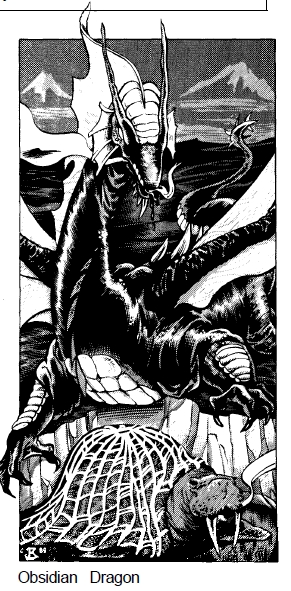
Obsidian dragons appear
in most
respects to be like
silver dragons. The
main difference between
the two is that
obsidian dragons
are black with silver
highlights. Known
only from the northern
reaches of the continent
of Oerik (in the
WORLD
OF GREYHAWK® setting), obsidian
dragons are thought
to be distant but
more powerful cousins
of silver dragons,
originating (some
speculate) in the Land of
Black
Ice. All obsidian dragons are lawful.
Some 65% are of good
alignment, while
25% are neutral and
10% are evil. As with
silver dragons, these
creatures are able to
polymorph themselves
at will in order to
appear to be a human
or normal animal.
The obsidian dragon?s tail attack only
affects those targets within 20? of the
tail
itself. The breath weapon of the obsidian
dragon is a cone of black acidic frost,
90?
long with a 30? base. Creatures who fail
their saving throws vs. dragon breath take
the usual damage from cold, equal to the
dragon?s hit points, but they must save
again at -2 to avoid taking 2-16 hp acid
damage as well (no acid damage is taken
if
this second save is made). This breath
weapon can be used three times per day.
Three times per day, the obsidian
dragon can also breathe forth a membranous
web of black ice 10? in diameter, shot
up to 60? away. Those failing a saving
throw vs. dragon breath are enveloped in
the web and encased in 5-8? of black ice
by the end of that round. All encased
creatures are held immobile and must
make a second saving throw vs. breath
weapon to keep their faces from being
covered. Otherwise, they will suffocate
in
2-5 rounds unless they can make their
bend bars/lift gates strength rolls to
break
free, or unless the black-ice web suffers
at
least 12 hp damage (attack vs. AC 4). Onequarter
of the damage done to the blackice
web is instead inflicted on the victim
so
encased.
While very young, obsidian dragons are
able to cast three first-level spells.
At each
age thereafter, they gain three more spells
of one higher spell level, plus one spell
from each lower spell level. Thus, an
ancient dragon could cast 10 first-level
spells, nine second-level spells, eight
thirdlevel
spells, etc. Ancient dragons have a
25% chance of knowing one ninth-level
spell. Furthermore, 45% of magic-using
obsidian dragons have spell books, so they
may select spells for use rather than
knowing only a limited number of spells
per level.
Obsidian dragons take - 1 hp/HD of cold
damage inflicted upon them. They are not
immune to their own breath weapons. In
addition, they take + 1 hp/HD of heat-,
fire-, and electricity-based attacks.
Gray
Dragon
Created by: Gregory
Detwiler
FREQUENCY Rare
NO. APPEARING: 1
(15% of 2)
ARMOR CLASS: 2
MOVE: 12”/30” (MC:
E)
HIT DICE: 5-7
% IN LAIR: 20%
TREASURE TYPE: E,
0
NO. OF ATTACKS: 2
claws and 1 bite
DAMAGE/ATTACK: 1-4/1-4/2-16
SPECIAL ATTACKS:
Major breath weapon,
spell use
SPECIAL DEFENSES:
High intelligence,
detects hidden/invisible
beings, fear
aura, saving-throw
bonus with age
MAGIC RESISTANCE:
Standard
INTELLIGENCE: Very
ALIGNMENT: Neutral
evil
SIZE: L (24? long)
PSIONIC ABILITY:
Nil
CHANCE OF:
Speaking: 50%
Magic Use: 40%
Sleeping: 35%
LEVEL/XP VALUE: 5
HD: V/360 + 5 per hit
point; 6-7 HD: VI/625
+ 6 per hit point
Sometimes seen along
the coasts of the
Ice Wall Glacier,
the great southern polar
cap of Krynn (the
DRAGONLANCE®
world), the gray
dragon vies with the
white dragon for
being the smallest and
swiftest of all evil
dragonkind. The gray
dragon, however,,
is more intelligent than
the white dragon,
and its thicker scales
give it better protection.
This intelligence
is shown by the gray
dragon?s greater
mastery of magic.
Gray dragons gain a
first-level spell
at each of the first two
stages of life, and
a second-level spell at
the next two stages.
At the adult and old
stages, they acquire
one third-level spell
for each stage, and
one fourth-level spell
each at very old
and ancient ages.
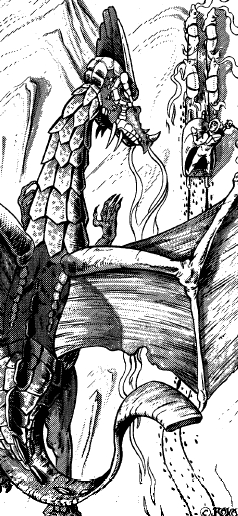
Although a gray dragon
can attack with
a claw/claw/bite
routine like nearly all
other dragons, its
main weapon of choice
is a paralyzing breath
weapon of cold air
that may be employed
three times per day.
This breath weapon
comes out of the
dragon?s mouth in
a cone, with a base
diameter of 2?, a
length of 70?, and an end
diameter of 50?.
When the dragon is airborne,
this power can bring
about the
death of a flying
opponent. Gray dragons
have been observed
on a number of occasions
using this weapon
against masses of
migrating birds,
particularly waterfowl.
Because of their greater
intelligence,
gray dragons recognize
the importance of
immobilizing the
opposition. They often
attack sled dogs
or draft animals first
when assaulting a
caravan or other large
group of traveling
people. The craftiest
dragons have even
been known to make
sneak attacks at
night, staying only long
enough to steal the
dog sleds, forcing the
travelers to go to
the dragon?s welldefended
lair to retrieve
them. This, of
course, enables the
beast to spend a pleasant
time elegantly picking
the interlopers
off one or a few
at a time. Gray dragons
old enough to know
fourth-level spells
favor dig, as it
enables them to create
pitfalls for intruders
without too much
work. They also favor
creating a phantasmal
force illusion of
the stolen dog sleds or
other booty in order
to tempt intruders
into a booby-trapped
area without risking
the loss of the real
prizes.
Gray dragons are not
known to have
joined the forces
of the Queen of Darkness
during the War of
the Lance. Instead, they
raid and kill any
creatures that wander
into their territories,
be they thanoi,
human barbarians,
or even white dragons
and their riders
from the White Dragonarmies.
This trait has not
endeared them
to any being, and
careless gray dragons
may find themselves
hunted by forces of
both evil and good
at the same time.
Gray dragons take
+ 1 hp/HD of damage
from attacks based
on fire and electricity,
but take - 1 hp/HD
damage from attacks
based on earth and
water.
Rainbow
Dragon
Created by: Gregory Detwiler
FREQUENCY: Very rare
NO. APPEARING: 1 (5% of 2)
ARMOR CLASS: -2
MOVE: 9?/24? (MC: E)
HIT DICE: 10-12
% IN LAIR: 60%
TREASURE TYPE: H, S, T, U
NO. OF ATTACKS: 2 claws and 1 bite
DAMAGE/ATTACK: 1-B/1-8/3-30
SPECIAL ATTACKS: Major breath weapon,
exceptional damage from bite, night
blinding, spell use
SPECIAL DEFENSES: Sun dazzle, low
armor class, high intelligence, detect
invisible/hidden beings, saving- throw
bonus with age
MAGIC RESISTANCE: Standard
INTELLIGENCE: Exceptional
ALIGNMENT: Neutral evil
SIZE: L (50? long)
PSIONIC ABILITY: Nil
CHANCE OF:
Speaking: 100%
Magic Use: 100%
Sleeping: 20%
LEVEL/XP VALUE: 10 HD: IX/6,750 + 14
per hit point; 11-12 HD: IX/8,050 per hit
point
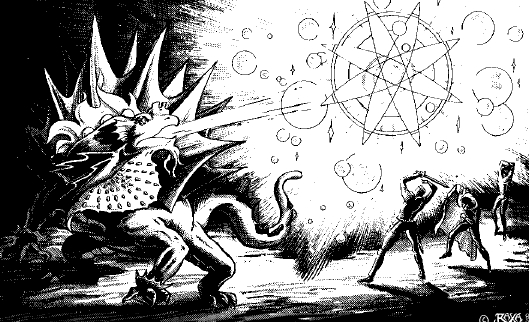
The rainbow dragon is one of the most
powerful of all evil-dragons. It is also
the
most beautiful, its hide displaying an
everchanging
display of iridescent hues of all
colors. When the dragon is in bright desert
light, this dazzling play of colors
gleams so brightly that it is painful to
the
eyes, causing any attackers to attack at
-2
to hit, or -4 in addition to penalties
for
fighting in the light if the attackers
(like
orcs or drow) are not accustomed to direct
sunlight.
The rainbow dragon usually fights with
a claw/claw/bite routine. Five times per
day, it can use its breath weapon of pure
energy, which looks like a rainbow-hued
blast of light. This weapon does damage
equal to the dragon?s hit points, but affects
only one target per attack. The breath
weapon is a 5?-wide beam of energy that
extends for 100?. So bright is this light
that
if the dragon attacks at night, everyone
within 100? of the beam must save vs.
spells or be blinded for 1-4 rounds.
In addition to-this, all rainbow dragons
are capable of spell use. Very young and
young stages of growth allow the rainbow
dragon to acquire one first-level spell
at
each stage; at subadult and young-adult
stages each, it may acquire a second-level
spell. A third-level spell is gained at
both
the adult and old stages, and a fourth-level
spell at both the very old and ancient
stages. All rainbow dragons can speak and
enjoy negotiating for ever-larger tributes
and payoffs from cities that wish to keep
such dragons from attacking them.
Rainbow dragons aggressively patrol
their territories (especially in daytime)
and
prefer to attack when the sun is out so
as
to take advantage of their light-enhancing
defenses. Rainbow dragons prefer brightly
lit desert and plains regions, making their
lairs in old ruins or caverns.
The blood of these beasts can be used as
ingredients in scroll ink for the spells
color
spray,
prismatic sphere, prismatic spray
and prismatic wall. A bit of bone from
a
rainbow dragon is said to tip the best
wands of conjuration.
Attacks based on elemental sources
(earth, air, fire, and water) affect the
rainbow
dragon normally. Electrical attacks
are taken with a - 1 hp/HD penalty to
damage, which is helpful if the rainbow
dragon fights a blue dragon for the same
territory.
Draken
Created by: Malcolm Bowers
FREQUENCY: Very rare
NO. APPEARING: 1-6
ARMOR CLASS: 3
MOVE: 9?/12? (MC: C)
HIT DICE: 3 +6
% IN LAIR: 55%
TREASURE TYPE: Incidental
NO. OF ATTACKS: 3 bites
DAMAGE/ATTACK: 1-6/1-6/1-6
SPECIAL ATTACKS: Breath weapon, shocking
bite
SPECIAL DEFENSES: Immune to sleep and
electrical attacks
MAGIC RESISTANCE: Standard
INTELLIGENCE: Low
ALIGNMENT: Lawful evil
SIZE: S (4? long)
PSIONIC ABILITY: Nil
CHANCE OF:
Speaking: 10%
Magic Use: Nil
Sleeping: 40%
LEVEL/XP VALUE: IV/175 + 4 per hit
point
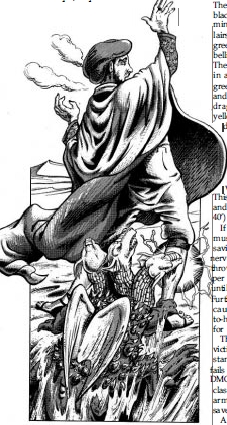
A draken resembles a small, three-headed
blue dragon in appearance, except
that its coloration is much darker (nearly
Prussian blue) and its wings and eyes are
tinged cyan. The draken is a dragonet,
cousin to both the firedrake and ice lizard,
and distantly related to blue dragons in
the same way that firedrakes and ice
lizards are to red and white dragons. It
inhabits the vast Calim Desert of Calimshan
(in the FORGOTTEN
REALMS setting),
where it is renowned for its
irascibility.
Its primary attack form is a breath
weapon, which each head can use twice
daily; this is a bolt of lightning 1? wide
and
60? long that delivers 2-16 hp damage (or
half that if a victim makes his saving
throw vs. breath weapons).
Drakens do not use their claws in combat,
but each head can bite in the same
round (and at the same or different targets).
If two bites are successful, a shocking
grasp effect does 4-11 hp damage to
the victim; if all three bite attacks hit,
the
extra damage is 9-17 hp damage. The
draken may use any combination of bites
and breath weapons from its three heads
in a round; a breath need not be at the
same target as bite attacks. The draken
is
immune to sleep spells and to all electrical
attacks. If it is sprayed with water, it
cannot
generate its breath weapon for 2-5
rounds. It takes + 2 hp damage per hit
die
of fire- or heat-based attacks.
Drakens lack the size and age categories
of their larger kin, growing to adulthood
within a year?s time after being hatched
(given sufficient food). They also lack
the
larger dragons? sensory powers, fear aura,
and saving-throw bonuses?but they cannot
be subdued, either.
Minidragon
Created by: David E. Cates
FREQUENCY: Very rare
NO. APPEARING: 1-2
ARMOR CLASS: 5 (2 in flight)
MOVE: 6?/28? (MC: A)
HIT DICE: See Table 2
% IN LAIR: 33%
TREASURE TYPE: Incidental (usually J-N,
Qx5)
sive spit, surprise 1-5 on 1d6
NO. OF ATTACKS: 1 bite
DAMAGE/ATTACK: See Table 2
SPECIAL ATTACKS: Poisonous and corro-
sive spit, surprise 1-5 on 1d6
SPECIAL DEFENSES:
Magic resistance,
minor spell immunities,
multiple savingthrow
bonuses
MAGIC RESISTANCE: 35%
INTELLIGENCE: Semi-
(low when empathically
bound)
ALIGNMENT: Neutral
SIZE: S (See Table 2)
PSIONIC ABILITY: Nil, but
immune to attack
CHANCE OF:
Speaking: See below
Magic Use: Nil
Sleeping: 10%
LEVEL/XP VALUE: Up to V/400
+ 5 per hit point
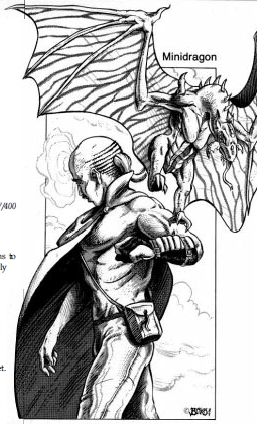
These strange creatures
look like winged snakes,
and they are distant cousins to
faerie dragons. They usually
live in or near wilderness
swamp areas, making
their homes in the trunks
of giant trees.
They freely associate with
black
dragons, who accept
minidragons outside their
lairs. Minidragons are dull
green, while their underbellies
are orange or scarlet.
Their wings are patterned
in alternating stripes of
green and orange or green
and scarlet. Rarer minidragons
have bluish or
yellowish tinges. There are no obvious
differences between males and females.
Four times per day, a minidragon of
adult age or older is capable of spitting
a nerve toxin that can be used to disable
or slay its enemies. The minidragon
must make a to-hit roll with its
venom in order to affect the target.
This toxic spit has a 60? range, with -
2
and - 5 to-hit modifiers for medium (21-
40?) and long (41-60?) ranges..
If the poison hits, two saving throws
must be made against its effects. The first.
saving throw is against the effects of
the
nerve toxin. If the victim fails his saving
throw vs. poison, he takes 1-4 hp damage
per round for 3-6 rounds until death or
until the poison is magically neutralized.
Furthermore, the intense pain of the toxin
causes the victim to take a -4 modifier
on
to-hit rolls, armor class, and saving throws
for the first 1-4 rounds.
The second saving throw is made for the
victim?s armor, against a corrosive substance
found in the venom. If the armor
fails a save
vs. acid (see the 1st Edition
DMG, page 80), it loses one step
of armorclass
protection permanently. Magical
armors lose their enchantments if this
save is failed as well.
A neutralize poison spell neutralizes the
nerve toxin but has no effect on the damage
already done by it. Nor will this spell
have any effect upon the damage done by
the corrosive nature of the venom.
Minidragons have a permanent sense of
empathy, as per the psionic discipline,
that
functions in a 20? radius. This power gives
them +4 to all their saving throws if
attacked by creatures within this range,
since they are able to instantly take evasive
actions and dart for cover. Because of
their unique constitution, minidragons
receive an additional + 4 bonus to their
poison and acid saving throws. All minidragons
have an innate magic resistance
of 35% and are immune to charm and
summon monster spells.
Left alone, the minidragon is fairly eventempered
and will not usually attack
humans unless angered or its lair is disturbed.
Even then, the minidragon will
usually sense if the intrusion is willful
or
not. If it senses the intrusion is an accident,
the minidragon tries to warn off the
intruder. If the minidragon senses that
it is
being hunted, it can be very cunning, as
its empathic ability allows it to evade
cap
ture often. The minidragon?s swift, darting
movements while flying give it a better
armor class. When its colorful wings are
folded to its body, and it is in natural
surroundings,
the minidragon blends in with
these surroundings so well that it surprises
on 1-5 on 1d6.
| Age category | Hit dice | Bite damage | Length |
| Very young | 1 | 1-2 | 6" |
| Young | 2 | 1-3 | 1' |
| Subadult | 3 | 1-4 | 1'6" |
| Adult | 3+2 | 1-4 | 2' |
| Old | 4 | 2-5 | 2'3" |
| Very old | 4+2 | 2-5 | 2'6" |
| Ancient | 5 | 1-4 | 3' |
Minidragons have the age categories of
major dragons, but lack the size categories,
sensory powers, fear auras, and
saving-throw bonuses. They cannot be
subdued.
Though minidragons have 60? infravision,
they are not usually nocturnal.
When trying to frighten or warn off a
creature, they are capable of emitting
a
very loud and piercing hiss. Minidragons
are also able to spit harmless spittle
at an
opponent, perhaps for the purpose of
frightening it.
Minidragons have a simple language that
is based upon the language that black
dragons speak. Minidragons prize shiny
objects such as pieces of glass, coins,
or
jewels. Minidragons are capable of hovering
in one place. These drakes usually eat
insects, rodents, berries, tubers, and
nuts,
but are quite capable of downing larger
creatures for food, if necessary. Minidragons
are fond of salt and often react to it
as a cat does to catnip.
JUNE 1989