
| Av | Bhatel | Kiita | Vor | Wandega |
| Advanced Dungeons & Dragons | - | Dragon magazine | - | Dragon #149 |
They left me alone
to guard
the rocky, north-coast
road, probably figuring
that I couldn't do any harm
there. The outlaws were supposed to be
coming from the south. So I watched the
road--really a path--for about an hour,
jumping at every passing bird, before
finally getting myself calmed down. Then
I
left my spear
and bow on the hill and slid <spear=x>
over the boulders down to the beach.
?A bit later, as I was leaning back to skip
another stone across a wave, I heard a
snicker behind me. I nearly fell over as
I
turned around, expecting the worst. But
I
wasn?t being watched by the outlaws or
my sergeant.
?It had come up behind me. Its flat-faced
head was cocked a bit to one side, and
its
four hooves sank into the sand. It was
something like a horse, but it?s eyes were
much closer together and it had a furry
hide that was?well, blue.?
One oddity with fantasy games and
literature is that the everpresent horse
never seems to change from world to
world. With only a few exceptions, no
matter how different the campaign milieu,
we always see the same ponies and chargers,
bays and roans. While this continuity
makes for a nice island amid the creative
chaos, there is no reason that the AD&D®
1st Edition game
should be limited in this
way.
Of the exceptions to this rule, J.
R. R.
Tolkien's
mearas (from The Lord of the
Rings) form an interesting
breed, but they
are only normal horses of superior blood
and strength. Steven R. Donaldson's ranyhyn
(from the Covenant series) are quite
different from other horses but would be
difficult to add to a campaign without
their attendant environment. There are
other fantasy horse-types, but all have
similar limitations. The practical solution
to this is to create some unusual new
?horses? with special characteristics and
abilities to fill the gap.
Following are the details of five new
horselike creatures. Any or all of them
could be added to a world as random
encounters or as established sources of
transportation. They can be included with
normal horses or substituted for them
entirely. (My world of Lervanis uses vor
predominantly, with kiita and bahtel occasionally.)
Each type excels at one or more
tasks, and all of them make excellent specialized
mounts for certain missions and
particular characters, such as cavaliers.
A new statistic is presented here: load,
which shows the weight in gold pieces
each creature can carry. The first value
given shows, the maximum load in goldpieces
weight that the creature can carry
at normal movement; the second figure
shows the encumbered movement maximum
load, at which the creature moves at
one-half normal speed.
FREQUENCY: Rare
NO. APPEARING: 3-60 in wild (10% chance
of 1)
ARMOR CLASS: 7
MOVE: 30” (see text)
HIT DICE: 2+2
% IN LAIR: Nil
TREASURE TYPE: Nil
NO. OF ATTACKS: 2 hooves and 1 bite
DAMAGE/ATTACK: 1-4/1-4/1-3
SPECIAL ATTACKS: Nil
SPECIAL DEFENSES: Nil
MAGIC RESISTANCE: Standard
INTELLIGENCE: Semi-
ALIGNMENT: Chaotic good
SIZE: L (see text)
PSIONIC ABILITY: Nil
LOAD: 3,000/4,500
Av, or sand runners, are extremely thin,
long-legged horses
of great speed and
reliability?the ?greyhounds? of the horse
world. They are of particular value in
farflung
kingdoms, as they swim well (6?
alone, 4? mounted, 2? encumbered),
never get lost, and can travel without
a
rider to a known destination. They are
also sufficiently intelligent to learn
simple
commands and even recognize one or two
simple symbols, such as a coat of arms.
Thus, their allegiance can be extended
to
everyone in a certain group who knows
the proper commands or signs.
Av serve any kind masters and have no
particular racial preferences. They dislike
barding. Sand runners like magic and are
not afraid of most spells, but they are
terrified of fire and all firelike effects.
Wild av travel in swift packs and are
hard to catch. Once captured, they are
skittish but easily trained. They can be
bred, but horse-av combinations always
result in fair-quality standard horses.
Av are rather weak in melee and prefer
to run from trouble, but they can be
trained for combat much as normal horses
of good quality. However, av are forced
to
the fringes of battle even by light war
horses and are certainly no match for
medium and HEAVY HORSES(Jethro Tull).
Sand runners prefer deserts, plains, and
other hot, dry regions, but are reasonably
tolerant of all climates and weather with
the exception of rain. They are slow and
troublesome on wet days. Av have very
good endurance, being able to travel up
to
15 hours per day with ease, and require
only three-fourths the water required by
normal horses. Stallions (uncut adult
males) are capable of bursts of speed of
33? (this can be added to the cavalier
speed bonus). They can do this once a day
for up to three turns.
Av have large, flaring nostrils and small,
double-lidded eyes in thin heads. They
are
bony, with long, hairy tales and manes
and
tufts of hair around their hooves. They
range from butter
yellow to golden brown
in color and often have bands and stripes
in dark brown or reddish-brown. Av are
usually about 15 hands at the withers.
They eat a normal horse diet and live up
to 25 years.
FREQUENCY: Very rare
NO. APPEARING: 1-12 in wild
ARMOR CLASS: 6
MOVE: 18”
HIT DICE: 4+4
% IN LAIR: Nil
TREASURE TYPE: Nil
NO. OF ATTACKS: 2 hooves, 1 bite, and 1
head butt
DAMAGE/ATTACK: 1-8/1-8/1-4/2-5
SPECIAL ATTACKS: Rear-leg kick
SPECIAL DEFENSES: Nil
MAGIC RESISTANCE: Standard
INTELLIGENCE: Low
ALIGNMENT. Neutral
SIZE: L (see text)
PSIONIC ABILITY: Nil
LOAD: 4,500/7,000
Bahtel (bah-TEL) are large, powerful
horses that excel in combat. They are
intense, high-strung, and always ready
to
fight. They are sometimes referred to as
berserker
horses or whirlygigs for their
wildly aggressive behavior in battle. They
are not as fragile as normal horses, having
thicker legs and stronger bones. In melee,
they bite with their strong jaws, kick
with
their front hooves, and use their large,
bony foreheads to butt opponents. Unlike
other horses, bahtel can attack on the
first
round of melee.
Every other round, a bahtel can kick
with its rear hooves (both hooves thrusting
at a single target) for 2-12 hp damage
(save vs. paralyzation for one-half damage).
This ?rear? attack can be directed
against an opponent in front, as the bahtel
can leap up and kick its rear feet forward.
An opponent hit by a bahtel?s rear hooves
must make a dexterity check on 4d6 or be
knocked down. There is only a 1% chance
that bahtel will panic and bolt from a
fight
while mounted, but they always retreat
if
wounded while facing poor odds.
During combat, only cavaliers and characters
with riding proficiency are able to
stay in the saddle of a berserker horse.
Others are thrown in 1-6 segments by the
beast?s continual wild bucking and twisting
as it fights. All but cavaliers have their
number of attacks per round reduced by
one, so that a 9th-level ranger would have
one attack every two rounds and a thief
of
the same level would have none. All attacks
by the rider are at -2 to hit. A rider
must use one hand to hold the bahtel?s
reins while it fights, his other hand being
free to hold a weapon.
An unskilled character could tie himself
into the saddle and
but there are some
thus stay on the horse,
obvious problems with
any normal saddle, but they must have
special bitless bridles in order to accommodate
their huge jaws.
Berserker horses are not particularly
loyal, usually following whomever feeds
them best. However, since they are somewhat
intelligent, they do pay attention to
their masters and riders, showing preference
for skilled and aggressive cavaliers,
paladins, rangers, fighters, barbarians,
and clerics. Riding mastery is slightly
more
important to them than food, so the better
rider wins out over the rich one. If one
master is killed, a bahtel will go with
the
next best one.
For some reason, berserker horses are
not fond of gnomes and halflings, preferring
to avoid (or kick) them. They tolerate
dwarves, but recognize them as nonriders.
They are neutral with regard to all other
species except unicorns, which bahtel
dislike. Bahtel are not interested in (or
intelligent enough for) matters of good
and
evil, or law and chaos.
A bahtel can learn to recognize 2-5 simple
verbal commands. These can be for
any simple action such as charge, wait,
or
come. It takes a minimum of two weeks
for the beast to learn each command, and
it obeys the command if a roll of 1d100
is
less than or equal to its loyalty score
(10d4, +5% per month of service, modified
by the rider’s charisma (the loyaltybase
modifier); 19 is maximum score).
Bahtel communicate among themselves in
a simple language of grunts and thin whistles.
During melee, they sometimes whistle
quite loudly, with any nearby bahtel answering.
A bahtel willingly fights any
creature, including another bahtel.
Due to their thin, rough hide, berserker
horses are not at all suited to cold climes
and prefer hot, wet regions. They take
150% damage from cold-based attacks
(e.g., taking 15 hp instead of 10 hp damage)
and always try to avoid snow and ice.
Bahtel are omnivores, with a normal diet
of grasses and fruits supplemented with
eggs, small mammals, insects, and lizards.
They eat one-and-a-half times as much as
medium war horses.
In the wild, bahtel travel alone or in
small packs. All berserker horses have
very good eyesight, and they are very
difficult to catch alive. Once captured,
they require six months of training in
order to mesh successfully with heavy,
armored riders and mounted companies,
though they are subject to loyalty rolls.
They never go underground or into any
buildings other than stables. They are
indifferent to most magic. Bahtel can
sometimes he bred with other horses (see
note which follows), but the horse genes
dominate and sterile, normal, fair-quality
war horses always result.
Female bahtel are larger and stronger
than males and get + 1 hp on each hit die
rolled; females absolutely refuse any nonbahtel
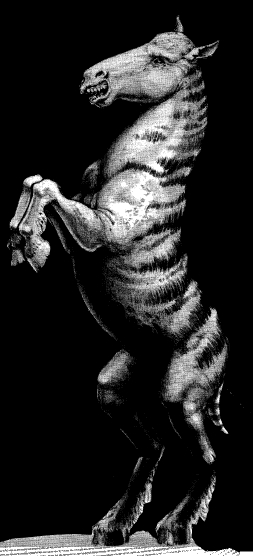
stud. All bahtel have short, broad
bodies with thick, muscular legs and long,
very flexible necks. Their heads are short
and wide, with a heavy knot of bone over
the eyes. They are usually striped in wide,
vertical bands of gray, white, or black.
They have no manes; their tails are short,
thick and hairless. Males are usually about
15 hands and females 16 hands. Bahtel are
rather short-lived, maturing in one year
and living to about 12 years of age.
FREQUENCY: Very rare
NO. APPEARING: 1-4 in wild
ARMOR CLASS: 4 (see text)
MOVE: 18”
HIT DICE: 3
% IN LAIR: 5%
TREASURE TYPE: Nil
NO. OF ATTACKS: 2 hooves and 1 bite
DAMAGE/ATTACK: 1-6/1-6/1-4
SPECIAL ATTACKS: Nil
SPECIAL DEFENSES: ESP
MAGIC RESISTANCE: Standard
INTELLIGENCE: Average
ALIGNMENT: Neutral good
SIZE: L (see text)
PSIONIC ABILITY: Nil, but see text
LOAD: 3,500/5,000
Kiita (KEE-tah) are intelligent creatures
who sometimes choose to align themselves,
singly, with powerful humans
and
demi-humans. They accept these friends
as riders, but only within certain limits
and never with saddle and bridle. Because
of their skills, intelligence, and loyalty,
kiita are highly prized mounts.
Kiita Reaction Table
| 1d12 | Reaction |
| 1-4 | Leaves character or party at first opportunity |
| 5-6 | Leaves character or party at next dangerous situation (or after a maximum of 4 hours) |
| 7-9 | Stays with character or party for 2-20 hours |
| 10-11 | Stays with character or party for 1-4 days |
| 12 | Stays with character or party for 5-8 days |
Kiita prefer monks, rangers, and clerics
as partners, and very rarely join other
types. Kiita only join characters of good
alignment and with intelligences greater
than their own. They stay with characters
of equal or lesser intelligence or of neutral
or evil alignment for no more than one
week.
Kiita try to meet possible partners but
attempt to carefully choose the time and
place of such encounters to avoid putting
themselves in danger. They prefer one-onone
encounters, always keep their distance,
and invariably try to surprise
potential friends. When a lone kiita is
encountered, a normal reaction roll is
made for it. If the kiita’s result is neutral
or better, it wishes to go with the character
or party it has met. If a monk, cleric,
or ranger is present, the kiita quickly
selects that character (choosing a monk
over a ranger, and a ranger over a cleric)
as a possible partner. Kiita also prefer
elves and half-elves to other species and
select such characters first if all else
is
equal. They are neutral toward small
demi-humans, since they are not usually
riders, but they dislike half-orcs.
If there are no characters of the three
first-choice classes, roll for the creature’s
reaction on the Kiita Reaction Table. A
roll
is also required if and when a chosen
character is not up to the kiita’s standards
of goodness, intelligence, and class. If
a
kiita decides to leave a character, it
never
goes to another member of the same
party, regardless of eligibility.
If the chosen character proves to he one
of the three preferred classes, is more
intelligent, and is of any sort of good
alignment,
the kiita stays with that character.
Once a rider is chosen (usually in return
for a promise of food and security), a
kiita
is able to establish a limited telepathic
link
with that person. This requires 1-4 weeks
(or only 2-8 days with a monk or psionic
PC). Wounds to either partner, great distress
(such as extreme hunger or strong
emotions), or separation greater than one
mile between mount and rider disrupt the
link, but otherwise the kiita and its rider
can converse in something approaching
normal speech, mind to mind. No training
or riding is necessary for this; the kiita
becomes something of a brave and loyal
henchman.
In addition, the kiita is usually able to
scan the surface thoughts of human, demihuman,
and humanoid opponents, much
as a doppleganger does but to a lesser
degree. This anticipation produces the
kiita’s low armor class. Against mindless
foes (e.g., slimes, skeletons, dinosaurs)
or
foes with psionic powers that prevent the
use of ESP, the kiita’s armor class is
6. A
kiita can only ESP one opponent at a time.
Kiita are wary of nonclerical spellcasters
(except for druids). A kiita stays on
as a partner for 2-8 years, at the end
of
which time it suddenly departs, its whim
satisfied. It is not possible to force
a kiita
into service, except by charm—but should
the charm be broken, the kiita flees.
Kiita are able to twist their necks so far
as to look directly behind themselves,
thus
being able to bite anyone near their front
flanks. They are average in fighting ability.
They wear light barding (leather, padded,
or lighter-weight ones). A kiita’s armor
class while encumbered is worsened by
one point. Like bahtel, kiita can attack
on
the first round of melee.
The only sounds that kiita are able to
make are clicks and snaps (used for communication
among themselves) and a thin
screech for warnings and as a fighting
call.
Kiita are temperate and subarctic creatures,
with considerable ability to endure
cold and hardship. They are only moderately
tolerant of heat. Kiita dislike going
underground, as do elves, but they are
agile enough to enter large areas and will
do so with their partners. Kiita have small,
weak hooves that require monthly reshoeing
by an expert if they are expected to
accept riders on long journeys. They are
able to digest just about anything but
live
best on grains and vegetables. There are
no appreciable differences between male
and female kiita, and all have keen ears
and noses. Note that because kiita refuse
to wear saddles and bridles, they cannot
wear stirrups—thus, their riders must
hang on to their mounts with both hands
when the mounts are running or fighting.
Being very distantly related to normal
horses, kiita cannot be crossbred with
their “average” cousins.
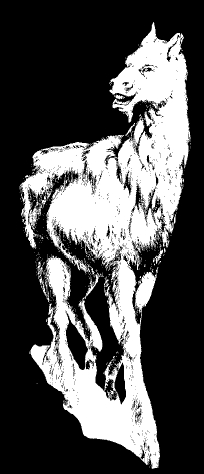
Kiita have flat, expressive faces with
small eyes and broad mouths. Their necks
are short and thin on small, wiry bodies.
They are usually about 13-15 hands. Kiita
are normally pale blue in color, with some
much darker and others almost white.
They have warm, furry hides that are
sought by (stupid) hunters, but are obviously
hard to obtain. Kiita have no manes
or tails. They live about 40 years.
FREQUENCY: Uncommon
NO. APPEARING: 2-40 in wild (10% chance
of 1)
ARMOR CLASS: 8
MOVE: 15”
HIT DICE: 3+3
% IN LAIR: Nil
TREASURE TYPE: Nil
NO. OF ATTACKS: 1 horn butt
DAMAGE/ATTACK: 1-8
SPECIAL ATTACKS: Bellow
SPECIAL DEFENSES: Smell poison
MAGIC RESISTANCE: Standard
INTELLIGENCE: Animal
ALIGNMENT: Neutral
SIZE: L (see text)
PSIONIC ABILITY: Nil
LOAD: 5,000/9,000
Vor are extremely strong and surefooted.
They are quiet, placid creatures,
valuable for their ability to carry heavy
loads virtually anywhere. However, they
are slow and not strong in combat. Being
of animal intelligence, they recognize
only
good treatment and food,
although they do
have some rider loyalty.
Vor are very tractable, easily-trained
beasts are are usually calm and trustworthy.
They are less nervous than horses.
Vor dislike dwarves but otherwise enjoy
the smaller demi-humans, who find vor
vastly amusing and can triple up when
riding the larger specimens. They are easy
to catch and breed (only among themselves)
and are fairly disease-resistant. Vor
are comfortable in temperate regions,
where they roam in small herds, often in
rocky uplands. Vor are very distantly
related to horses.
Vor are generally the size and weight of
heavy war horses but can carry significantly
more than any horse and can climb
even steep grades with large loads. Vor
will enter cave mouths but are terribly
claustrophobic and never willingly enter
any sort of enclosed space other than a
stable.
In melee, vor can attack opponents only
directly ahead or just to the side. They
attack on the second and succeeding
rounds of any melee. Vor let out a tremendous
bellow when they are wounded and
when charging into a fight. Anyone directly
in front of the beast at this moment
must save vs. breath weapon or lose initiative
on the following melee round.
Vor are very faithful to masters who
treat them well, and they stay at the sides
of their dismounted riders until they are
driven off or one of them is killed.
Other than their roaring and great
strength, a vor?s only special skill is
the
ability to smell poisonous substances.
The
vor can smell poison at 1" distance, only
if
there are no other strong smells present.
Thus, a poison mixed in with a complete,
odorous meal would escape the vor, but
one in a glass of white wine would not.
Vor require only normal saddles and
other tack. They can be fitted with barding
at 150% of the usual cost. They are
herbivores and like most good grasses and
feeds.
Male vor are larger than females and
have a 60% chance of having six legs instead
of four. Those with six legs are the
largest and strongest, gaining +2 hp per
hit die. Females have a 20% chance of six
legs, with six-legged specimens receiving
+ 1 hp per hit die.
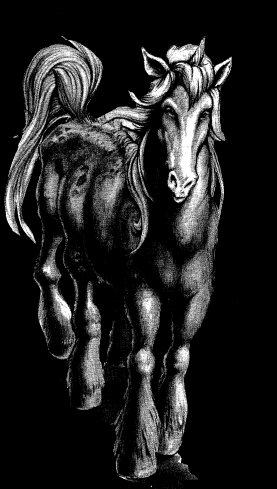
Vor mounts are tall (16-17 hands), heavy,
orange or red beasts with thin, handsome
faces and large ears. They have large,
hard hooves that help them climb in steep
and stony areas. They each have one
small, hard horn at the top of the forehead.
Vor have hairy tails and manes, and
live up to 30 years.
FREQUENCY: Very rare
NO. APPEARING: 1-4 in wild
ARMOR CLASS: 7
MOVE: 21”
HIT DICE: 2+4
% IN LAIR: 10%
TREASURE TYPE: Nil
NO. OF ATTACKS: 2 hooves
DAMAGE/ATTACK: 1-4/1-4
SPECIAL ATTACKS: Spells
SPECIAL DEFENSES: Surprised on 1 on
1d6
MAGIC RESISTANCE: 30%
INTELLIGENCE: Very
ALIGNMENT: Lawful neutral
SIZE: L (see text)
PSIONIC ABILITY: Nil
LOAD: 2,500/4,000
Wandega (wan-DAY-gah) are intelligent
creatures with a special relationship to
magic. They are rarely seen, almost impossible
to catch, and, exceptionally valuable.
All wandega are resistant to magic, and
females are capable of learning as many
as
three first-level
magic-user spells. Male
wandega cannot learn spells. Wandega are
even more distantly to horses than are
kiita or vor.
Wandega are very choosy, preferring
individual freedom to pleasureless service,
but occasionally one approaches an individual
or a group of adventurers, hoping
to attach itself to someone with spellcasting
ability. This is true for both female
and male wandega. Wandega encountered
in this way do not yet know any spells.
They attempt to ally themselves with a
lawful spell-caster, choosing a magic-user
or illusionist, in that order. A wandega
can
sense if a character is lawful, choosing
the
first eligible spell-caster. The race of
the
spell-caster is not a factor. Wandega refuse
to join any nonlawful character, but a
lawful rider can be good, evil, or neutral.
A female wandega can learn one magicuser
spell per month, to a total of three
spells. Such spells can involve the use
of
verbal and somatic components only (the
latter fulfilled with the wandega?s hooves
and tail). Learning these spells requires
at
least two hours per day of uninterrupted
work with the teacher/partner, and any
serious disruption sets progress back one
week. The wandega can never relearn
spells without the help of its partner.
Wandega are intensely loyal. If a wandega
?s master is killed, it never again teams
up with another character, preferring
instead to go back to the wild.
Wandega dislike buildings, including
most stables, and never go underground.
They are not very tolerant of separation
from their partners, so provision must
be
made for them in dungeon adventures.
However, they can be taught to wait and
even stand watch over lesser creatures.
This and their magic lessons are the only
training they need. Wandega that are left
alone have their own henchman morale
and get normal morale checks.
Wandega speak their own hissing language
and can learn one other language
(in addition to their spells) in six months
time. In human and demi-human languages,
wandega speak in a weak, crackly
voice and cannot speak loudly.
Wandega are weak in melee and will not
wear barding but will gladly accept magical
protective devices. They do not require
bit and bridle and will not accept them,
but they can be convinced to carry saddles,
stirrups, and light packs. Wandega
are usually small (13 hands) and are never
suitable war horses, though they are hard
to panic.
Male and female wandega are much
alike and cannot be bred with horses.
They have light coats and prefer temperate
grasslands and forests. When in their
native terrain, they are surprised only
on
1 in 6. They are herbivores, with a preference
for fine grains and grasses. They are
usually brown, white, or mottled combinations
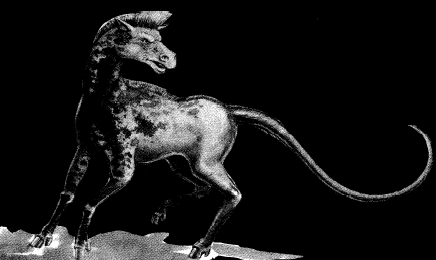
of the two, with thin, roundish necks
and small heads. Wandega snouts are quite
short, ending in small mouths. Their ears
are small and pointed, and their eyes are
usually green or brown. They have short,
stubby manes and long, whiplike tails.
Wandega females live about 25 years,
males up to 35 years.
SEPTEMBER 1989
FREQUENCY: Rare
NO. APPEARING: 1-12
ARMOR CLASS: 4
MOVE: 12"
HIT DICE: 8
% IN LAIR: 30%
TREASURE TYPE: [C]
NO. OF ATTACKS: 1
DAMAGE/ATTACK: 2-16
SPECIAL ATTACKS: Nil
SPECIAL DEFENSES: Regeneration
MAGIC RESISTANCE: Standard
INTELLIGENCE:
ALIGNMENT:
SIZE:
PSIONIC ABILITY: Nil
Attack/Defense Modes:
Nil
LEVEL/X.P. VALUE: