| - | - | - | - | - |
| Dungeons & Dragons | Advanced Dungeons & Dragons | Monsters | Dragon magazine | Dragon #116 |
The Dragon's Bestiary last graced the
pages of DRAGON® Magazine in issue #61.
Since then, new monsters have made only
occasional appearances here (save in our
Creature Catalogs) -- but that has now
changed. We are pleased to bring back one
of the most-liked of our columns, hopefully
for a long stay.
This edition of The Dragon's Bestiary
presents new flora and fauna for oceanic
adventuring. Handle them with care -- if
you handle these creatures at all.
Credits
Gregg Chamberlain: Brain coral, giant
clam,
giant grouper, giant porcupine
fish,
electric ray, sawfish/sawshark,
Alex Gray: Sea titan,
Spike Y. Jones: Sea centaur, weed
giant,
Nick Kopsinis: Giant sea anemone,
Robert Maurus: Morana.
<Undine?>
BRAIN CORAL
by Gregg Chamberlain
FREQUENCY: Very rare
NO. APPEARING: 1
ARMOR CLASS: 10/5 (exoskeleton)
MOVE: Nil
HIT DICE: 3
% IN LAIR: 100%
TREASURE TYPE: Incidental
NO. OF ATTACKS: See below
DAMAGE/ATTACK: See below
SPECIAL ATTACKS: Poison, psionic powers
SPECIAL DEFENSES: Psionic powers
MAGIC RESISTANCE: Standard
INTELLIGENCE: Exceptional
ALIGNMENT. Neutral
SIZE: S (2')
PSIONIC ABILITY: 60-100
Attack/Defense Modes: See below
LEVEL/X.P. VALUE: III/120 + 3/hp
Brain coral is an evolutionary offshoot of
a type of stony coral. It has an exoskeleton
that is convoluted and ridged so that it
resembles a human brain. Like its simpler
cousin, this more advanced type of brain
coral is restricted to the warm waters of
the tidal zone, but may be found at depths
of 1,000? + . Usually, it is found with the
growth of a coral reef or atoll where
feeding is easier.
The brain coral consists of the animal
polyp which has settled and, over the
years, built up an exoskeleton of pure
calcium carbonate around it for protection.
The exoskeletonis AC 5 and takes
damage equal to the total hit points of the
polyp before fracturing enough to allow
the attacker to actually get at the AC 10
polyp. Nematocyts (stinging cells) throughout
the skeleton inject a weak neurotoxin
into victims which can paralyze for 1-10
rounds (save vs. poison at +4).
The brain coral has a psionic strength of
30-50 points (60-100 psionic ability) with
attack/defense modes randomly determined
as for player characters. It has 2-5
minor disciplines and a 25% chance of
having a major discipline. The minor disciplines
are among the following: animal
telepathy, cell adjustment (as fighter),
domination, ESP, invisibility, and clairvoyance.
The major discipline is telekinesis,
which is always accompanied by clairvoyance
as a minor discipline. All powers are
at the ninth level of mastery.
If encountered, a brain coral may attempt
to read its visitors? minds if the
coral has ESP If attacked and if
it possesses
telekinesis, the brain coral uses its
power either to move attackers away from
the area or to batter one attacker with
underwater debris for 2-5 hp damage/
round.
Brain coral skeletons are yellow, brown,
or olive in color. If removed from the
water, the skeleton turns bone white.
CENTAUR, SEA
by Spike Y. Jones
FREQUENCY: Very rare
NO. APPEARING: 1-3
ARMOR CLASS: 5
MOVE: //24?
HIT DICE: 5
% IN LAIR: Nil
TREASURE TYPE: See below
NO. OF ATTACKS: 1 weapon
DAMAGE/ATTACK: By weapon type
SPECIAL ATTACKS: Spells
SPECIAL DEFENSES: Spells
MAGIC RESISTANCE: 5%
INTELLIGENCE: Average to exceptional
ALIGNMENT: Chaotic good
SIZE: L (12-15? long)
PSIONIC ABILITY: Nil
Attack/Defense Modes: Nil
LEVEL/X.P. VALUE: V/245 + 5/hp
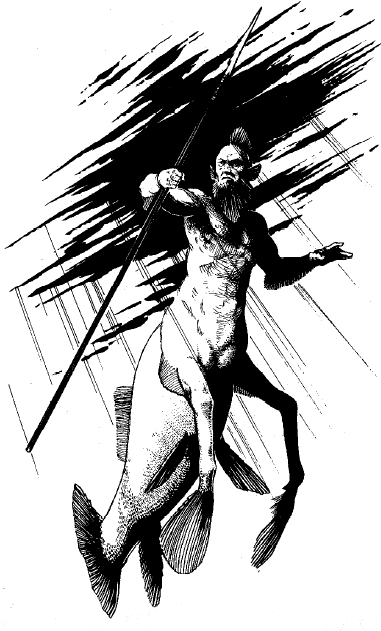
These aquatic creatures appear to be a
cross between a triton and a hippocampus.
They are found in any area where
either of the other two creatures might be
found.
Sea centaurs usually gather in small,
nomadic families, but occasionally may be
found amongst a group of tritons. Tritons
feel superior to the sea centaurs because
of the latter?s lesser abilities (e.g., lower
magic resistance, lack of psionic ability,
etc.); tritons sometimes use sea centaurs as
mounts if the latter are agreeable.
For the most part, sea centaurs have no
treasure (except for an occasional piece of
jewelry), although 10% of them have acquired
tritons' magic conch shells. When
used by sea centaurs, these shells summon
2-8 hippocampi; they can also be used to
send messages underwater within a halfmile
radius.
There is a 10% chance that any sea
centaur has the ability to cast spells as a
1st-4th level druid. All sea centaurs speak
triton and hippocampus, and 25% of them
also speak common. They say little about
the deity they worship, but it is assumed
to be the same one as worshiped by the
tritons (i.e., Triton).
CLAM, GIANT
by Gregg Chamberlain
FREQUENCY: Rare
NO. APPEARING: 1-4
ARMOR CLASS: 10/3 (shell)
MOVE: //1"
HIT DICE: 3
% IN LAIR: 100%
TREASURE TYPE: See below
NO. OF ATTACKS: Nil
DAMAGE/ATTACK: Nil
SPECIAL ATTACKS: Entrapment
SPECIAL DEFENSES: Nil
MAGIC RESISTANCE: Standard
INTELLIGENCE: Non-
ALIGNMENT: Neutral
SIZE: M (6' length)
PSIONIC ABILITY: Nil
Attack/Defense Modes: Nil
LEVEL/X.P. VALUE: III / 90 + 3/hp
CLAM, GIANT CARNIVOROUS
by Gregg Chamberlain
FREQUENCY: Rare
NO. APPEARING: 1-4
ARMOR CLASS: 10/4 (shell)
MOVE: //1" [10" using bursts]
HIT DICE: 4
% IN LAIR: 50%
TREASURE TYPE: See below
NO. OF ATTACKS: 1 ram
DAMAGE/ATTACK: 1-10
SPECIAL ATTACKS: Poison cloud, surprise, continuous damage
SPECIAL DEFENSES: Nil
MAGIC RESISTANCE: Standard
INTELLIGENCE: Animal
ALIGNMENT: Neutral
SIZE: M (6' length)
PSIONIC ABILITY: Nil
Attack/Defense Modes: Nil
LEVEL/X.P. VALUE: IV / 175 + 4/hp
Both the giant clam and the giant carnivorous
clam are found in shallow tropical
and semitropical waters, down to a maximum
depth of 200'. Both have numerous
tiny, blue eye spots located near the edges
of the shell. These eye spots can distinguish
between light and shadow, and can
detect movement, but not size. Special
organs near the front of the mantle cavity,
where the soft body of the clam sits, detect
and analyze chemical traces in the
water.
The giant clam is a filtrationist, living on
minute shrimp and microscopic animals,
and on algae colonies growing inside the
clam?s shell mantle. When threatened or
when something reaches inside the clam?s
shell, the giant clam?s usual defense is to
close its shell. Due to the animal?s powerful
adductor muscles, which act as a hinge
for the shell, a bend bars/lift gates roll is
required to force the shell open again.
The giant carnivorous clam has evolved
a slightly higher intelligence than its sessile
cousin, which it uses to hunt for prey.
Both clams are capable of using their
inhalent and exhalent siphons to move
across the sea bottom; the carnivorous
clam can also, through vigorous clapping
of its shell halves, ?swim? in a jerky fashion
with its exhalent siphon, providing
lateral adjustment and maneuverability.
The shell thickness of the clam is reduced
to increase buoyancy. The clam?s external
cilia have evolved into a set of 4-10 2?-long
tentacles, used mainly to grasp and move
prey to the clam?s stomach. The tentacles
are too weak to do any damage or to grasp
and hold prey with a strength greater
than 6.
The carnivorous clam can, by a sudden
expulsion of water through closing its
shell, jet backwards and ram an opponent
within 5? for 1-10 points of damage. The
clam?s usual method of attack is to shoot a
mild neurotoxin into the water through its
exhalent siphon. The toxin disperses in a
5?-diameter cloud and causes paralysis for
1-12 rounds to any creature that fails to
make its saving throw vs. poison. The
paralyzed prey is then grasped by the
clam?s tentacles and either pulled directly
into the clam (for 1 hp/turn digestion
damage thereafter) or cut into smaller
pieces by sawing motions of the clam?s
shell (1-2 hp damage/round).
The inside of both clam shells are lined
with nacre or mother-of-pearl, with a base
value of 50 gp depending on the amount
of mother-of-pearl adventurers can recover.
(DMs should consult the table on
page 26 of the Dungeon Masters Guide to
determine the final amount. This amount
should never exceed 500 gp.) There is a
10% chance that a clam has one giant
pearl worth 500-1000 gp, depending upon
its size and quality. The pearl may be as
large as a fist, but will not be as lustrous
as smaller pearls from pearl oysters.
There is a 5% chance that, scattered about
or buried in the sediment around the
clam, a few coins, accoutrements, or minor
magic items were left behind by an
unfortunate victim who was caught and
drowned.
Both clams are nearly identical in ap
pearance. The upper shell of both clams is
light brown, while the lower shell is white.
Giant clams of both varieties are found
nestled in the sand or resting on the sedimentary
bottom of oceans. Sometimes, the
giant clam buries itself to provide an offensive
advantage against prey (surprise
on 1-5). <surprise, d133>
GROUPER, GIANT
by Gregg Chamberlain
FREQUENCY: Uncommon
NO. APPEARING: 1-6
ARMOR CLASS: 5
MOVE: //20?
HIT DICE: 5
% IN LAIR: 75%
TREASURE TYPE: R, X
NO. OF ATTACKS: 1 bite
DAMAGE/ATTACK: 2-12
SPECIAL ATTACKS: Swallow whole,
continuous damage
SPECIAL DEFENSES: Nil
MAGIC RESISTANCE: Standard
INTELLIGENCE: Non-
ALIGNMENT: Neutral
SIZE: L (17?-20?)
PSIONIC ABILITY: Nil
Attack/Defense Modes: Nil
LEVEL/X.P. VALUE: IV/205 + 5/hp
The largest of the grouper family of fish,
the giant grouper weighs as much as 1,000
pounds. A deep sea predator, the giant
grouper can usually be found lurking near
coral reefs or lairing in the sunken hulls of
wrecked ships. Its huge jaws act in a manner
similar to that of a suction pump,
drawing smaller fish into the gaping maw
of the grouper. Solitary divers sometimes
fall prey to this fish.
The grouper can, on a natural die roll of
20, swallow a man-sized or smaller object
whole. If a swallowed person swallowed
has a dagger or similar small sharp-edged
weapon in hand when swallowed, he may
cut his way out of the fish by inflicting
damage equal to 25% of the total hit points
of the fish. A character has only 1 turn in
which to do this, as the giant grouper?s
digestive fluids then begin to act, delivering
1-4 hp/round thereafter. Characters
may try to exit the grouper when it opens
its mouth to swallow other prey as well.
FREQUENCY: Uncommon
NO. APPEARING: 1-4
ARMOR CLASS: 6 (2 if moving)
MOVE: //18?
HIT DICE: 3 + 2
% IN LAIR: 30%
TREASURE TYPE: Nil
NO. OF ATTACKS: 1 bite
DAMAGE/ATTACK: 3-6
SPECIAL ATTACKS: Surprise, continuous
damage
SPECIAL DEFENSES: Evades missiles,
regeneration
MAGIC RESISTANCE: Standard
INTELLIGENCE: Animal
ALIGNMENT: Neutral
SIZE: S (3-4? long)
PSIONIC ABILITY: Nil
Attack/Defense Modes: Nil
LEVEL/X.P. VALUE: IV/160 + 4/hp
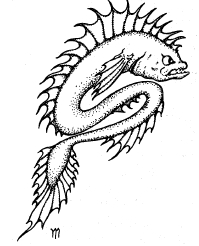
The morana is similar to a moray eel in
shape, having the temperament of an
angry piranha. Moranas are usually gray
green, but may be found in lighter or
darker colors, usually blending with the
aquatic environment. The morana regenerates
at the rate of 1 hp/turn if wounded
The morana's movement is a quick,
constant, side-to-side pattern. Missile fire
automatically misses the creature at first,
and a -4 penalty applies to all such ?to
hit? rolls thereafter. The morana has AC 3
while in motion. Though the damage from
a bite is but 2-5 hp, the morana inflicts
additional damage by locking its jaws; the
victim of such a bite takes double damage
each round following. While locked onto a
victim, the creature has AC 6. The morana
releases its hold and flees if it is reduced
to a third of its hit points or less.
Moranas are aggressive and are avoided
even by sharks. They lair in
coral niches
or caves, much like moray eels, and are
often mistaken for morays while resting. If
encountered in its lair, a morana may
shoot out to 40? in a single thrust, thus
gaining a +2 bonus on its ?to hit? roll and
surprising on a 1-5.
PORCUPINE FISH, GIANT
by Gregg Chamberlain
FREQUENCY: Rare
NO. APPEARING: 1-2
ARMOR CLASS: 6
MOVE: //25"
HIT DICE: 1
% IN LAIR: 25%
TREASURE TYPE: Nil
NO. OF ATTACKS: 1 bite
DAMAGE/ATTACK: 1-3
SPECIAL ATTACKS: Killing poison
SPECIAL DEFENSES: Nil
MAGIC RESISTANCE: Standard
INTELLIGENCE: Non-
ALIGNMENT: Neutral
SIZE: S (2-3?long)
PSIONIC ABILITY: Nil
Attack/Defense Modes: Nil
LEVEL/X.P. VALUE: II/45 + 1/hp
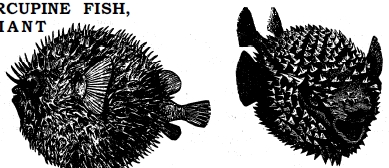
The giant porcupine fish is related to the
puffer fish and the smaller porcupine fish.
The giant porcupine fish is territorial and
is most often found near rocky shelters
and coral reefs. If endangered, this creature
flees to its abode at the earliest
opportunity.
The giant porcupine fish can bite for 1-3
hp damage; when attacked or threatened,
it inflates its body, swelling to a size three
times its normal girth. This action is performed
by retaining water in the creature
?s stomach and using flexible
abdominal sacs. By inflating itself, the fish
causes numerous dagger-length spines to
appear across its body. If an attacker
comes within 5? of these spines, the giant
porcupine fish may approach and attempt
to score a successful hit; if this happens,
the attacker takes 3-12 hp damage from
the spines and must also make a save vs.
poison; failure results in death
within 1-4
rounds. In any event, damage is taken,
even if the attacker saves vs. poison.
RAY, ELECTRIC
by Gregg Chamberlain
FREQUENCY: Rare
NO. APPEARING: 1-3
ARMOR CLASS: 7
MOVE: //9"
HIT DICE: 2 + 4
% IN LAIR: Nil
TREASURE TYPE: Nil
NO. OF ATTACKS: Nil
DAMAGE/ATTACK: Nil
SPECIAL ATTACKS: Electric shock,
surprise on 1-5
SPECIAL DEFENSES: Camouflage (treat as
invisible if buried)
MAGIC RESISTANCE: Standard
INTELLIGENCE: Non-
ALIGNMENT: Neutral
SIZE: M (6' long)
PSIONIC ABILITY: Nil
Attack/Defense Modes: Nil
LEVEL/X.P. VALUE: III/120 + 3/hp
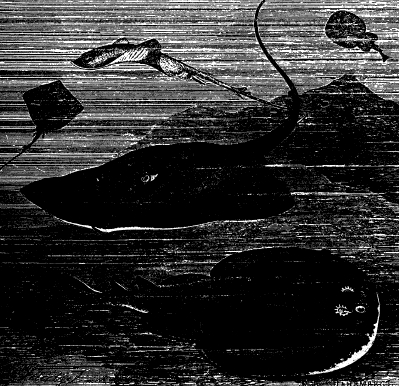
Also known as the crampfish and as the
torpedo ray on some planes of the multiverse,
this member of the family of skates
and rays is generally found at depths of
200' in warmer ocean waters, though the
creature has been encountered at wading
distance from shore. The SLOW swimming
speed for a marine animal of its size is due
to the muscles at the base of the pectoral
fins -- fins which have evolved to form
organic plates with a negatively charged
underside and a positively charged upperside.
The ray generally makes use of protective
camouflage and burrows into the
sediment on the ocean floor to avoid its
enemies, becoming effectively invisible.
The ray uses its electrical shock to stun
or kill the smaller fish upon which it feeds.
However, when threatened by larger
predators, the ray releases all its stored
electrical energy in one massive jolt (approximately
200 volts) which stuns any
creature within a 15' radius. Failure to
make a SAVE vs. paralyzation results in a
stun which lasts from 2-8 rounds. Regardless
of saves, the following damage
is taken on a shock: those creatures
within 5' of the electric ray take 2-12 HP
damage, those within 10' take 1-6 points,
and those within 15' take 1-3 points. Any
creature outside the 15' radius feels a
slight tingle, but is otherwise unaffected.
The ray itself needs 5-20 rounds to recharge
itself, and flees until it can do so.
An electric ray can USE its shock 5 times
a day.
SAWFISH/SAWSHARK
by Gregg Chamberlain
FREQUENCY: Uncommon
NO. APPEARING: 2-8
ARMOR CLASS: 6
MOVE: //20?
HIT DICE: 3
% IN LAIR: Nil
TREASURE TYPE: Nil
NO. OF ATTACKS: 1 slash
DAMAGE/ATTACK: 2-8
SPECIAL ATTACKS: Nil
SPECIAL DEFENSES: Nil
MAGIC RESISTANCE: Standard
INTELLIGENCE: Non-
ALIGNMENT: Neutral
SIZE: L (10- 12' long)
PSIONIC ABILITY: Nil
Attack/Defense Modes: Nil
LEVEL/X.P. VALUE: II/35+ 3/hp
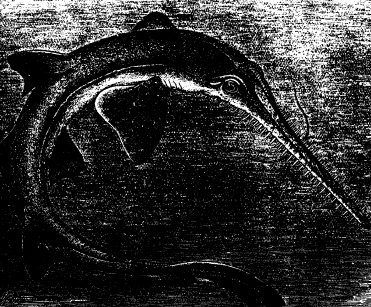
There is little to distinguish the sawfish
from the sawshark except for the position
of the gill slits on each fish. On the sawshark,
the gill slits are on the sides of the
neck; on the sawfish, the gills are on the
underside of the body.
The sawfish belongs to the family of
rays, and is similar in some ways to the
manta and stingray. The sawshark,
however,
is a true shark. Both the sawfish and
sawshark are characterized by a long, flat
snout with a row of teeth on each side.
Both fish use a side-to-side slashing motion
to attack their prey and to defend themselves.
This sawlike snout makes up
roughly half the total body length of each
fish. On some individual fish, the snout
itself may be 6? long.
SEA ANEMONE, GIANT
by Nick Kopsinis
FREQUENCY: Rare
NO. APPEARING: 1 or 50-200
ARMOR CLASS: 10
MOVE: //1"
HIT DICE: 7
% IN LAIR: 98%
TREASURE TYPE: Incidental
NO. OF ATTACKS: 1-3 tentacles
DAMAGE/ATTACK: 1-3
SPECIAL ATTACKS: Paralytic poison,
entrapment, swallow prey whole,
continuous damage
SPECIAL DEFENSES: Nil
MAGIC RESISTANCE: Standard
INTELLIGENCE: Non-
ALIGNMENT: Neutral
SIZE: L (see below)
PSIONIC ABILITY: Nil
Attack/Defense Modes: Nil
LEVEL/X.P. VALUE: VI/875 + 8/hp
The giant sea anemone is essentially a
larger and far more dangerous version of
its smaller relative. The larger of the two
creatures lives in a variety of ocean
depths; At depths greater than 50', however,
the giant sea anemone is encountered
singly. In tidal pools and secluded
shorelines, smaller varieties live in
colonies numbering from 50-200.
The giant sea anemone has a maximum
tentacle reach of 30?. The body of this
creature is roughly 8? in diameter; its
mouth is nearly 6? across and is centered
between the creature?s tentacles. Most
creatures of this species have 100 tentacles,
with a rare few having more or less
than this amount.
A successful hit with a tentacle causes
thousands of small, hooklike needles to
spring forth from the appendage. The
needles as a whole (not each individually)
cause 1-3 hp damage on the initial strike.
In this manner, the giant sea anemone
attempts to restrain its victim, trapping it
within the grasp of several tentacles. On
the round following a successful tentacle
hit, the sea anemone begins secreting its
poison into the victim's body. The poison
secreted causes a loss of 1 point/round
from the character's STR and
DEX
scores; similarly, the victim's movement
base is slowed by 1" / round. A character
reduced to 0 in either strength, dexterity,
or movement suffers the effects of paralyzation
and is unable to move without
outside assistance. A save vs. poison negates
the effect of this secretion, as does a
neutralize poison spell or power.
At the beginning of each round, a
trapped victim may attempt to break free
of the giant sea anemone?s grasp. To do so,
the character must roll successfully on his
open doors ability. If the character is held
by more than one tentacle, a successive
number of rolls equal to the number of
tentacles holding the character must be
made. Failure to make any of these rolls
means that the character has not broken
the grasp and is still within the giant sea
anemone?s grasp. The sea anemone can
grasp a character with no more than three
tentacles at a time. Once the giant sea
anemone has wrapped three tentacles
around the character (an action requiring
three successful ?to hit? rolls), the creature
attempts to swallow the victim whole. A
successful ?to hit? roll by the creature at
this point results in the victim being swallowed.
A swallowed victim is ground up
by internal organs which do as many
points damage per round as the victim?s
armor class (so AC 0 victims take no
damage).
The giant sea anemone cannot be killed
by cutting off its tentacles; the central
body itself (where the hit points are) must
be attacked. A severed tentacle grows
back at a rate of l?/day. The base of this
creature cannot regenerate if destroyed
(i.e., taken to 0 hp or less). Although the
giant sea anemone has the ability to move,
most rarely do so, prefering instead to
remain in one spot for the duration of
their lives. The tidal anemone fastens itself
to a rock, while its deep-water cousin sits
freely on the ocean bottom or on a rocky
ledge. Any treasure left around the giant
sea anemone?s lair is simply incidental; it is
the remaining accoutrements of previous
victims.
FREQUENCY: Very rare
NO. APPEARING: 1
ARMOR CLASS: 4
MOVE: //21?
HIT DICE: 22-28
% IN LAIR: 20%
TREASURE TYPE: A, U, Z
NO. OF ATTACKS: 1 punch or 1 flipper
slap
DAMAGE/ATTACK: 10-60 or 10-40
SPECIAL ATTACKS: Crushing hug, spells
SPECIAL DEFENSES: Spells
MAGIC RESISTANCE: 50%
INTELLIGENCE: High and up
ALIGNMENT: Neutral (25% evil)
SIZE: L (40?+ 2?/HD beyond 22)
PSIONIC ABILITY: Nil
Attack/Defense Modes: Nil
LEVEL/X.P. VALUE: X/16,600 + 35/hp
These monstrous beings inhabit the
deepest, darkest depths of the ocean,
although they sometimes swim to lesser
depths to hunt for whales or passing
ships. Occasionally, a hungry sea titan
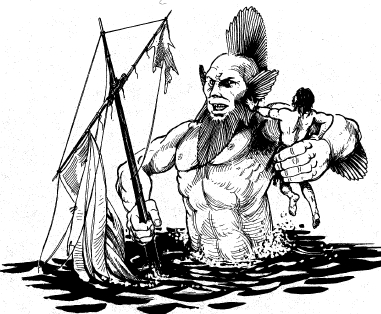
ventures into coastal waters. In appearance,
sea titans resemble tritons ? the
main difference being their size. The
lower body of a sea titan resembles a
scaled pair of fish tails in place of legs
(with the fins upright, not flat like a
whale's), with the upper body of a man.
The sea titan has a ridge of small fins
along its spine which extend down the
creature?s back and legs, diminishing before
the flippers. The sea titan?s fingers
are webbed, and they have blue to bluegreen
hair, silvery upper body skin, and
blue-silver scales.
Sea titans have the ability to summon
and control creatures of the sea through
charm monsters spell use (by
touch, usable
five times per day). Sea titans have the
additional ability to use as many first- to
third-level spells as a 6th-level magic-user
(but at the 12th level of ability).
Sea titans feed on larger sea creatures
and occasionally on passing sailors. For the
most part, however, sea titans do not
approach or harass seafarers unless harassed
themselves, unless they are evil. An
attack on a sea-going ship is performed in
one of several ways. The sea titan might
batter the ship with its massive arms,
capsize the ship by coming up from be-
neath it, or slap it with a flipper. If the
ship is small enough, the sea titan may try
to crush it by embracing it in its sinewy
arms. A punch from a sea titan delivers 4
points of structural (hull) damage per hit;
a flipper slap delivers 2 points. A crush
delivers 8 points of structural damage. Sea
titans have titan strength (a rating of 25).
Though they have little use for magical
items, sea titans do have an interest in
treasure and often have a sizable stockpile
of gold and silver as a result. Sea titans
speak their own language, as well as triton
and 2-8 other oceanic tongues.
FREQUENCY: Very rare (uncommon on
Elemental Plane
of Water)
NO. APPEARING: 2-20
ARMOR CLASS: 6
MOVE: //12?
HIT DICE: 2
% IN LAIR: 80%
TREASURE TYPE: P, R, any two magic
items (20%)
NO. OF ATTACKS: See below
DAMAGE/ATTACK: See below
SPECIAL ATTACKS: Rapid drowning,
paralysis
SPECIAL DEFENSES: Invisible in water,
plane shift
MAGIC RESISTANCE: Standard
INTELLIGENCE: Low
ALIGNMENT: Neutral evil
SIZE: S(3? long)
PSIONIC ABILITY: Nil
Attack/Defense Modes: Nil
LEVEL/X.P. VALUE: IV/163 + 2/hp
These creatures come from the Elemental
Plane of Water. Like water weirds, they
enjoy drowning their victims; it is also
believed that they survive by draining the
lifeforce of their victims. In appearance,
undines are similar to miniature merwomen;
they have a single, scaled, lateral tail
(much like that of a dolphin) which is
connected to a humanoid upper body.
Their lairs are simply areas of water
which they use as a base for traveling
between planes, This area is found along a
well-traveled route, populated seacoast, or
any other area which offers a great number
of potential victims. As a result, many
bodies often litter the floor of the lake,
river, or ocean that they inhabit.
Undines have the ability to charm monsters
as per the spell, usable once per day.
By doing so, undines can command larger
sea creatures (whales, giant squids, or
octopi) to do their bidding. Undines use
these larger creatures to destroy ships or
whisk sailors from decks. Once in the
water, these sailors are then attacked by
the undines, who attempt to slay them.
During this time, the other creatures do
not attack as the undine must kill the
victim themselves in order to consume
their lifeforce. An (invisible) undine grasps
a person on a successful to-hit roll, which
causes the victim to save vs. paralysis or
become completely paralyzed. The victim
drowns in 1-2 rounds, even if able to take
a deep breath before going under. Undines
are not strong, so a mobile character can
easily escape from one?s clutches.
Undines are naturally invisible in water,
even if attacking. If an undine is losing a
battle, the creature flees for its lair. Characters
attempting to locate an undine must
use magical means (spells or devices) to do
so. In extreme cases, as when the undine?s
death is the probable outcome of combat,
this creature may use its ability to transport
itself back to the Elemental Plane of
Water if no other means of escape is available.
This plane shift ability works once
per year, so they are reluctant to use it.
FREQUENCY: Rare
NO. APPEARING: 1
ARMOR CLASS: 5
MOVE: //6?
HIT DICE: 8 (brain only)
% IN LAIR: Nil
TREASURE TYPE: Incidental
NO. OF ATTACKS: 1 arm strike
DAMAGE/ATTACK: 2-16
SPECIAL ATTACKS: Buffeting
SPECIAL DEFENSES: Hidden vulnerable
part, weapons resistances
MAGIC RESISTANCE: Standard
INTELLIGENCE: Semi-
ALIGNMENT: Neutral
SIZE: L (12? tall)
PSIONIC ABILITY: Nil
Attack/Defense Modes: Nil
LEVEL/X.P. VALUE: VI/725 + 10/hp
This creature is not a true giant, but is
actually a composition of several hundred
strands of semi-intelligent seaweed. The
weed giant is not rooted and, although it
gains food in the manner that regular
seaweed does (i.e., through nutrients in
the water), it also feeds by entrapping
creatures or other plants in its strands and
decomposing them with its digestive secretions.
The weed giant then absorbs its
victim(s) through its strands. In this manner,
the weed giant is similar to an aquatic
variation of a shambling mound.
Though composed of vegetable matter,
the weed giant is an intelligent lifeform; it
thinks and acts with the same instincts
and drives that many animals do. The
brain of this creature is at the center of its
weed structure; it is from this point that
the strands emanate. In order to kill a
weed giant, a successful attack must be
made against the creature?s brain rather
than against its kelp strands. Attacks made
against the creature?s brain are against AC
3; all other attacks are against AC 9, but
do not effective hit-point damage to the
monster, merely cutting away strands of
weed which grow back in full in 1-4
weeks. The brain can be attacked at random
10% of the time (roll this chance
before rolling to hit the necessary armor
class); because the brain is mobile, it is
virtually impossible to attack directly (in a
nonrandom fashion).
In combat, the weed giant does 2-16 hp
damage on a strike with its weedy appendages
(?arms? or ?legs?); if the creature
misses, the displacement of water forces
the victim away from the weed giant (a
distance equal to 4-24?) unless a save is
made vs. paralysis. This water buffeting
can also be employed by the weed giant to
deflect any missile fire from any engine
smaller than a ballista. However, unless
the missiles strike the brain, they cause no
damage to the weed giant at all. All edged
weapons (except magical) cause only half
damage against this creature; blunt
weapons cause no damage at all.
<revise anchors, so the monsters' name is in full>