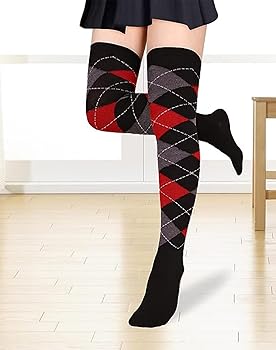
and chartruse Argyle stockings

| Advanced Dungeons & Dragons | - | Dragon | - | Dragon #26 |
| - | - | - | - | - |
Tarot cards have been
used as a means of divining the future for at
least 6 centuries
in Europe, and some form of Tarot probably existed in
India and the Middle
East during even earlier periods. The exact origin
of the ancient cards
cannot be explained. When selected and displayed
in a preordained
arrangement, or "spread", each card represents or
symbolizes an event,
idea, or personal characteristic. Historically, the
use of Tarot has
been confined to personality interpretation and fortune
telling. However,
I have recently incorporated a magickal set of Tarot
cards into my dungeon,
drawing on my own experience at reading
Tarot and then adapting
Tarot symbolism for D & D purposes. I have
found it an interesting
and enlivening item, a quasi-occult variant on the
Deck
of Many Things <(see
DMG)> but with many extra possibilities
for adding intrigue,
confusion, and a little healthy bloodshed to your
dungeon expeditions.
Like the Deck of Many
Things, the Tarot Deck of Unalterable Fate is
a rare, extremely
powerful magickal artifact. Only 1 exists in the known
Universe. It
belongs to no individual, but tends to appear when least
expected and is usually
well-guarded and/or booby-trapped. When its
true nature is revealed,
each dungeon adventurer may assume the
position of Questioner
and invoke upon the power of the Tarot cards by
saying aloud the
Name of his patron deity and drawing a card from the
deck (a list of cards
and explanatory notes are given below). The stated
effect of the card
drawn occurs immediately, with no save
allowed. Only
1 card per character may be chosen--taking a 2nd
card will inevitably
arouse the wrath of the invoked deity (or, worse still,
the D.M.), and usually
brings about such undesirable consequences as
permanent imprisonment
within the Tarot deck, the reversal of a previously-
drawn "good" card,
immediate teleporation to Muleshoe,
Texas, etc.
The Deck of Unalterable fate is not to be abused.
The following are
the 21 numbered and 1 unnumbered cards in
the Greater Arcana
of the basic Tarot deck, the cards most commonly
utilized in reading
Tarot. They are given in their ancient mystical sequence,
and should be chosen
randomly by the Questioner's roll at the
time when he selects
his card. (I recommend rolling the percentile dice
until a number from
1-21 turns up, with 00 equalling LaMat -- The Fool.)
| Card Number | The Greater Arcana |
| ----(00) | Le Mat (The Fool) |
| I | Le Bateleur (The Magician) |
| II | Junon (The Goddess) |
| III | L'Imperatrice (The Empress) |
| IV | L'Empereur (The Emperor) |
| V | Jupiter (The God, or Pope) |
| VI | L'Amoureux (The Lovers) |
| VII | Le Chariot (The Chariot) |
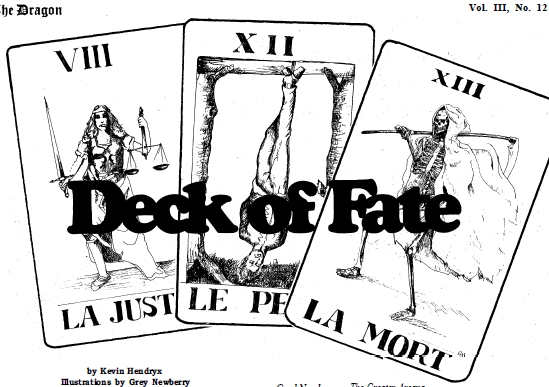
| VIII | La Justice (Justice) |
| IX | L'Ermite (The Hermit) |
| X | Le Roue de Fortune (The Wheel of Fortune) |
| XI | La Force (Strength) |
| XII | Le Pendu (The Hanged Man) |
| XIII | La Mort (Death) |
| XIV | Temperance (Temperance) |
| XV | Le Diable (The Devil) |
| XVI | La Maison de Dieu (The House of God, or The Lightning-Struck Tower) |
| XVII | L'Etoie (The Star) |
| XVIII | La Lune (The Moon) |
| XIX | Le Soleil (The Sun) |
| XX | Le Jugement (Judgment) |
| XXI | Le Monde (The World) |
Le Mat-The Fool: Signifies folly, frivolity.
Any character drawing
The Fool gains a silly, worthless item from the table below (or create
your own "zonks").
| Roll | - |
| 1 | A giant wabbit costume |
| 2 | A plate of hot potato salad |
| 3 | A "Learn-to-Speak-Magyar" record |
| 4 | A leopardskin loincloth |
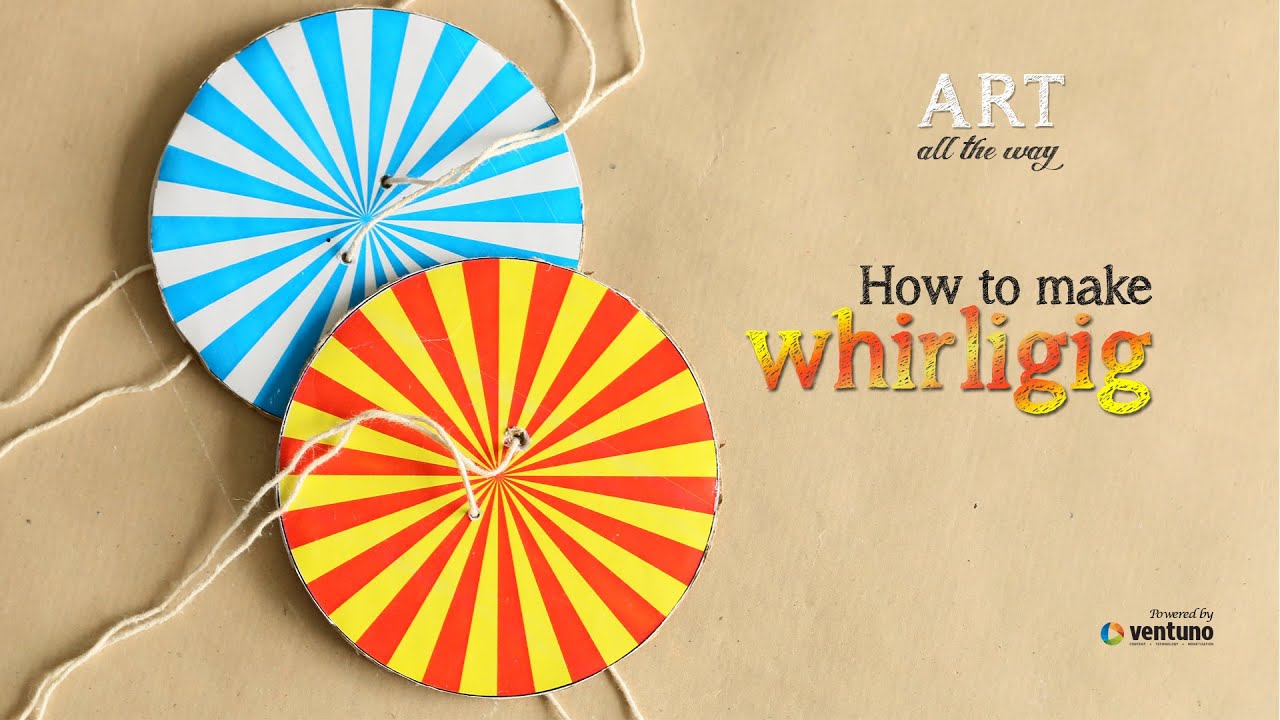
| 5 | A plastic whirligig
|
| 6 | A rubber duck |
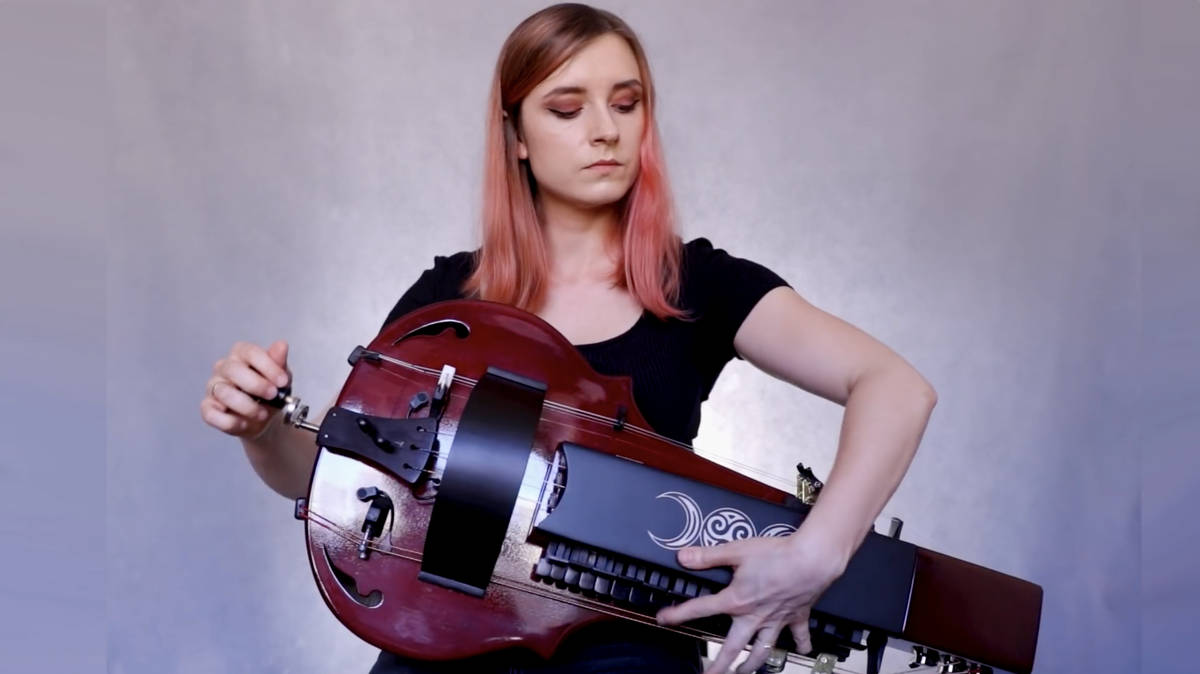
| 7 | A hurdy-gurdy
|
| 8 | A pacifier |
| 9 | One pair of long, glow in the dark, violet
and chartruse Argyle stockings
|
| 10 | A bottle of Scope
|
Note to D.M.‘s—Some ingenious players will actually find various bizarre
uses for a few of these things. Do not discourag their creativity—
the results are often highly entertaining.
I Le Bateleur - The Magician: Symbolizes mysticism,
imagination,
craft. This card is specifically directed at Magic-Users. A non-Magic-User
drawing it merely gains a miscellaneous magic item from the Greyhawk
<UA tables>
tables. A Magic-User not only gains a miscellaneous magic item, but
also
gains the permanent use of 1 spell
of the next highest level, i.e., a 2nd
level Magic-User gains the use of a spell usable by a 3rd Level Magic-
User. The D.M. should select the spell by a die roll rather than let
the
player choose.
II Junon - The Goddess: Represents wisdom,
sagacity. This card
has no effect on any player except Clerics. A Cleric taking this card
has
his wisdom boosted to 18 and gains permanent use of one spell of the
next higher level.
III L’Imperatrice - The Empress: Symbolizes feminine
progress,
attainment. Has no effect unless drawn by a female character. A woman
gains a sum of money from the following table:
| Roll | Treasure |
| 1-4 | 400 G.P. |
| 5-7 | 600 G.P. |
| 8-9 | 800 G.P. |
| 10 | 1,000 G.P. |
IV L’Empereur - The Emperor: Represents wealth,
worldly power.
The masculine equivalent of The Empress, this card affectrs only
male characters. A man gains treasure on the same table as for a woman
under The Empress, above.
V Jupiter- The God, or Pope: Symbolizes mercy,
humility, spiritualism.
Like its companion card, Junon, Jupiter only affects Clerics. It
also raises a cleric’s wisdom to
18, but grants 2 permanent spells of
the next highest level.
VI L’Amoureux - The Lovers: Signifies romance,
yearning. The
character drawing this card will fall uncontrollably in love with the
first
character (player or non-player) of the opposite sex he/she encounters.
VII Le Chariot - The Chariot: Represents ordeal,
turmoil, CONQUEST(uh),
WAR(jp). The player gains one magic sword, misc. weapon, or piece
of armor from the Greyhawk lists. <UA
lists>
VIII La Justice - Justice: Signifies justice,
trial, honor, fairness.
This card brings about an immediate “Trial-by-Combat”, in that a
character of the same level, armament, and hit points but of opposite
alignment will appear and engage the player in a fight to the death.
If he
kills the player, or is killed himself, he will instantly vanish. All
other
players in the room are frozen in suspended time and may not move,
speak, or interfere; no wandering beasties will enter the room during
the
battle. Note: a player of neutral alignment will be matched against
a
neutral opponent, but the combat will be resolved in the same way as
for
a Good vs. an Evil. Magic-Users, Clerics, Druids, etc. will face opponents
commanding the exact same spells, though they may not necessarily
employ them
IX L’Ermite - The Hermit: Represents withdrawal,
SOLITUDE(bs), desertion.
Drawing this card instantly transports the hapless player—and
he alone—to another room of the dungeon, to be randomly chosen. As
this is often tantamount to a death sentence in its own right (though
not
always), D.M.‘s should be mercyful and at least keep the poor beggar
on
the same dungeon level.
X La Roue de Fortune - The Wheel of Fortune:
Signifies advancement
(for better or possibly worse), luck, fate, destiny. Because
this is such an all-encompassing card I recommend a roll on the table
below to determine the area of concern:
| Roll | Receive |
| 01-20 | Magic Sword |
| 21-40 | Misc. Magic Weapon |
| 41-60 | Magic Armor |
| 61-70 | Magic Potion |
| 71-80 | Magic Ring |
| 81-90 | Magic Wand, Stave, or Rod |
| 91-00 | Misc. Magic item |
Roll again for the actual result on the appropriate table in Greyhawk. <appropriate tables in UA>
XI La Force - Strength: Symbolizes fortitude,
energy, physical
strength, fervor. This card is specially tailored for the fighter character.
All characters drawing La Force add one to their strength and have
any
lost hit points restored. But a fighter has his strength
raised to 18, and
may then roll for additional benefits and pluses-to-hit on the tables
found in Greyhawk or Advanced Dungeons & Dragons.
XII Le Pendu - The Hanged Man: Suggests life
in suspension,
readjustment, transition, sacrifice.
Player drops one level of experience,
losing all affected spells, hit points, modifiers, etc. Naturally,
a 1st level
character will, (ahem) die. <actually, a 1st level character becomes
0
level>
XIII La Mort - Death: Symbolizes loss, ruin,
disaster, death. Instant
death. (Sorry, Charlie, It’s a 1-22 chance you take)
XIV Temperance - Temperance: Suggests harmony,
compatability.
This card raises the player’s CHA
3 points.
XV Le Diable - The Devil:
Represents violence, astral influence,
bondage, black magic. Drawing this card summons a Bone
Devil (See
Advanced D&D Monster Manual) from the 5th plane of Hell
who will
attack the party and attempt to kill the characters or take them enslaved
in Hell.
XVI La Maison de Dieu - The House of God, or The
Lightning-
Struck Tower: Suggests major catastrophe, misery, bankrupcy.
The
player unfortunate to draw this card loses all his material wealth
(money,
gems, valuable or magic weapons, armor, potions, artifacts, etc.) except
for a simple tunic, basic dungeon supplies, one non-magic weapon, and
13 G.P.
XVII L’Etoile - The Star:
Symbolizes good omen, Hope, good
luck. The drawer permanently gains a +3 modifier
on all saving throws.
XVIII La Lune - The Moon:
Implies deception, false pretense,
trickery, dishonesty. The player’s alignment
changes to Chaotic Evil. If
already Chaotic Evil, the player goes insane.
(See The Dragon #18,
Sept. 1978 for insanity
chart and rules by Kevin Thompson.) <dmg: insanity>
<d138: insanity>
XIX Le Soleil - The Sun:
Symbolizes success, triumph, achievement.
The drawer gains 100 to 600 G.P. (roll one 6-sided
die) and is
automatically raised 1 level, with all benefits
and modifiers taking
immediate effect
XX Le Jugement - Judgment: Suggests rebirth,
rejuvenation, readjustment.
All lost HP are restored at once to the drawer of this
card.
XXI Le Monde - The World: Represents attainment,
ultimate culmination,
triumph in all undertakings. The player gains two miscellaneous
magic items from the Greyhawk tables and gains 100 to 800 G.P. <ua
tables, 3e>
(roll one 8-side die).
The Tarot card system is, of course, wide-open to expansion and
improvement within a Dungeons &
Dragons context. Readers familiar
with Tarot may wish to enlarge the scope by devising rules governing
the Lesser Arcana, with its 56 cards and four suits (Epees, Batons,
Coupes, and Pentacles), the forerunner of today’s card deck.