| Advanced Dungeons & Dragons | - | Dragon | - | Dragon 149 |
| Charged items | Silver-iron weapons | Dedicated weapons and armor | Items of Illusion | Vial bombs |
| - | - | Use in the campaign | - | - |
Magical items should be handed out
sparingly, but problems still arise, especially
with fighters. The majority of permanent
(i.e., chargeless) magical items are
weapons and armors. There is a limit to
how many weapons, even magical ones, a
fighter can carry, and he can only wear
one suit of armor at a time. Unlike the
various wands, miscellaneous magical
items, and rings, the items used by fighters
do not get used up; they stay in the
game. Thus, the fighter is stuck with the
same old weapons and armor (?Why
should I let your fighter get a broad sword
+3? He still has a perfectly good short
sword +2.”). Letting fighters use more
wands is no solution; it merely blurs the
differences and unique qualities between
the classes, making each less fun to play.
At the same time, the lowest levels are
the most dangerous. Monsters that 1stlevel
PCs face are the weakest available,
but the PCs are also at their weakest,
particularly in regard to hit points. One
blow from a weapon doing maximum
possible damage can kill most 1st-level
characters, and can often kill even a 2nd-,
3rd-, or 4th-level character. At a crucial
point during a battle, a PC may need a
bit
more protection than he would in most
mundane encounters with wandering
monsters.
Hitting power also poses problems. Even
on the first level of a dungeon, PCs may
meet unnatural opponents. Consider the
manes demon from the Monster Manual.
One to four of these demons may beencountered
on the first level of a dungeon.
At least a + 1 weapon is required to hit
a
manes, unless a PC is wielding a weapon
of cold iron. A single manes doing up to
8
hp damage per round could wipe out a
cornered party that far outnumbers it in
combatants and in hit points, especially
if
the party is armed with nothing but ordinary
weapons. But giving + 1 weapons to
1st-level PCs just to deal with the occasional
manes is going a bit far.
What is required is a series of magical
devices made for novice PCs?devices that
can be found in the treasure hoards of
even the weakest monsters. In really
tough campaigns, some PCs can be allowed
a + 1 weapon or a potion of healing
as family bequests. One of the following
items would do just as well, tiding the
PC
over until he can acquire a more conventional
magical device without giving him a
continual benefit in combat.
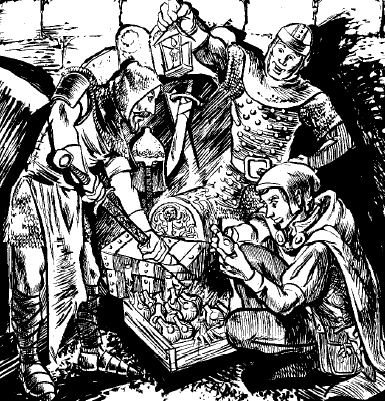
Charged
items
Unlike wands, these devices are conventional
weapons, armor, and protective
devices. Ordinarily, they are mundane and
offer no special bonuses. When the command
words are spoken, however, they
become + 1 for purposes of attack or
defense (nothing greater than + 1 should
be used). Each weapon, suit of armor, or
item has 2-8 charges, each charge lasting
a
full turn. Expending a charge gives the
PC
a temporary magical benefit.
Naturally, there must be some limitations.
Once all the charges are used, the
device becomes an ordinary weapon or
suit of armor of the finest quality. These
devices may not be recharged; rechargeable
items are little different from items
with a permanent dweomer, and these
magical items should be distinctive.
Another important fact about the
charges is that a charge cannot be divided
among turns. If a charge is expended at
the beginning of a turn when a fight
breaks out and the PC manages to eliminate
his 1st-level opponent in the first
combat round, the weapon stays + 1 for
the next nine rounds, even though the PC
doesn?t need it. In this way, players are
encouraged to save the magic for the truly
critical fights and not expend charges
on
every giant rat or ant their PCs see in
the
corridor.
This should also make players less likely
to pick a fight with a dangerous foe than
they would if their PCs had permanently
magical weapons. Magical weapons can
miss; the fight might take longer than
expected; and if a PC runs out of charges
in the middle of a crucial battle, he may
come to regret his challenge. The same
goes for protection; the point at which
a
PC is surrounded by club-wielding kobolds
is not the point at which he wants to be
reduced to his old armor class. This is
especially true of protective items used
by
a magic-user.
FINALLY, these temporarily magical devices
have no special abilities other than
the temporary boosting of protection and
combat capabilities to + 1. The DM may
rule that normal magical swords, even
swords + 1, can shed light. However, DMs
who do not want to let 1st-level PCs have
an eternal torch with an edge should
announce that these temporarily magical
weapons do not shed light. As an alternative,
they could glow but not shed light,
being useful merely for letting opponents
know the owner?s location in the dark.
This will cause prudent characters to keep
their weapons sheathed; it also preserves
game balance. A thief planning to backstab
someone in the dark runs the risk of giving
himself away, either by the weapon?s
glow or by the sound he makes pulling it
out of the scabbard. A DM may also rule
that the weapon glows in the dark only
when a charge is being used.
Miscellaneous magical protective devices
and rings are worth 100 xp, and are worth
roughly the same number of gold pieces
if
sold while still magical. When the charges
run out, they are worth only what similar
ordinary items are worth. No protective
ring of this sort will ever have a stone
worth more than 10 gp. Weapons, shields,
and suits of armor are worth 100 xp, and
while magical are worth five times the
gold-piece value that their mundane equivalents
are worth. Thus, since a regular
dagger costs 2 gp, a charged dagger would
be worth 10 gp. If players are careful,
the
charged items should be used up just
about the time the PCs get their first
+ 1
devices (around 2nd level).
Since magical arrows and sling bullets
are generally designed to be used only
once, there are no charged versions of
these weapons. The only charged missile
weapons are the reusable ones: the aklys,
harpoon, javelin, and spear, as well as
throwable hand weapons such as the
dagger and hammer. Weapons such as the
mancatcher, sap, and garrote (having
special effects) cannot be charged.
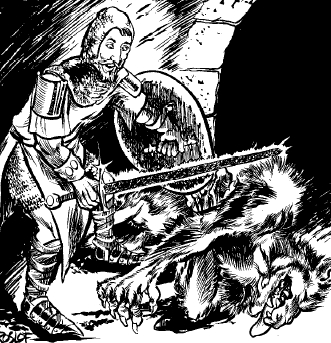
Silver-iron
weapons
As noted in the various lists of creatures,
some supernatural monsters can be struck
by nonmagical weapons. Some of these
creatures may be struck only if the weapons
are silvered; others may be struck
only by weapons of cold iron. There are
no creatures that are vulnerable only to
either type of weapon. This leads us to
a
more enduring type of magical weapon.
Silver-iron weapons are created by the
magical bonding of silver and cold iron.
The finished products have a mottled
black and silver appearance. These weapons
do not have a magical bonus (not even
+ 1), but they can hit unnatural monsters
such as demons, devils, lycanthropes,
gargoyles, and some undead. Note that
since the weapons are magically bonded
silver and cold iron, they count as magical
weapons (though without ?pluses?) as well
Although unnatural creatures can be hit
with weapons of this nature, the weapons
themselves bestow no bonuses to hit or
on
damage unless the creature has such an
aversion to cold iron or silver that the
mere touch causes extra damage. Since
these weapons have no pluses, they do not
grow weaker when carried to another
plane any more than a wand or the average
miscellaneous magical item would
become weaker. A silver-iron weapon is
still weaker than a regular magical
weapon, but it retains its effectiveness.
Therefore, although these weapons are
not in the forefront of action once conventional
magical weapons are found, they
are still useful backups, especially on
extraplanar adventures.
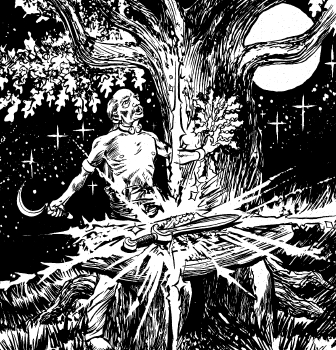
Silver-iron weapons cost (in both experience
points and gold pieces) exactly half of
what a + 1 weapon of the same type
would cost. Thus, a silver-iron sword
would be worth 200 xp and 1,000 gp. If
the weapon is hit by a rod of cancellation
or the beam from a wand of negation, the
silver, cold iron, and handle (if such
exists)
separate from each other. The silver is
worth half the weapon?s weight in gold
pieces. The silver and the iron must both
make saving throws as hard metal in the
case of most magical attacks to prevent
them from separating. As a bonus, the
magical bonding gives the cold iron a
saving throw of 20 vs. rusting attacks
like
those of a rust
monster.
Dedicated weapons
and armor
This is a special category of weaponry
and protective devices. Dedicated weapons
are a weaker version of the various magical
weapons that gain bonuses against
certain creature types. These weapons are
?dedicated? by a high-level spell-caster
(usually magic-users, but clerics and
druids may also do so) for use against
a
specific type of monster that cannot be
harmed by normal weapons (demons,
devils, etc.). The dedicated weapon normally
has no bonuses and strikes most
opponents as an ordinary weapon. However,
against the type of enemy that it is
dedicated to fight, the weapon hits and
does normal damage to that creature. A
mace dedicated to fighting golems, for
instance, strikes and does damage against
them as if it were a special weapon effective
against golems. The mace has no to-hit
or damage bonuses; golems
are simply
ordinary opponents as far as the mace is
concerned. Unlike charged weapons, this
dedicated power is permanent. Thus, oneshot
missile weapons such as arrows and
sling bullets may be dedicated.
In general, these weapons are dedicated
by a spell-caster who has a strong hatred
toward the target species or whose deity
hates a certain race. Thus, since the Egyptian
deity Seker
is a special opponent of
undead, a cleric of Seker would generally
dedicate weapons for use against one type
of undead. Note that no special benefits
are gained against lesser demons, devils,
undead, and so forth that can be harmed
by ordinary weapons. A sword dedicated
to fighting undead strikes effectively
against wights and vampires, but would
have no advantage in fighting other types
of lesser undead, such as skeletons. There
would be no benefit in dedicating a
weapon against a skeleton or zombie,
since these are already affected by normal
weapons. The process of enchantment is
a
permanent and generalized version of the
first-level shukenja spell weapon
bless in
Oriental Adventures campaign
worlds or
an independently developed version in the
more typical AD&D game world.
Dedicated weapons gain a + 1 bonus on
saving throws against special attacks
launched by their special foes (including
spells cast by demons or devils).
A second category of dedicated weapon
is dedicated to creatures that can be hit
by
nonmagical weapons, but still present
special problems for opponents. For instance,
a weapon dedicated to the slaying
of adherers would never stick to the opponent,
and one dedicated against rust monsters
would never rust. Such benefits can
be just as important in a fight as being
able to strike an otherwise-invulnerable
opponent. Again, these weapons can hit
the foe without any trouble, but do no
extra damage to that opponent.
Dedicated protective devices, whether
cloaks, rings, or armor, give protection
to
the wearer against the attack methods of
a
particular type of foe. A suit of chain
mail
dedicated against dragons, for instance,
is
+ 1 against the physical attacks of a
dragon and bestows an additional + 1 to
saving throws vs. breath weapons or spell
use of a dragon. Dedication is based on
general groups of monsters, not on individuals
or specific groups. Armor dedicated
against demons works against all
types of demons, not just against Type
I
demons, for example. Against opponents
to which they are not dedicated, these
devices are ordinary suits of armor or
(in
the case of items like cloaks) are totally
useless as a means of protection.
All dedicated devices, whether weapons
or protective devices, are worth 150 xp.
The protective rings and miscellaneous
items are worth 5,000 gp, while the weapons
and suits of armor are worth 10 times
as much as their nonmagical equivalents,
Furthermore, the dweomer of such an
item is permanent though weak.
Note also that the spiked buckler is
treated as a weapon, rather than as armor,
regarding its cost; it does, however, give
the same protection as an ordinary dedicated
buckler. Dedicating caltrops is possible
but rather impractical.
Items
of illusion
These magical items generate illusions
of
weapons and armor that may then be used
by the possessors of such items. In general,
the forms of these illusion-creating
items are:
1. A brooch that conjures an illusory suit
of armor;
2. A ring that conjures an illusory shield;
and
3. A ring or small object (such as a gem)
that conjures an illusory melee weapon.
Only the basic, mundane types of armors
and weapons can be conjured. A
brooch of illusory plate mail armor would
give its wearer AC 3 if its illusion was
successfully believed, but it could not
create an illusion of magical plate mail,
such as plate mail +5.
These devices derive their powers from
the minds of their users. The owner of
such an item thinks of the armor or
weapon type desired, and a magical field
shaped like the desired item appears
around the owner or in his hand. The
owner?s mind creates these illusions; the
minds of both owner and enemy power
them in battle. If an enemy believes a
suit
of illusory armor is real, some of his
mental
strength is siphoned off to magically
improve the owner?s armor class. Likewise,
if the foe believes an illusory weapon
is real and has struck him, some of his
own mental energy creates a wound
equivalent to what a real weapon would
have inflicted (treat illusory weapons
as
real ones for estimating damage). If the
foe
is nonintelligent or disbelieves the illusion,
no benefit is gained. As a result, these
items are weaker than regular magical
weapons and armor.
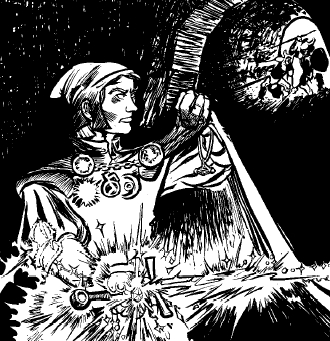
Because the power to create such items
is drawn from the user?s mind, a character
may only use such illusion-creating items
as his class, size, proficiencies, etc.
would
allow if the illusory items were real.
Thus,
a magic-user could not use the previously
named brooch of plate mail armor; but
could use a gem of illusory quarterstaves
if he had proficiency with such weapons.
Remember that the successful use of
these items requires an intelligent enemy.
Illusory armor is no protection against
a
mechanically operated blade, golem,
missile
trap, green slime, or skeleton. Furthermore,
unintelligent foes such as golems
are not harmed by illusory weapons, and
a
character can?t chop down a wooden door
with an illusory axe (nor can an intelligent
onlooker think he is doing so).
Each magical item of this sort can create
an illusion of only one type of weapon,
shield, or suit of armor. Each such item
is
worth 250 xp and 2,500 gp. Most such
items are charged, having 3-30 charges
(they cannot be recharged). Items that
are
permanent are worth twice the previous
values. Each charge is good for one hour
each day. Since the items must be touched
or worn in order to draw mental strength
from the owner, only melee weapons can
be conjured; a missile weapon would
disappear the moment it left the owner?s
hand. Since such items are useless if disbelieved
and cause no more damage or protection
than mundane weapons and armor
as a result, they are particularly suited
to
low-level characters.
Vial
bombs
These devices are found in groups of
4-16 vials. They are simply empty glass
vials of the size used in storing holy/
unholy water. They may be used against
an enemy as grenadelike missiles with
maximum range of 3?. When the appropriate
command word is spoken (usually
right before throwing), the empty vial
is
magically filled with either firewater
(as
per the Unearthed Arcana spell),
holy/
unholy water, or acid. Each missile may
be
used only once, and each automatically
breaks when striking any solid surface
after being hurled. Despite the uniform
size of each vial, damage is done as per
the
statistics given in the 1st Edition DMG,
page 64, and as per the firewater spell
(treat firewater as oil for splash effects,
etc.). Each such vial is worth 50 xp and
500 gp. Any such vial may create any of
the above liquids, provided that the
proper command word is spoken.
Use in the campaign
Although most of the weapons
and
armor
here may be altered for use in
Oriental Adventures campaigns, this
article
has been restricted to Western weaponry
and armor for two reasons. First, the
majority of AD&D game players
still play
in Western-style campaigns. Second, players
of Oriental Adventures already have
adequate 'borderline' equipment in the
form of weapons
of quality and armor
of quality. Of
course, anyone who wants Oriental equivalents
of the devices in this article can
easily extrapolate from the lists to create
their own versions.
These magical items show the most
advantage in magic-poor campaigns. In
some campaigns, they might even be the
only types of magical weapons and armor
available. Adventurers could pursue
lengthy quests in search of weapons and
armor that would last in magical form just
long enough to defeat a particularly powerful
opponent, (such as a demon or devil).
Dedicated items should be a favorite with
DMs who give players weak magical items
as bequests. To return to an earlier example,
a cleric of Seker could receive from
his temple a weapon or suit of armor
dedicated against undead. In such a case,
loss of the item could cause a loss of
prestige
far greater than the loss of an ordinary
magical item. This would be
especially true if the item was presented
to the character as part of an elaborate
ceremony upon the completion of his
initial training. If the item was a family
bequest, the character would covet it as
proof of lineage.
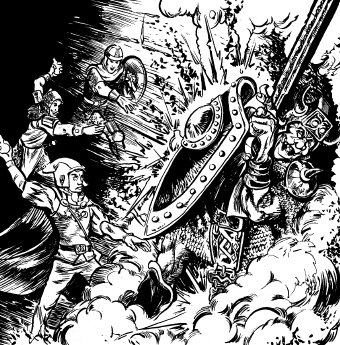
Dedicated items may be used by highlevel
characters, of course. They could
also be a real pain if not examined properly
with an identify spell. If a magical suit
of armor saves a fighter from a fireball
spell cast by a demon, said fighter might
assume that the armor protects against
all
fire-based attacks. When he confidently
steps up to that angry red dragon in his
demon-dedicated armor, he could be in for
a surprise. And if use of a magical weapon
against a dedicated foe makes him think
it
is always magical, put the character up
against an unnatural foe of a different
species and watch the fun! (If you?re kindhearted
or if the player is generally good,
you might leave an escape route open.)

Charged weapons, as stated before,
should be saved for the big fights. If
any
reason exists to suspect that an unnatural
opponent like a manes demon might be
encountered, it would be wise not to
waste a charged weapon on orcs. This
makes fights with wandering monsters
more fair, as these relatively weaker creatures
won?t receive the same magical
might that the strongest enemy in the
adventure will.
The remaining items can be used quite
well by even high-level adventurers. They
might even be handed over to trusted
henchmen after more conventional magic
weapons are located. It might be a good,
idea to hang on to those silver-iron weapons
even after ?regular? magical weapons
are found. If the PCs travel to another
plane, either deliberately or inadvertantly,
a silver-iron item might be more magical
and more useful than a regular + 1 or +
2
weapon. And if characters raise families
in
a long-lasting campaign, old weapons
would make ideal bequests for adventuring
children. Such weapons could have
their own legends and history, just as
normal magical weapons might.
It is hoped that this article will improve
play in the AD&D game and ease
the
pressure on the poor DM to come up with
magical treasures. These weak items
should enable the DM to stretch out the
supply of regular magical items by allowing
him to introduce the stronger items
much later in the campaign. Certainly,
these items increase the variety of magical
items in the game (a worthy end in itself).
And, since these items are cheaper in
terms of experience points and gold
pieces, characters gaining them will not
rise as rapidly in levels, thereby reducing
the threat to game balance. Players want
magical items for their PCs; you want to
keep PC advancement slow. Now everyone
can get what he wants.
SEPTEMBER 1989