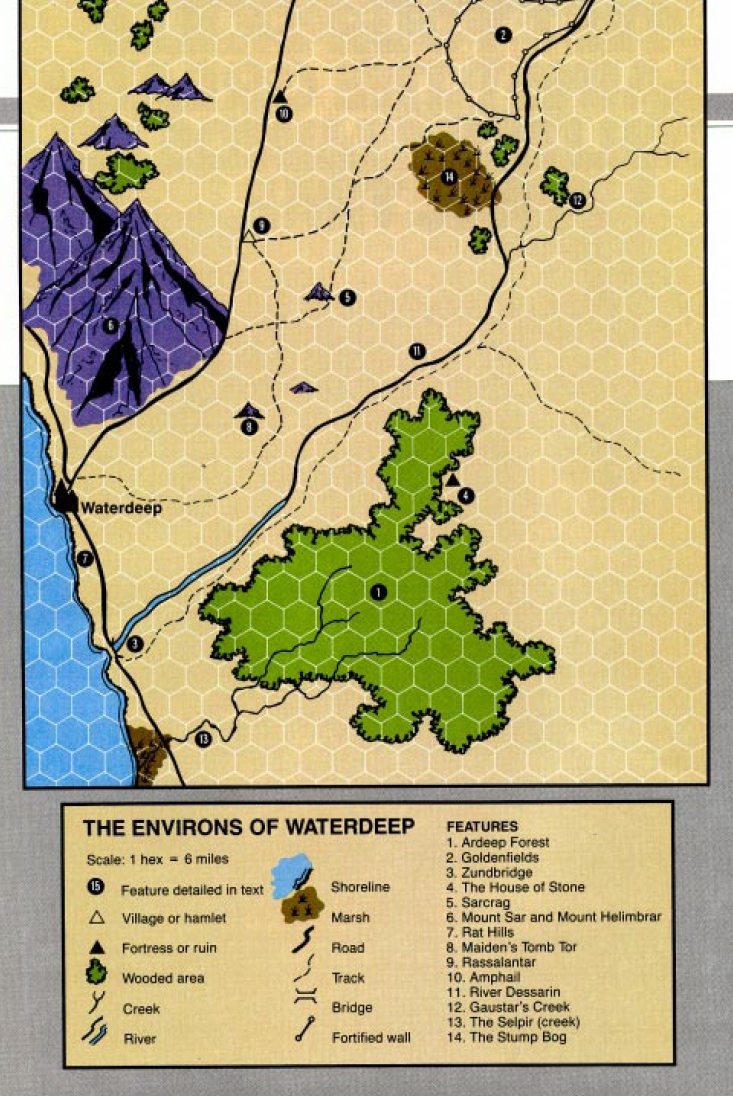
| 1.Ardeep Forest | 2. Goldenfields | 3. Zundbridge | 4. The House of Stone | 5. Sarcrag |
| 6. Mount Sar and Mount Helimbrar | 7. Rat Hills | 8. Maiden's Tomb Tor | 9. Rassalantar | 10. Amphail |
| 11. River Dessarin | 12. Gaustar's Creek | 13. The Selpir | 14. The Stump Bog | Until swords part |
| 1st Edition AD&D | - | Dragon #128 | - | Dragon magazine |
The following is an introduction to the city
of Waterdeep, often mentioned in many of
Ed Greenwood?s tales from the Forgotten
Realms published in DRAGON® Magazine.
Though this was originally written for FR1
Waterdeep and the North, the
first of the
FORGOTTEN REALMS? sourcebooks,
there was no room for it ? so we were
able to steal this piece away for publication
here. It will not be seen in the final
version of Waterdeep and the North, but it
is compatible with the material in that
work. With that, we welcome you to
Waterdeep.
Waterdeep is the gateway to the North.
It dominates the lesser cities of Silvery
moon, Mirabar, Luskan, Neverwinter, and
Sundabar (listed here in order of relative
size and influence). The North is a frontier
land of rugged mountains, seemingly
endless forests, many ruins and dungeons
(subterranean cities left behind by the
dwarves), and mineral wealth now
being
taken by humans as the dwarves retreat,
as detailed in the first chapter of Waterdeep
and the North. This article deals with
the immediate vicinity of Waterdeep, as
shown on the Environs of Waterdeep map.
Numbered map features are detailed
below. The area to the immediate east and
south of the City of Splendors is mostly
open, rolling grassland, long since logged
bare. This land is currently used by many
herdsmen for grazing camps near their
markets in Waterdeep.
1. Ardeep Forest
Until recently, this ancient forest, a
remnant of the woods that once covered
the North from the river Delimbiyr to the
mountains of the Utter North, was the
home of the Moon Elves. This ancient race
of elvenkind once lived in harmony with
men and dwarves in a kingdom that
stretched to the east of the forest, in what
is now rolling moorlands known as ?the
Fallen Kingdom.? The forest is now forlorn
and largely empty. The elves have all gone
overseas to Evermeet via many covert
voyages aboard The Morning Bird, a ship
owned by Mirt the Moneylender, a local
merchant of Waterdeep.
The elves have left the forest of tall
blueleaf, duskwood, and weirwood trees
unattended (see DRAGON issue #125,
"Woodlands of the Realms"). This region
was known as ?Faraway Forest? to the
elves because, although it was near the
western coast of Faerun, it was still ?far
away? from what the elves considered
home: the island realm of Evermeet. It is
here that exploring PCs may encounter
the NPCs Quth and Vedellen Hawkhand
(detailed in chapter 7 of Waterdeep and <link>
the North), as well as some fearsome forest
creatures that the elves once lived in
harmony with.
After deleting encounters with evil creatures,
lycanthropes, and bandits, the "cold,
civilized forest" encounter table
on page
141 in Monster Manual II may be used.
Most evil elves have left the area entirely
or have gone into the City (see Elaith <links>
Craulnobur and Zabbas Thuul in chapter
7 of Waterdeep and the North). Few were
welcomed onto the ship to Evermeet. DMs
should check for encounters only once
every two turns.
Somewhere deep in this forest is the
overgrown tomb of Reluraun, a warriorhero
of the elves, who is said to lie in his
vault clad in magical elfin chain mail, with
a sword +2, dragon slayer upon his
breast. According to legend, the tomb is
not unattended; magical creatures guard
Reluraun?s remains. ?Ardeep? was the
name of the western region of the ancient
Fallen Kingdom, and now gives this forest
its name.
2. Goldenfields
Begun only a handful of years ago by the
cleric Tolgar Anuvien of Waterdeep,
the
fortified abbey of Chauntea has grown
from a small keep with a farm to a walled
farm complex 20 miles on a side. Over
5,000 inhabitants, all of whom are devout
worshipers of Chauntea, tend crops of
edible vegetables. Patrols of adventurerpriests
scour the lands around Goldenfields
as far north as the Stone Bridge and
as far east as the High Forest. ?Raveling in
mounted groups of 20 or more, these
patrols seek trolls, goblinkind, and other
evil to fight; they also track game for
capture and domestication.
To protect their environs, these patrols
challenge all whom they meet, but will not
fight unless they meet evil creatures or
are themselves attacked. These groups
usually include four or five clerics of 3rd-
5th levels, five or six men-at-arms (accoutred
with chain mail and lances), and a
remaining force of zero-level devotees
(accoutred with leather armor and a variety
of weapons). There is a 20% chance for
each patrol to include a magic-user of 2nd
to 5th level who is of neutral-good or
lawful-neutral alignment.
Goldenfields is rapidly becoming the
granary of the North, supplying food to
Waterdeep and the other inland cities.
With the increased importance of Golden
fields, the influence and stature of Tolgar
Anuvien have also increased. He is quickly
becoming equal in power to the rulers of
Silverymoon and Neverwinter. Tolgar
plans to expand Goldenfields north to
control the strategic Ironford river crossing,
then to use that control to safely
expand to the east bank of the Dessarin.
To do this, Tolgar needs adventurers who
are willing to defend Goldenfields and
push back the evil creatures that roam the
area. These adventurers must be completely
loyal to Chauntea (or Lathander)
and Goldenfields. They will most likely
have boring careers in the constant patrolling
of the region, so PCs may not be interested
in such service.
Goldenfields enjoys good relations with
Waterdeep and all the cities of the North
(except Hellgate Keep), and happily takes
in adventurers weary of danger or on the
run from justice elsewhere, as long as they
are willing to work in the fields.
3. Zundbridge
Named for its creator, the wizard Zund,
this squat, massive stone bridge spans the
River Dessarin, carrying the main caravan
road south from Waterdeep to the lands
of
the Inner Sea far to the east, and to
Baldur?s Gate and the kingdoms of the
South. Zundbridge has held firmly for
over 80 winters, even in the roaring
spring floods of the Dessarin, and has not
been in need of repairs. Waterdeep patrols
the road as far as Zundbridge and maintains
a guard post there to stop adventurers
who come in search of a stone golem
said to have been used by Zund in the
construction of the bridge. According to
legend, the golem was left at the bridge
upon Zund?s death, and may be taken by
any who can divine or stumble upon the
secrets of commanding it.
Over the years, many such seekers have
dug around the bridge on both banks,
swum beneath it, and even tried to pry
stones out of the bridge arches. Waterdeep
?s Guard fears that if the bridge was
left unguarded, it would soon be demolished
by these zealous, would-be golem
owners. The post is equipped with a flight
of 3 griffon steeds to give Waterdeep
advance warning of the approach of any
important visiting delegation or an attacking
force.
4. The House of Stone
To the east of Ardeep Forest is a huge,
square tower built a thousand years ago
by dwarves
under the charge of Turgo
Ironfist. The citadel was built to help
defend the shared kingdom of the elves,
dwarves, and humans against attacking
tribes of orcs, hobgoblins, bugbears, and
trolls. The dwarves excavated huge, manylevelled
storage granaries out of the rock,
and built above them a fortress cunningly
crafted of fitted stones. The fortress came
to be known as ?The House of Stone? after
the old children?s rhyme of the same title:
An elf calls the deepest wood
his own,
A human everywhere may roam,
But a dwarf just wants a house
of stone.
For many years, the Moon Elves guarded
the tower, letting no one near it. Since
their departure, however, several groups
of adventurers have set out to explore the
structure. As far as Waterdhavians know,
none of these groups have returned. In old
tales, The House of Stone is said to have
many hidden doors, sliding rooms, and
chambers that rise or fall in shafts like
buckets in a well. The House of Stone is
also believed to have dangerous traps,
designed to capture intruders, and numerous
caches of treasures (rooms of gold
coins and of gems mined by the dwarves
from everywhere in the North). Most
importantly, an armory of, weapons for the
defense of the kingdom is said to have
been collected here, including weapons of
powerful magic crafted by the elves and
by dwarven smiths of long ago.
The famous bard Mintiper Moonsilver
was allowed to see The House of Stone
some years ago at the permission of
Eroan, Arch-Mage of the Moon Elves. He
reported that its gates were open. ?A hill
giant had forced them apart some months
before my visit,? Eroan told the Lords of
Waterdeep, ?for its huge corpse hung just
beyond, impaled on a massive stone claw
that had sprung out into the space beyond
the doors. The elves just smiled when I
asked if the place was full of such traps,
and said it was best to assume so from
safely outside its walls.? It seems unlikely
that later visitors will bear Mintiper?s
report in mind. Even now, such Waterdhavian
adventurers as Elaith Craulnobur (see
chapter 7 of Waterdeep and the North) are <link>
said to be forming adventuring companies
to explore this fabled fortress.
5. Sarcrag
This small, jutting crag of bare rock
provides a perfect natural lookout. On a
clear day, some 60 miles of territory can
be viewed; on a clear night, campfires can
be seen 90 miles off to the north or east.
Sarcrag also serves Waterdeep as a warning
beacon. From its heights, northern
patrols can signal the approach of attackers
(as happened some 22 winters ago
during the ?Bleak Winter? of the Year of
the Shaking Serpent). Sarcrag is said to be
haunted by the ?Howler? a bansheelike
creature who is never around when
adventuring bands come seeking it, but
always seems to attack the weak or
unwary. Leucrotta are also a persistent
problem in this area, and are the main
reason Waterdeep and Goldenfields patrol
the road north as far as the trail that
heads east to Ironford.
According to popular legend, bandits are
said to have buried a fabulous treasure
here at the foot of Sarcrag. Long ago, an
armed force escorting the person and
regalia of King Jaszur of Tethyr was
ambushed north of Waterdeep and
destroyed by bandits. These bandits were
surrounded by Waterdeep?s armies and
slaughtered the next morning. Jaszur?s
body was found stripped of its golden and
bejewelled crown, orb, scepter, and sword
of state (a flame tongue blade). The soldiers
of the Guard swear that no man
could have escaped through their lines, for
mages cast detect magics all night to prevent
magical escapes or attacks, and found
nothing. Likewise, warriors of Waterdeep
searched from the air on the backs of
griffons. Many hopefuls have continued
the search for King Jaszur?s treasure over
the 80 intervening years, but none have
found the lost riches.
6. Mount Sar and Mount Helimbrar
These mighty peaks rise north of Waterdeep,
guarding it from the worst winds of
the North. To the east runs the road to
Triboar and the northern interior. To the
west runs the coastal road which, after
passing the two great peaks, enters the
vast and treacherous swamp known as the
Mere of Dead Men. The road then passes
near the ruins of Iniarv?s Tower. Iniarv
was a mighty Arch-Mage of the ancient
North who became a demilich later in his
life. Some say Iniarv still guards the ruins
of his spell library, though others claim
that the famed ?Company of the Howling
Wolf? destroyed him 42 winters ago. None
who may have investigated have made
public any report on the truth of this
academic dispute, however.
Mount Sar and Mount Helimbrar are
named for two great fomorian giants who
lived in the mountains until they were
slain by early Warlords of Waterdeep.
These mountains are still said to harbor
stone giants and more fearsome menaces,
although travelers also report seeing
sylphs on the high ledges and side peaks.
Gulyaikin Dzrund, ?The Mad Dwarf,? also
lived in a warren of caves somewhere high
up in Mount Sar some 70 winters ago (and
may yet live there, if travelers? tales are to
be believed). Gulyaikin was said to possess
rich treasures and was noted for his occasional
fits of berserk glee. During these
fits, Gulyaikin delighted in killing all sorts
of passersby by rolling large rocks onto
the roads below and by catapulting large
boulders at fishing boats offshore.
The evil mage Marune, once the chief
agent of the outlawed Shadow Thieves in
Waterdeep (prior to his exile from the
City), is believed to have inhabited a subterranean
stronghold at the base of Mount
Helimbrar. This fortress was (and still may
be) safe from Waterdhavian patrols, local
monsters, and curious travelers alike
because of the six will-o?-the-wisps that
guarded the cavern and climbing shaft
that was its only entry. Marune has not
been heard from in 15 years, although he
may yet be scheming and developing fell
magic for revenge upon the Lords of
Waterdeep. Marune is a chaotic-evil, 17thlevel
magic-user (maybe higher) with both
an intelligence and a dexterity
of 18.
7. Rat Hills
This area was once a barren, windswept
pebble beach. Waves crashed and rolled
incessantly across the shoal, for the water
was and still is very shallow at this point.
For almost a mile out, the seabed is a mere
5? from the surface of the water. In days
of old, large ships beached here for
repairs, and lumber barges pulled up for
loading. As Waterdeep became rich
enough to suffer human raiding, its people
began to see this easy landing place as a
danger to their safety ? and as a free
alternative to Waterdeep?s harbor. A rough
shantytown came into being, and the
Shadow Thieves moved quickly to control
it. Waterdhavians saw the danger immediately
and acted swiftly.
The men of the Guard were called out in
force. They drove out the inhabitants of
?The Beach,? slaughtering those who resisted
and setting fire to everything that
would burn. The Guard camped on the
spot for two days, waiting for the fires to
die down and keeping the area clear with
strong patrols. The burnt debris was then
tossed into the water, and the City began
to bring its garbage to The Beach in wagonloads
(now done by the Dungsweepers?
Guild) rather than burning it outside the
City walls.
Today, the Rat Hills are almost four miles
in length and up to a mile in width. These
hills of piled, rotting garbage poison the
water in the shallows and extend along the
entire beach area, effectively barring any
hostile landings. The Guard patrols the
caravan road and oversees the daily garbage
convoy of Dungsweepers? wagons,
but otherwise leaves the Rat Hills alone.
As the name suggests, these tangled hills
are infested with rats. Scrub trees and
gnarled creepers are everywhere. The
reek is indescribable and foils all attempts
to track by scent. Fresh garbage is
brought daily, causing the Rat Hills to
grow by almost half an acre per year. The
inhabitants of the Rat Hills have made it
too dangerous for the Dungsweepers to
carry garbage into the interior, so fresh
garbage is now piled at the outer edge of
the Hills. Several attacks have made the
City strengthen the Guards presence
whenever garbage is brought or whenever
parties pass the Rat Hills by night.
If the PCs elect to explore the area, DMs
may use Table 1 to determine possible
encounters. To render these encounters,
roll 1d8 and ldl2, adding the result. Monsters
listed in Table 1 are from the Monster
Manual and may have treasure as
indicated therein.
The Rat Hills are frequented by lizard
men from the coast farther south, who are
considering establishing a fortified lair in
concealment here, and by kobolds from
Maiden?s Tomb Tor. At the DM?s option,
strong patrols of these creatures may be
encountered. The Rat Hills are also home
to Hlaavin, a giant doppleganger (HD 9, 67
hp, with otherwise normal attacks and
abilities of dopplegangers) who
occasionally
hunts with leucrotta who also dwell in
the area.
Hlaavin is particularly dangerous to
visitors because of the wand of illusion it
gained from an unwary sorcerer. The
doppleganger uses the wand to lure parties
of victims into pit traps and snares it
has set in the area. After scattering a
group, Hlaavin slays adventurers singly
and feeds on the victims. Hlaavin creates
tantalizing glimpses of treasure when
small groups venture near in daylight. By
using the wand, Hlaavin may cause a rusty
sword hilt to appear to be of gold set with
gems, glowing as if magical; a skeleton?
may appear to be wearing a gold ring;
half-buried chests or partially corroded
trade bars are other favorite illusions.
Most of these images are made to appear
atop a thin mat of garbage that Hlaavin
has laid over a pit it has dug, placing rocks
and spears nearby for throwing down at
trapped creatures.
In twilight or dawn, when the light is
poor, Hlaavin attempts more difficult illusions,
and uses its vocal mimicry. A favorite
illusion is the image of a running girl
clutching a clinking sack, followed shortly
by a lumbering warrior. The warrior
snarls ?Come back, you little swindler!
Half that gold is mine!? The illusion then
disappears deeper into the Hills.
DMs should bear in mind that Hlaavin
uses its ESP to create an image of precisely
what a particular PC finds most attractive.
This ESP allows Hlaavin to provide second,
third, and additional illusions, if necessary,
to make a PC believe the lure to be real.
Hlaavin?s wand has 67 charges left. Hlaavin
does have a very real chest of treasure in
its possession, containing 166 gp, 36 sp, 6
cp, and a diamond necklace worth 6,000
gp. The chest is buried somewhere in the
heart of the Hills.
Many plant monsters may be added to
the list of encounters, if a DM desires;
shambling mounds and all manner of
marine horrors may lurk in the shallows.
There are said to be deep pools and flooded
beast-tunnels in the tainted waters.
Lizard men have also been seen in the
area, and giant gar sometimes drift into
the shallows to await the unwary.
Even simple contact with the water has
its perils. Immersion or excessive skin
contact with the tainted water of the Rat
Hills shallows and the pools within the
garbage (where rainwater collects) offers a
20% chance of contracting disease and a
14% chance of contracting a parasitic
infestation (refer to the Dungeon Masters
Guide for details on both). Characters
must make an exposure-check roll on
percentile dice once for each such contact;
for prolonged contact, characters must
check once per turn for each turn of
continuous contact. Ingesting any of the
water carries a 32% chance of contracting
disease and a 30% chance of contracting a
parasitic infestation. Characters should
make an exposure check per ingestion.
Note that dilution with water or wine cuts
the chances of these contractions in half
and may lessen them further due to further
dilution. Boiling tainted water reduces
disease chances to 2% per contact, and
parasitic infestation chances to 0%.
Contact with the garbage of the Rat Hills
(and the many insects that swarm in the
noisome air above it) carries its own peril:
a 5% chance of contracting disease and a
9% chance of contracting a parasitic infestation.
An exposure check should be made
once for each day in which a being is in or
enters the garbage of the Rat Hills. (Thus,
a character could enter and leave the Hills
a dozen times in a day, and still suffer only
a single check). If the garbage is excessively
disturbed, however, whether by digging,
an extensive physical fight, or
spell-casting involving an explosion, all
creatures in the vicinity must make an
additional exposure check (one per disturbance).
Chances are not cumulative. Eating
the meat of any inhabitant creature of the
Rat Hills carries a 60% chance of contracting
disease and a 100% chance of contracting
a parasitic infestation (reduce chances
by half if the meat is cooked).
If PCs adventure in the Rat Hills repeatedly,
DMs may wish to expand adventures
to include creatures such as boggles or a
gathering of Shadow Thieves who are
planning to jump a convoy of Dungsweepers
? garbage wagons. Great treasure
could well be located in the Rat Hills,
perhaps left deliberately for the use of
slavers in the City. A beholder or powerful
evil creature could well lair in the heart of
the Hills to provide a challenge if PCs are
of formidable strength.
8. MAIDEN's Tomb Tor
This bare, high-peaked landmark is so
titled for an unknown barbarian princess
who was buried at the foot of the peak
some 400 winters ago by warriors of
Waterdeep. This honor occurred after the
princess?s people had attacked the City of
Splendors in the harshest time of winter
and had been repelled. The princess and
her bodyguard fought with such ferocity
that they slew thrice their number of fully
armored fighting-men of the City in their
day-long, bloody retreat. The barbarians
died fighting to the very last warrior,
ending their valiant campaign at the foot
of the Tor. In memory of their heroism,
the princess and the last of her bodyguards
were laid to rest in a cairn under
the summit of the Tor.
Recently, more than 450 kobolds have
taken up residence beneath the Tor (see
the Rat Hills), under a chief by the name of
Kuthil. DMs should determine the precise
dispositions of the kobolds and any treasure
they may possess as desired. Kobold
patrols have not yet menaced the Lords to
any extent; Waterdeep and Goldenfields
are not aware of the precise location of
the little monsters. The kobolds could well
have their attention directed mainly
beneath the earth, in hitherto unknown
subterranean realms of which their
caverns are part. There are several surface
connections to their lair on the sides
of the Tor itself.
9. Rassalantar
Rassalantar is the first settlement of any
size on the Long Road north of the City of
Splendors. This hamlet is named after its
founder, the ancient fighter Rassalantar.
He built a keep (which is now in ruins) just
west of the present buildings. (DMs may
well locate a simple starter adventure for
low-level PCs in the keep, which is not
detailed in the sourcebook.)
Today, Rassalantar is little more than
half a dozen walled farms adjoined in this
spot, with a horse-watering pond on the
west side of the road and a good inn, The
Sleeping Dragon, on the east. Beyond the
pond and to the west rises the Keep
Woods, a narrow but dense strip of thickly
grown, gnarled woodlands in which the
ruined Keep stands between 2 of the
farms. The innkeeper, ?Spider? Samallahan,
is a close friend of Durnan (a lord of
Waterdeep), and the village is under
Waterdeep?s protection. The Guard maintains
a 60-man outpost here, patrolling the
road as far as a cairn five miles north of
Amphail (listed later) and as far south as
the gates of the City.
These men-at-arms are all zero-level and
are accoutred with chain mail and shields,
lances, long swords, hammers, and daggers.
They are commanded by two 3rdlevel
fighter armars (sergeants) and a
5th-level fighter civilar (captain). The
personnel rotate each week. The three
commanders are named Blaskos Ulraven,
Timmer Longschal, and Gheldarm Tassor,
respectively.
10. Amphail
This village boasts the following establishments:
The Laughing Bandit Inn; a
forge of excellent reputation, which is run
by the tall, bearded human Akrosz
Ulvinhand; a horse-breeding ranch belonging
to the retired adventuress Elraghona
Selember; and, a small temple to Waukeen.
Perhaps the most successful business in
Amphail is the horse-breeding ranch,
which supplies remounts to travelers all
along the Long Road through inns such as
The Sleeping Dragon in Rassalantar (which
buys dozens of horses each year from the
ranch).
Named for one of Waterdeep?s early War
Lords, Amphail the Just (who is said to still
ride the area in spirit form, frightening
away trolls and hostile barbarian tribes),
this village, like Rassalantar to the south, is
patrolled by Waterdeep?s Guard in all
seasons but winter. Amphail is ruled by a
Lord Warder, presently the 3rd-level fighter
Briiathor Alougarr. The Lord Warder
swears fealty to Piergeiron, one of the
Lords of Waterdeep. In return, the City of
Splendors provides military strength, a
Warder?s purse of 600 gp quarterly, and
many orders for fresh mounts from
Elraghona?s ranch.
11. River Dessarin
The fast-moving, cold, and deep Dessarin
flows down to the sea from this
POINT. The river is navigable and is home
to many shalass (silver, troutlike fish that
grow to 2' length), which make a highly
prized meal throughout the North. The
river can be crossed "dry" in this vicinity
only at Zundbridge, at Ironford,
and at the
Stone Bridge, far to the northeast. The
River Dessarin can otherwise only be
crossed by swimming; it cannot be forded.
12. Gaustar's Creek
This small, fast-flowing stream has cut a
narrow but deep gorge along its route.
Many tiny caves and tunnels have been
scratched out of the soft rock of the gorge
walls by various creatures. A ?thirst? of
stirges have
laired in one of these caves
for many years. Attempts to find their
home and to thus corner and destroy
them have been unsuccessful. Other creatures
may well make one of the many
caves their home. This small creek is
named for the dwarf Gaustar, who is said
to have buried a large chest of precious
gems somewhere along the banks of the
creek. Gaustar perished at the hands of
pursuing orcs shortly thereafter. His people
had been forced from their delves in
the depths of winter some 60 years ago
and, being harried by orcs all the way
south, were slaughtered one by one. Gaustar
?s treasure has never been found, or at
least none have admitted gaining it.
13. The Selpir (creek)
This slow, quiet creek drains Ardeep
Forest. Lizard men sometimes lurk in the
mouth of this marshy source, but mermen
also like to congregate in the area. Recent
history is marked by several vicious battles
between the two races, many taking
place in the shallows.
In elder days, the Fallen Kingdom was a
proud realm. Many grand heroes of both
elven and dwarven descent were laid to
rest in the heart of the woods (the now
much-smaller woods are known as Ardeep
Forest). Over the centuries, the waters of
this tiny creek have run endlessly to the
sea, breaching many such tombs. Overgrown
and forgotten even by the demihumans,
these tombs have yielded their
riches to the relentless water. A patient
searcher has a 22% chance (check once
every 20 continuous turns) of finding
some treasure in the streambed, such as
an electrum piece, perhaps, or a gold key.
A dagger + 1 may well turn up; rarely are
larger objects found. The DM should select
items to be found here rather than rolling
at random, and should decide if any monsters
make the vicinity their home.
14. The Stump Bog
The vast, sprawling Bog is named for
numerous rotting stumps which rise from
the still, green waters like blackened teeth
(the dead trees were cut by an enterprising
woodcutter long ago). Frog-fishermen
are the only humans who have entered
the marsh since. The Bog?s algae-covered,
muddy waters are home to many unpleasant
creatures.
The Bog?s waters may well hide many
small treasures. Countless corpses have
been dumped in the Bog over the years of
fighting in the North. Many victims have
drowned in the Bog after dark following
nearby battles, getting lost and collapsing
as a result of their wounds. Today, the Bog
remains a favorite corpse disposal site for
brigands, thieves, and City
folk who find it
more convenient for someone to disappear
than to be found dead.
If the PCs enter the Bog, DMs should use
Table 2 to determine encounters. As with
Table 1 before, roll 1d8 and ldl2, and add
the results together to render encounters
on Table 2.
Until swords part
Beyond these environs of Waterdeep lie
the greater glories of the North. In the
hands of a DM, more of their mysteries
may well be revealed, and many of the
secrets of the City of Splendors, too!
Adventures galore await PCs in these
lands of savage beauty ? adventure
enough to fill many lifetimes. Come: Bring
a friend, and bring a sword ? and that?s
two friends to keep close, for in the North
a good swords the best friend you can
have. And what?s an adventure without
good friends to share it with?
Table 1
Rat Hills Random
Encounter Table <d8+d12>
| Roll | Encounter |
| 2 | 1 mimic |
| 3 | 1-6 skeletons |
| 4 | 5-20 rot grubs in carrion |
| 5 | 1 otyugh |
| 6 | 1-4 jackalweres |
| 7 | 4-16 wild dogs |
| 8 | 4-24 wererats |
| 9 | 5-50 giant rats |
| 10 | 2-24 giant centipedes |
| 11 | 5-50 giant rats |
| 12 | 1-12 huge spiders |
| 13 | 5-50 giant rats |
| 14 | 1-3 leucrotta |
| 15 | 1-4 ear seekers |
| 16 | 2-12 poisonous frogs |
| 17 | 1-12 zombies |
| 18 | 1 neo-otyugh |
| 19 | 1-4 catoblepas |
| 20 | Special encounter (Table 2) or DM's choice |
Table 2
Stump Bog Random
Encounter Table <d8+d12>
| Roll | Encounter |
| 2 | 1-3 catoblepas |
| 3 | 1-3 gas spores |
| 4 | 2-12 giant crabs |
| 5 | 4-16 giant leeches |
| 6 | 1-20 giant wasps |
| 7 | 1-4 giant crayfish |
| 8 | 4-16 giant leeches |
| 9 | 5-40 giant frogs |
| 10 | 1-2 lampreys |
| 11 | 3-12 giant frogs |
| 12 | 1-4 giant crayfish |
| 13 | 3-12 giant frogs |
| 14 | 1-2 lampreys |
| 15 | 1-3 shambling mounds |
| 16 | 4-16 giant leeches |
| 17 | 1-4 giant leeches |
| 18 | 2-12 giant lizards |
| 19 | 1-3 will-o-(the)-wisps |
| 20 | Roll twice again on this table, or DM's choice of any monster |
DECEMBER 1987