For King and Country
A call to arms--and a new sort of campaign
by Dan Salas
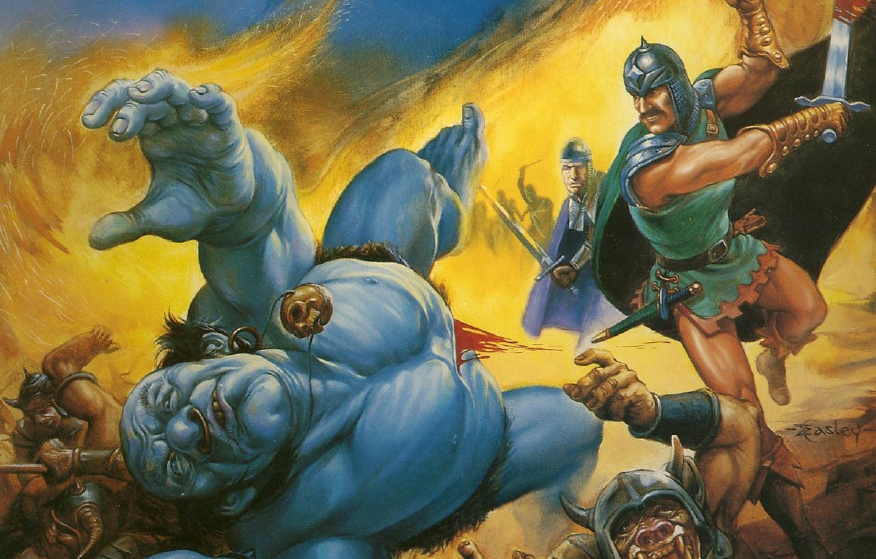
From the top of the wooden tower,
Lieutenant Thoran Ormgar could barely
see the rest of the camp through the
smoke and the night?s dark shroud. What
he did see was not cheerful: burning tents,
fallen soldiers, and dark wet stains on the
snowy ground. As he watched, many tall,
grim shapes began to appear at the edges
of the darkness in the battlefield below.
?You see them?? Thoran said without
turning to face the four men who surrounded
the catapult next to him.
?Aye, sir,? answered the sergeant there.
?Loose!? Thoran barked. The sergeant
raised his hand, an artilleryman yanked
back the lever, and the weapon?s 8?-long
arm swung up. The small boulder flew out
of sight toward the humanoid shapes
below. After a moment, there were muffled
cries of pain. Two of those shapes no
longer stood. Thoran grinned.
Even before the missile hit, the artillery
crew began to crank down the wheel that
drew the catapult?s arm. As they did this,
their sergeant moved to stand beside
Thoran. Both men scanned the shapes that
still moved in the camp below.
"How long before we can expect reinforcements?
" the sergeant asked, using a
deep, steady voice so as not to sound
afraid.
"SOON," Thoran said flatly--but not soon
enough, he thought. This border fort is
too deep in the wilderness, and if I hadn't
protested its construction, I might not
have been assigned to command it. However,
he maintained a hard, stern expression.
He glanced toward a nearby tower,
where a huge fire blazed at the top, and
said, ?The signal will reach the Second
Brigade in two hours. By then the whole
border will be on alert.?
The sergeant?s voice raised in pitch
slightly, revealing his true concern. ?What
about us?
Thoran sighed, considering how to answer.
At last he said, ?I?ve fought ogres
before. They?re a fierce bunch, but not
indestructible. Loose!?
Instinctively, the sergeant raised his
hand toward his crew, and another boulder
sailed into the darkness. More cries,
another gap opened. This time the lieutenant
did not grin.
"Thirty infantry in the tower," Thoran
said, "and 20 ogres in the camp. That's
a fair siege."
?I?d rather fight it out,? the sergeant said
in a grim voice.
Thoran turned, his eyes gleaming as he
touched the hilt of his long sword. ?Good. I
hate sieges. You might just get your promotion
when this is all done.?
The sergeant grunted, as if amused.
?And you??
?A field medal . . . or a funeral with full
honors.?
?Then we?ve saved the border.?
?Yes.? Thoran drew his razor-sharp blade
from its sheath and studied the silvery
edge. Then he turned a hard gaze on the
sergeant. ?Now let?s save ourselves.?
?Aye, sir.?
As the sergeant went back to his crew
and ordered another shot, Thoran looked
down on the camp again. His brow was
wet and his heart beat faster than he
would have liked?signs of tension before
a battle. He knew that such signs would
disappear in the fury of combat. Then he
pushed away such time-wasting thoughts
and began to form an attack plan. His
hand clutched the grip of the sword so
hard that the knuckles turned white, but
he never noticed it.
In the medieval world of the AD&D®
game, armies are a vital ingredient to any
successful nation. Borders must be
watched, cities must be patrolled, bandits
must be conquered, and INVADERS must be
repelled. Even LG governments
need troops to deal with enemies, who
often gather in large numbers that cannot
be stopped by anything less than a large,
organized band of warriors.
Table 1A
Military Duties: No Warfare
| 1d100 (plus modifiers) | Duy |
| up to 10 | construction |
| 11-40 | patrolling |
| 41-60 | scouting |
| 61-70 | raiding |
| 71-100 | garrison duty |
| 101+ | special mission |
Table 1B
Military Duties: Minor Warfare
| 1d100 (plus modifiers) | Duty |
| up to 50 | campaigning |
| 51-70 | patrolling |
| 71-80 | scouting |
| 81-85 | raiding |
| 86-90 | construction |
| 91-100 | garrison duty |
| 101+ | special mission |
Table 1C
Military Duties: Major Warfare
| 1d100
(plus modifiers) |
Duty |
| up to 65 | campaigning |
| 66-80 | patrolling |
| 81-85 | scouting |
| 86-100 | garrison duty |
| 101+ | special mission |
| Officer | Fighter level | BATTLESYSTEM supplement rank * | Command group | Number of soldiers |
| Sergeant | 1 | - | squad | 10 |
| Lieutenant | 2-4 | unit commander | half-century | 50 |
| Captain | 5-6 | unit commander | century | 100 |
| Colonel | 7-8 | brigade commander | brigade | 500 |
| General | 9+ | army commander | legion | 5,000+ |
* The 2nd Edition (1989) BATTLESYSTEM rules uses a different system of command, detailed on pages 58-59 of that booklet.
| Rank | Required FXP | No warfare | Minor warfare | Major warfare |
| Sergeant | 500 | 80%/month | 50%/week | 95%/week |
| Lieutenant | 2,000 | 40%/month | 30%/week | 60%/week |
| Captain | 18,000 | 20%/month | 30%/month | 20%/week |
| Colonel | 70,000 | 10%/month | 20%/month | 30%/month |
| General | 250,000 | 10%/year | 5%/month | 15%/month |
Table 4
Officers: Number of Weaknesses
| 1d8 | Weaknesses |
| 1 | two |
| 2-4 | one |
| 5-8 | none |
Table 5
Officers: Types of Weaknesses
| 1d20 | Weakness |
| 1-4 | cowardice |
| 5-8 | compassion |
| 9-12 | quick temper |
| 13-14 | recklessness |
| 15-20 | pride |
Table 6
Officers: Level of Weaknesses
| 1d6 | Level | 1d20 saving throw |
| 1-3 | slight | 16+ |
| 4-5 | moderate | 12+ |
| 6 | extreme | 6+ |
In history, fighting became a full-time
profession when there was a division of
labor among the members of society.
Farmers grew food, merchants traded and
transported goods, and soldiers fought
battles. This article explains the lifestyles
of these professional soldiers, and provides
tips for Dungeon Masters on handling
player characters who enlist.
For the purposes of this article, the
word ?army? describes a sizable organization
of fighters sworn to serve a particular
government, with a strict hierarchy of
leaders and common soldiers. It does not
mean a large, unorganized band of warriors
such as a barbarian horde, nor does
it mean the knightly orders followed by
cavaliers. The best example of such an
army is that of ancient Rome, on which
much of this article is based. DMs may, of
course, develop their own army structures
and rules, but they should consider these
guidelines carefully.
Volunteers for military service are interviewed
at a military headquarters or office,
one of which is usually found at
every major city in a kingdom. An officer
questions each recruit to determine his
alignment, and the chance of acceptance is
100% unless the volunteer is obviously not
a fighter or cavalier; clerics and monks are
accepted only 25% of the time, druids and
magic-users (including illusionists) only
10%, and thieves only 5% of the time. Of
course, the volunteer may disguise himself
or attempt to pass a 4d6 charisma check to
fool the interviewer. Note that clerics,
magic-users, and illusionists may be hired
to help the army, but not as part of the
regular troops.
After the interview, the recruit is
checked by a doctor (or 20% chance by a
cleric) to see that he is physically fit. The
recruit must meet the minimum ability
requirements of the fighter class (strength
9, constitution 7) and have no obvious
diseases or physical handicaps.
After acceptance into the military, each
recruit swears on oath that he will be loyal
to his superiors and the government
which he serves, and will be honest and
brave at all times. After a short ceremony
which includes a prayer to a war god
(Mars, Anhur, Hachiman,
or whomever),
the recruit signs his name to a legal document
indicating the date, the place of
enlistment, and the length of enlistment
(typically five, 10, or 25 years). The recruit
is also given a permanent mark on the
upper arm, either by tattooing or branding,
which displays the man?s name, date
of enlistment, and the insignia of the army
or kingdom he is to serve.
Next, the recruits are transported to a
military base or training camp. There,
each new soldier is assigned to a type of
troops such as one of the following: archery,
artillery, cavalry, heavy cavalry, heavy
infantry, light infantry, mounted archery,
navy, etc. Some nations may use all of
these types of troops, while most use only
a handful of them, as influenced by the
terrain.
For example, a government in heavily
wooded lands will support an army of
light infantry and cavalry, with only limited
missile use. Hills and mountains favor
light infantry, while plains and deserts
favor fast, light cavalry, preferably with
long bows. Naturally, any nation bordering
on a large body of water will support
warships, especially if hostile neighbors
are across those waters.
As an option, the Dungeon Master may
allow a recruit to volunteer for a certain
type of troops. At this point, the recruit?s
qualifications are important. For example,
a youth who has spent most of his life at
sea will usually be allowed into the navy.
A volunteer for cavalry must pass a test
of horsemanship by riding a speeding
horse, wielding a weapon from the saddle,
and dodging obstacles; only one riding
proficiency check must be passed, though
the recruit only gets two tries. A volunteer
for heavy cavalry must have the minimum
ability scores of 12 strength and 11 constitution,
and he must pass the horsemanship
test.
To volunteer for archery, a recruit must
hit a man-size target at long range. The
target has an effective armor class of 3,
and the recruit gets only three shots. To
enter a mounted archery unit, a volunteer
must pass both the horsemanship and the
archery tests.
Anyone who volunteers for artillery
duty will not be allowed to enter an artillery
unit, because artillerists are often
considered to be laborers more than fighters.
To volunteer for such duty may be a
sign of fear of combat.
After the decision for the unit type is
made, the recruits are put through several
weeks of basic training, which includes
long marches, weapon training, riding
practice (for cavalry units), and drills on
battlefield tactics.
The soldiers receive proficiencies as
necessary, such as horsemanship, artillery
weapon use, and hand-held weapon use.
Note that cavalry units tend to use spears
or lances for charging and scimitars for
slashing, while infantry units tend to use
spears for throwing, swords, and sometimes
pikes. The new recruits receive the
minimum proficiencies necessary for
operation in their units. If no proficiency
slots are available, then the next slots that
would normally be available during classlevel
increases are used up.
At the end of training, the soldiers receive
500 xp (not applicable to field experience
points?fxp?described later) and the
bonuses of + 1 strength (or + 10% for
fighters with 18 strength) and + 1 constitution.
These ability increases cannot
exceed racial maximums. Then the soldiers
are given armor and weapons suited
to their unit, and sent into the world to
perform their duties.
A soldiers duties
After training, the new soldiers are
assigned to duties according to the needs
of their kingdom. Use either Table 1A, 1B,
or 1C; Table 1A is for a kingdom with no
serious military conflicts, Table 1B is for a
kingdom with minor conflicts (i.e., limited
warfare, skirmishes, small border wars,
etc.), and Table 1C is for a kingdom involved
in a full-scale war.
These tables have the following cumulative
modifiers:
- 30% for characters in their first year
of service;
+ 1% per previous year of service;
+ 5% per field medal (explained later);
+ 10% per previous successful special mission.
Check each soldier?s assignment at the
beginning of each new year of service or
when his last assignment ends. Also check
again if the kingdom?s situation (no warfare,
minor warfare, or major warfare)
changes, such as if a border skirmish
turns into a major conflict with another
kingdom, or if a major war ends in PEACE.
For the sake of the game, the DM should
make only one assignment check for all of
the PCs. This keeps the PCs together as a
group so they can still play the game together,
and it also makes the DM?s job
easier. However, each modifier listed is
then taken as an average; for example,
three PCs with two previous years of
service each receive a +2% bonus, not
+ 6%. Also, one field medal in a group of
five PCs causes a + 1% bonus (from 5
divided by 5), not + 5%.
The assignments are designed to generalize
the tasks ahead, and they ignore such
menial duties as kitchen duty, latrine
cleaning, weapons oiling, and armor
scrubbing. Each assignment is explained
below.
Campaigning: This duty means service in
a unit involved in open warfare. The PCs
are individuals in a massive group which
marches, camps, and combats the enemy
on the battlefield. The D&D® Companion
Set's War Machine or the BATTLESYSTEM
miniatures rules may be needed.
However, the DM can simply use his own
wisdom to determine the outcome of a
battle by considering the strengths and
weaknesses of each army, the abilities of
the commanders and troops, morale,
tactics, surprise, and other factors. If this
last system is used, then the PCs will be
involved in round-by-round melee combat
while the rest of the battle rages around
them, its events chosen by the DM.
Construction: The PCs
are assigned to
help build or repair forts, castles, city
walls, stone-paved roads, bridges, or whatever
else is needed by the kingdom. Their
group is equipped and treated like regular
soldiers, though combat is rare. Engineers
and officers oversee all operations.
Construction assignments last for six
months in kingdoms with no warfare, or
one month for kingdoms in minor warfare.
At the end of each half-year of construction
duty, each PC has a 10% of
gaining a bonus of + 1 strength (or + 10%
for those with 18 strength) and a 10%
chance of gaining a + 1 constitution, to
racial maximums.
Garrison duty: Reserved as a reward for
experienced troops, this assignment indicates
guard duty at a fort or castle. When
the military base stands beside a city or
town, then the garrison troops also patrol
these places, acting as police forces. Garrison
soldiers do a lot of training, guarding,
and patrolling. They might see occasional
small-scale combat (such as skirmishes
with bandits, brawling civilians, and wandering
monsters), but they see major conflicts
only when under siege.
Patrolling: This duty involves traveling
within the kingdom and dealing with
trouble wherever needed. Patrols may
camp in the field or at a military base, but
they do not usually stay in any one area
for more than one week unless they are
needed. Light cavalry and mounted
archers are the most common troops
assigned to this duty. Patrols may be as
small as 20-50 soldiers in areas where no
real trouble is expected, or up to 500
soldiers in areas where small-scale battles
are likely.
Raiding: This duty involves lightning-fast
attacks to gather food, loot, or prisoners.
Only light infantry and mounted archers
are assigned to this duty (all others reroll
for assignment): Average troop size is 50
horsemen, and these soldiers base themselves
in the protection of a military fort
or campaigning army. Scouts gather information
about the target and its defenses
before each raid, so that raiding troops
need only get to the target, overcome its
defenses, gather what is wanted, and
return home before enemy troops catch
them.
Raiding assignments last for 1 month,
during which time 2d4 +2 attacks are
made. Afterward, the characters reroll for
their assignment.
Scouting: Troops who scout will patrol
outside of the kingdom?s borders, in enemy
territory and in wilderness lands.
Scouts are equipped and mounted as are
raiders, though scouts travel in fewer
numbers for the sake of speed. The purpose
of a scouting mission is to gather
information on wandering monsters,
enemy activities, and other dangers, then
return home. Scouts are expected to fight
only in self-defense. Characters assigned
to scouting troops are also part of a large
military group, either one campaigning or
in garrison duty.
Special missions: For proven veterans
only, this assignment may take from a few
days to many months to complete. The
main purpose of each mission is to benefit
the kingdom, its people, and its army, not
to indulge the soldiers in destruction and
treasure hunts. Rules may be nonexistent
("anything goes") or many, depending on
the mission?s goals and its complexity.
Military organization
A civilized army is organized into groups
of specific sizes, commanded by officers.
PCs should be placed in the same group
but will still be under the orders of an
NPC officer, usually a harsh, battlehardened
sergeant at first. PCs may learn
to hate their sergeant, but they should also
respect him, especially when he smashes a
PC?s nose with one punch (and they discover
his strength bonuses), and when his
combat experience leads them out of a
tight situation (such as an ambush by orcs,
or an enemy maneuver that leaves them
surrounded on the battlefield).
A large army contains at least one of
each of the following groups: a squad (10
soldiers), a half-century (five squads, or 50
soldiers), a century (10 squads or 100
soldiers), a brigade (five centuries, or 500
soldiers), and a legion (10 brigades, or
5,000 soldiers).
Types of officers are listed on Table 2.
Fighter class levels are listed for each type
of officer. The officer' rank in the 1st
Edition (1985) BATTLESYSTEM supplement,
page 8, is listed in the 4th <here, it seems
that there is a mistake in the article>
column. Lastly, the group commanded by
each officer is listed, as well as the composition
of each group.
In addition to soldiers, every brigade
maintains a group of tradesmen who are
exempt from the menial duties of the
soldiers. These tradesmen include engineers,
blacksmiths, armorers, weaponsmiths,
leatherworkers, bowyers, and
fletchers. Medics with healing proficiency
are also needed, and spell-casters (clerics,
magic-users, and illusionists) are a rare but
well-appreciated addition to any army.
Rangers may be temporarily hired as
scouts. Finally, minstrels (and, very rarely,
a bard) may be included for inspiring
songs and moral support.
The life of a medieval soldier can be
summed up in two ways: life on the
march, and life at the fort.
Life on the march
This description refers to troops who
are continuously moving, especially armies
on campaign who send out scouting parties
and sometimes raiders. Such troops
regularly march by daylight and make
camp at night.
The marches cover an amount of
ground determined on page 58 of the 1st
Edition Dungeon Masters Guide, pages
122-125 in the 2nd Edition Dungeon Master's Guide, or page 120
in the 2nd Edition
Player's Handbook. Use the movement rate
of the slowest members of the group, so
that if light cavalry is traveling with heavy
infantry, then the infantry determines the
movement rate. Troops on the march
carry at least an average burden, since
each man must carry his own armor,
weapons, supplies, and building equipment
for the night?s camp.
Marching troops travel in defensive
formations, usually in a column no more
than 20 men wide, to conceal their numbers.
Scouts watch for danger far ahead
and to the sides. Cavalry and archers
usually lead the column as well as guard
its rear. At the center of the column are
the infantrymen, the tradesmen, and the
mules that carry extra supplies (including
one tent per squad) and pull the siege
engines. The highest-ranking officers
remain toward the front of the column
and are mounted on horses, camels, or
whatever is appropriate. Also at the front
are drummers and trumpeters who relay
messages from the upper officers to other
officers throughout the column.
A forced march increases the efficiency
of the march but wearies the troops. A
forced march increases the distance traveled
in one day by 50%, or allows an army
to move its normal distance in five hours
rather than the normal eight hours. For
each day of a forced march, NPC foot
soldiers suffer a penalty of -2 to hit and
damage. The maximum number of forced
marches allowable in a row is four, when
the NPC foot soldiers are at -8 to hit and
damage. At that time, they begin to collapse
from exhaustion and suffer low
morale, while the cavalry?s mounts will
also be exhausted. Foot soldiers raise their
attack modifiers back to normal by +2 for
each day of a normal march, or by 100%
for one whole day of rest.
A forced march affects walking PCs
similarly, though a PC may make a constitution
check each day to avoid the combat
penalties. These ability checks are made at
+ 3 per previous check, and the PC recovers
in the same way as the other foot
soldiers.
At the end of the day?s march, the soldiers
spend a couple of hours building a
camp. Normally, half of them work while
the others stand guard. The ancient Romans
first dug a square trench that surrounded
the entire camp. They piled the
dirt into a rampart beside the trench, then
built a stockade of logs (when wood was
abundant) or merely set sharp stakes into
the top of the earth wall. Other variations
were possible, though simplicity and speed
of construction were desired, especially in
hostile territory. After the outer wall was
completed, the Romans set up their tents,
tended to the animals, ate, and rested.
At least 20% of the troops should stand
guard while the rest sleep. In the morning,
the soldiers break down the camp and
prepare for the next day?s march, leaving
only the trench, the soil rampart, and
unwanted garbage behind them.
Combat may be rare, occasional, or
frequent, depending on the circumstances
and the DM's judgment. Certainly, wandering
monsters, bandits, and enemy soldiers
will occupy most of the campaigning army
?s fighting experiences.
Life at the fort
This description applies to troops in
garrison duty, those doing construction,
and those who patrol, raid, or scout from
a military base. Life for these troops centers
around the fort or castle, though they
need not spend most of their time within
its walls.
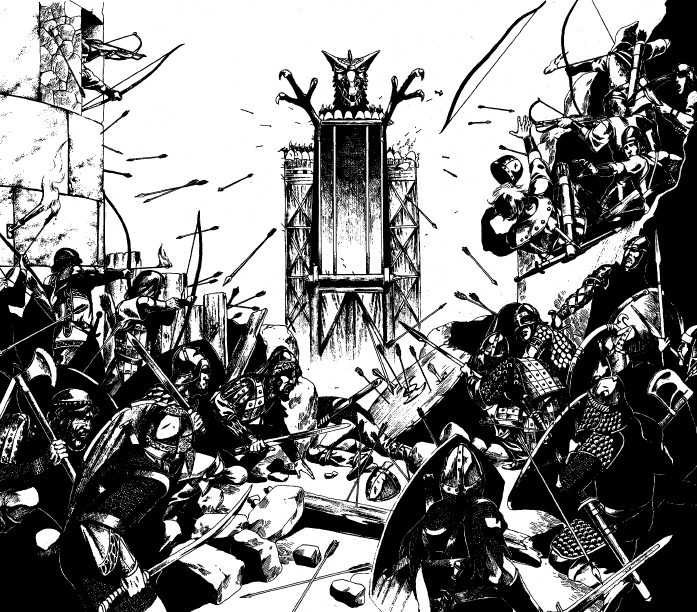
Menial duties occupy much of the time
spent inside the fort. Soldiers clean their
equipment, cook, wash floors, shovel
manure from the stables, and groom the
animals. Those assigned to construction
duty may work on repairing the fort's
wooden or stone structures, or may work
on projects outside the fort. Also, soldiers
stand guard on the walls and at important
doors (e.g., the main gates, officers? quarters,
the armory, the granary, etc.).
If there is a town or city next to the fort,
the troops might patrol these civilian areas,
stop crimes, and detain offenders.
Thus the city guard and watchmen might
be soldiers stationed in a nearby fortress.
The government also uses soldiers as
bodyguards for important officials and
nobles, as riot police, and as guards for
city gates, granaries, law courts, and other
such places.
Off-duty soldiers spend a lot of time
gambling, possibly playing the games
described on pages 215-216 of the 1st
Edition DMG. If the fort is next to a town
or city, then soldiers will be found at taverns,
brothels, bath houses, gambling
dens, and other businesses designed to
drain the silver pieces from their pockets.
Brawls involving soldiers are not appreciated
by the officers in command of those
soldiers, nor by the businesses themselves.
Off-duty PCs can get into town and city
adventures which have nothing to do with
their military life. However, illegal activities
will draw serious penalties from the
PCs? officers.
The troops also train each day. They
march in circles around the fort and
through the surrounding countryside,
then practice battlefield drills and hand-tohand
combat.
The most exciting form of training,
however, is the war game, which is held
once a month or more. In the war game,
the commanding officer of the garrison
divides his troops into equal forces and
pits them against each other on a battlefield.
Clubs take the place of arrows,
spears, and swords, and casualties are
noted by the red paint left by these clubs.
These small-scale battles are taken very
seriously by the soldiers, since normal
experience points and field experience
points (detailed later) are gained from war
games as if from real battles.
Who's in charge?
During battles and other events, the
personalities of the officers have serious
effects on how well the army operates.
This section deals with the leadership
ability of the senior officer who is in command
of the PCs' group. The DM should
secretly record the personalities of the
leaders of both sides of the conflict, and
let the PCs draw their own conclusions.
Wisdom is a very important aspect of
leadership. For the commander in question,
roll 4d6 and drop the lowest roll. His
wisdom score is also modified (but not
beyond racial limits) as follows: + 1 for
captains, + 2 for colonels, and + 3 for
generals.
The officer may have one or two leadership
weaknesses, as determined by Table 4.
The 1d8 roll is modified by the NPC's
wisdom-based magical-attack adjustment.
Each weakness is then determined by Table
5, whose results are explained below.
Cowardice means too much care for
one's own life, leading to a hesitancy to act
offensively and take advantage of opportunities.
It can cause more waiting and retreats
than should be expected.
Compassion means caring too much for
the lives of others, with similar results as
from cowardice. The commander may act
foolishly to rescue hostages or save civilians,
or may refuse to engage in battle for
fear of "unnecessary loss of lives."
A quick temper is a tendency to react
violently and irrationally toward anything
that causes anger. The officer may launch
an attack because of the enemy?s insults or
their offensive acts.
Recklessness indicates a tendency to act
courageously but without thinking. The
commander may launch an attack at the
first sight of the enemy, not considering
that other troops might be hiding to attack
him. A reckless commander tends to forget
one or two important factors (weather,
terrain, troop strength, tactics, etc.) in his
impatience to attack.
Pride indicates the officer
is too aware
of his own self-image, and he acts irrationally
when that image is threatened. His
pattern of behavior is similar to that of a
quick-tempered man. Insults and humiliation
tend to draw him to attack, even at
his own disadvantage. He may also refuse
to retreat or call for reinforcements when
such things are necessary.
Table 6 determines the severity of each
weakness, with a saving throw noted.
Each time the NPC commander faces a
situation that would appeal to his weakness,
he must pass the saving throw or act
on that weakness.
The DM can hint at the commander's
weaknesses off the battlefield but should
not make the hints too obvious. For example,
severe punishments for minor rulebreaking
may indicate a quick-tempered
officer, while no punishments may indicate
cowardice or compassion. Also, too
many forced marches may show the commander
to be reckless (?They?ll be all right.
Don?t worry about it!?) or overly proud
(?They?re my boys. They can take it.?).
If the commander?s actions have disastrous
results, and if his weakness is the
obvious reason, then he may face serious
punishments, especially demotion or dangerous
assignments. Then the PCs get a
new leader whose secret weaknesses (if
any) will be revealed to them only at the
worst times.
Field XP
When a character's position in an army is
considered, only experience points gained
in service to that army should be considered.
These points are called field experience
points, and they are recorded
separately from normal experience points
that count toward class-level advancement.
Experience points for slain opponents
and monsters may count toward both field
experience points and normal experience
points, but only if those points were
gained in service to the army. For example,
if a PC kills a maximum-hit-point frost
giant that is attacking his lords
castle, then
the PC adds 3,426 points to his field experience
points, and 3,426 points to his normal
experience points. However, if the
same character gains 850 experience
points in a tavern brawl, then he adds
those points to his normal experience
points but not his field experience points.
Field experience points count toward
military rank, which will be detailed later.
Rules and punishments
From the start of his career, every soldier
is made aware of the rules of the
military. Crimes are obvious and need no
lengthy explanations: theft, duelling in a
lethal manner, sleeping on guard duty,
lying, murder, corruption, disobedience,
cowardice, treason, desertion, and conspiracy
are some examples. In general,
anything that harms the army, its system,
its government, or the people of that gov-
ernment is considered illegal.
Sometimes a trial is used if the offender
might be innocent. However, only major
crimes require this, and lesser offenses
(such as sleeping on guard duty) need only
the word of the offender?s superior officer
to be taken as truth.
The severity of each crime should influence
the severity of the punishments. Note
that officers receive harsher punishments
because they are expected to provide
examples to their men, and bad examples
are not appreciated. However, officers are
exempt from certain punishments if such
punishments reduce the respect given to
the officers by the troops; an unrespected
leader is a useless leader.
Some of the punishments follow, in
order of severity. Also, each punishment
inflicted is accompanied by a loss of field
experience points but not normal class
experience points.
Unpleasant duties (25 fxp lost per week).
The offender is ordered to perform tasks
usually reserved for new recruits, such as
latrine cleaning, kitchen service, and horse
manure shoveling, for 1-8 weeks. Officers
are excluded from such duties.
Pay loss (150 fxp lost). The offender
forfeits 1-3 months pay. This is the most
common penalty given to officers, since it
does not cause them to be humiliated in
front of their men.
Flogging (500 fxp lost). The offender is
tied to a post and whipped by his immediate
superior. Typical numbers of lashes
are five, 10, or 20, causing a total of 2-5 hp
damage. After flogging, the victim must
pass a constitution check (at +2 per five
lashes received) or be weak (half strength
and dexterity scores) for 24 hours. Officers
are exempt from flogging.
Gantlet of bats (100
or 500 fxp lost).
Sentenced only by violent or harsh officers,
the gantlet is a narrow lane lined by
10 soldiers on either sides. The offender
(who wears no armor) must run through
the lane while each soldier swings a club
at him. Successful hits inflict 1-6 hp damage.
If the victim is knocked unconscious,
he loses 500 fxp, and a medic moves in to
keep him alive. If the victim passes
through the gantlet without falling, he
only loses 100 fxp because he gains respect
from the soldiers and officers. Officers
are exempt from this punishment.
Dragging (100 or 500 fxp lost). A ruthless
punishment, dragging requires that the
offender be tied to the saddle of a horse
and must run behind it for three hours.
The victim must make three constitution
checks, one for each hour, at +2 per previous
check. Failure means that he is
dragged along the ground, taking 1-4 hp
damage per hour of dragging. Three successful
ability checks indicates that the
offender remains running after three
hours, and he loses only 100 fxp instead of
500. Afterward, the offender is weak (half
strength and dexterity scores) for 24 hours.
If the offender breaks the rope or attacks
the horseman, he is flogged (or worse).
Officers are exempt from dragging.
Unpleasant/Dangerous assignments
(1,000 fxp lost). The victim of this punishment
is usually either a common soldier
who has proven himself to be incurably
troublesome, or an officer who has greatly
angered his superiors. Typical penalty
assignments are garrison duty in a rebellious
town, border duty near a wilderness
full of hostile barbarians, scouting in an
area overflowing with orcs, and patrolling
a mosquito-infested swamp or sunscorched
desert. The assignments are
meant to punish the offender, not kill him.
Demotion (variable fxp loss). This penalty
is reserved for an officer who has
proven himself too corrupt or incompetent
to perform his duties at his present
level of responsibility. Demotion must be
approved by at least three officers who
have higher rank than the one to be punished,
so that the whims of a rival officer
do not ruin another soldier?s career. The
demoted officer drops up to three levels in
rank, depending on the severity of the
offense, and loses enough field experience
points to put him at the minimum amount
needed for that rank (see Table 3).
Execution. This punishment is usually
given to those guilty of murder, conspiracy,
desertion, or treason. The death may
be slow or fast, depending on the typical
alignment of the country. Hangings and
beheadings are the most common forms of
execution, while more elaborate and cruel
methods are less common. If the offender
escapes, then he loses all field experience
points for that kingdom and becomes a
wanted outlaw.
Rewards
The first awards given to a soldiers is his
monthly pay, as determined on page 29
of
the 1st Edition DMG or page 108 of the
2nd Edition DMG. New recruits receive
four months? pay at the start, then get
paid at the end of each month of service.
Pay advances and loans are not given.
Officers receive better pay. A sergeant
gets 10 times the amount paid to the
troops he commands, while a lieutenant
and a captain get 100 gp per level. A colonel
or a general receives 600 gp per
month, plus 50 gp per level above 6th.
Field medals are awarded for courage
and victory in battle. These medals come
in many forms, but most resemble jewelry.
Examples of field medals are listed below,
along with field experience-point awards.
?A silver medallion to be worn about
the neck, given to a soldier who risks his
own life to save another?s (250 fxp).
?A small silver dagger to be strapped to
the upper arm, given to a soldier who kills
10 opponents in one day (250 fxp).
?A silver cross to be hung on the breast
armor, given to a soldier who kills an
officer of the opposing army (300 fxp).

?A gold medallion to be hung on the
breast armor, given to an officer who wins
a field battle against 1:2 odds or worse, or
who resists a siege at 1:5 odds or worse
(1,000 fxp for sergeants, 5,000 for lieutenants,
20,000 for captains, 100,000 for
colonels, and 200,000 for generals).
?A silver star for the chest, given to an
officer who destroys a large force of bandits,
stops a large riot, or ends a large
peasant rebellion; a good-aligned government
will require that the officer also
avoided a slaughter of civilians (500 fxp
for sergeants, 2,500 for lieutenants, 10,000
for captains, 50,000 for colonels, and
100,000 for generals).
?A gold disc (with sword insignia) to be
hung about the neck, given to each member
of a scouting party who fought courageously
to return to his army group and
report information that helped to avert a
military defeat (500 fxp).
?A gold star to be pinned to the breast
armor, given to a soldier who performed
exceedingly well during a special mission,
at great risk to his own life (1,000 fxp).
Another type of award is a favorable
assignment, such as raiding duty (for
violent or adventurous soldiers) or garrison
duty in a wealthy city.
Loot taken in raids and conquests should
be transported immediately to the royal
treasury, and any soldier (especially an
officer) who steals from this loot risks
severe punishments. Note that spies and
informers are usually present to report
such thefts.
However, looting has its rewards in field
XP, and the points are
divided as follows: The leader ov the group
that conducted the raid takes 15% ov the
total xp to b awarded, his
immediate superior officer takes 10%, any
lesser officers involved divide up another
25%, and the common soldiers split the
remaining 50%.
e.g., if a lieutenant destroys an
evil temple and delivers 5,000 gp to his
king from the temple, then he receives 750
FXP, his captain receives 500 FXP, his 5
sergeants recieve 1,250 FXP (|or| 250 each),
and the 50 soldiers with him receive 2,500
FXP (or 50 each).
Retirement is the final reward ov service.
At the end of his term ov service, the
soldier receives an amount ov gold equal to
1 year's pay for each 5 years of service
completed. The retired soldier may
also buy his armor && weapons from the
army at -2% the normal price per year of
service. If he leaves the army then reenlists,
his position will have been filled and
he will have to wait for an opening to
apply for a position at his old rank; his
chance of success is determined as with a
soldier seeking promotion (detailed later)
but with a 20% bonus. Another benefit
ov retirement may be citizenship in the
kingdom that the soldier served.
Promotions
Promotion serves to elevate soldiers into
higher levels of command, in order to fill
new positions or to replace those who
leave old positions (either by death, demotion,
injury, retirement, etc.). It may help
the DM to know how many officers are in
the army, and this number can be found
by dividing the entire number of soldiers
by the number commanded by each type
of officer (as shown on Table 2). For example,
the City of Rel Astra in the WORLD
OF GREYHAWK® setting can raise
around
9,500 troops, including levies and militia
but not navy; therefore, its full army has
two generals, 19 colonels, 95 captains, 190
lieutenants, and 950 sergeants.
As a rule, any organized army should
have at least one general and two colonels,
though these officers may have to command
less than their maximum number of
soldiers because of the army?s size.
Table 3 lists the officer ranks, minimum
FXP necessary for those
ranks, and the percent chance that there
will be an opening for that position. Note
that kingdoms are rated as being involved
in no warfare, minor warfare, or major
warfare.
Once an opening exists, the soldier must
apply for promotion to his superior officer.
The chance of success is 9%, with the following
modifiers:
+ 1% per intelligence, wisdom, and charisma point;
+ 5% per silver field medal;
+ 10% per gold field medal;
+ 10% per previous attempt to reach the same rank;
- 25% if intelligence score is below 10;
- 25% if wisdom score is below 10;
- 25% if charisma score is below 10; and
- 20% for would-be sergeants, colonels,
and generals (because of
the number of applicants).
Note that if an officer loses the minimum
field experience points for his rank, he
does not drop in rank unless he is officially
demoted.
A high-born character may attempt to
enter the military as an officer rather than
a common soldier. A character of the
upper middle class may enter as a lieutenant,
a character of the lower upper class
may enter as a captain, a character of the
middle upper class may enter as a colonel,
and a character of the upper upper class
may enter as a general. There must be an
opening in the rank sought, at which time
the character applies to a high-ranking
military officer for acceptance. To be
accepted, the character needs a letter of
recommendation by his father (if the father
holds the same rank the character
seeks, in the same army) or by an officer
one rank higher. The base chance of ac-
ceptance is 0%, with the following cumulative
modifiers:
+ 1% per intelligence and wisdom point;
+ 2% per fighter or cavalier level;
+ 15% if father is in lower-upper class;
+ 30% if father is in middle-upper class;
+ 50% if father is in upper-upper class;
- 30% if the character has no living parents; and
- 20% if the character's parents are unmarried.
Also add or subtract the character?s
charisma reaction adjustments to the
chance of acceptance. If the attempt fails,
the character can only enter the army as a
common soldier. If the attempt succeeds,
the character must still go through basic
training and take assignments like the rest
of the soldiers, but receives enough field
experience points (not normal experience
points) to put him at the minimum amount
required for the rank he receives.
Why enlist?
The Dungeon Master may have trouble
convincing the players to enlist their characters
in an army, especially if they are of
medium or high levels and have a lot of
magical items and treasure to lose. However,
there are several methods to entice
PCs to enlist. It should be remembered
that the PCs will be more enthused and
cooperative if they enlist by their own
will, rather than being forced into military
service. Also, lower-level PCs are easier to
convince. Try the following suggestions:
1. If the PCs desire power, glory, and
military strength, then the DM should
point out that a career in an organized
army can offer all of these things.
2. The DM's campaign setting could be
plunged into warfare, the land overrun by
armies, scouting parties, and military
patrols. The PCs might witness a major
battle or two, be chased by a column of
heavy cavalry, or threatened by 50 arrows
hitting the ground in front of them; soon
they may begin to feel helpless against the
brigades they encounter. The DM should
let them know that joining one army may
be better than running from all of them.
3. The PCs could have a hostile encounter
with a patrol or scouting party, preferably
one in which the PCs start the
trouble. The wrath of an entire army
comes down on them, and they become
fugitives hunted by a seemingly endless
supply of professional warriors. The answer?
Join an opposing army and add a
few thousand companions to the fight!
4. The DM could mention that a PC can
gain great military strength to conquer
another kingdom or overthrow the government
by moving up through the army?s
ranks.
5. To enter a hostile land whose borders
are heavily guarded, the PCs can join an
army that plans to invade that land. Note
that this might have been Frodo Baggins?s
only option if he hadn?t known of Mordor
?s secret entrance. Another version of
this method is for the adventure?s villain to
command a great army, and the PCs may
need to join the army that plans to attack
the villain, unless the PCs want to stand
alone against 1,500 heavy cavalry and
3,000 light infantry!
6. In Oriental Adventures lands (especially
Wa and Kozakura),
bushi PCs may
join a daimyo?s army to prove their worthiness
on the battlefield and achieve samurai
status (note that such ah achievement
includes a bonus of + 10 honor points). In
Wa, where weapons are restricted to
professional soldiers, the army also provides
freedom to use a variety of weapons.
Service in a medieval army may seem
restricting, but there are many opportunities
for adventures. Some suggestions are
listed below, categorized by assignment.
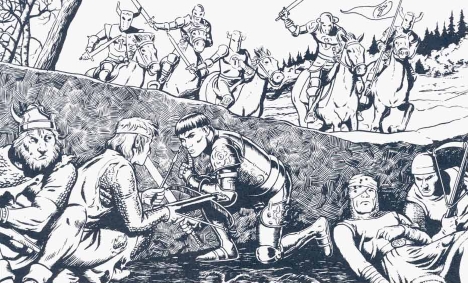
Campaign: The PCs? group is ordered to
capture a castle. After a fierce battle, the
PCs and their squad attack the sorcerer?s
tower, during which they encounter magical
traps, monsters, and a mid-level magicuser
and his henchmen. In other
adventures, the PCs? squad may be ordered
to chase after an enemy squad that
is shadowing the army, capture intelligent
monsters in their lairs for questioning, or
clear a dungeon of monsters and hostile
characters.
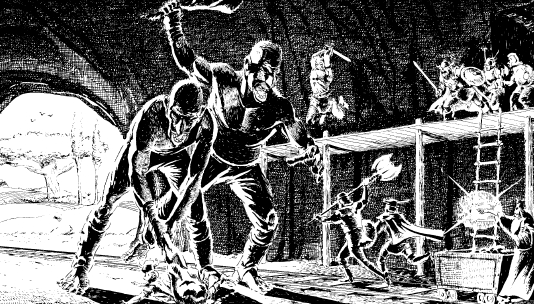
Construction Adventures:
during building
projects are rare but not impossible.
The PCs may dig into a lair of monsters or
fall into a cavern complex full of them.
Wandering monsters, hostile natives, or
enemy soldiers might show up at the
construction sight of a border fort. Also,
the PCs may get trouble from the prisoners
(such as criminals, evil spell-casters,
or caged monsters) of the building they
are repairing.
Garrison duty: Guarding an important
place is dangerous when sword-wielding
or spell-casting NPCs are determined to
get past the guards. If the garrison troops
also patrol a town or city, then there may
be powerful criminals (especially a thieves?
guild) to challenge. The most action, however,
occurs if an enemy army surrounds
the garrison and attempts to pound its
way into the castle.
Patrolling: Many encounters are possible
in the countryside, such as those with
wandering monsters, bandits, and adventurers.
The patrol might find a village
which needs protection from hostile
forces, or may need to rescue a damsel
from an orc-infested cave. Any threat that
appears suddenly within a kingdom?s
borders may first be discovered by a patrol,
and there may be no time to call for
reinforcements.
Raiding: Attacks on villages and caravans
outside the kingdom provide obvious
targets, opponents, and goals for the PCs.
However, there may be complications
unknown to the raiders, such as a secretive
wizard living in the village or an extra
century of soldiers guarding the caravan.
Wandering monsters and enemy patrols
may also be encountered.
Scouting: Soldiers assigned
to gather
information outside their kingdom?s borders
usually search for enemy troops, but
they can encounter almost anything. Long
range scouting missions are uncommon,
though any scouting party is often many
hours? ride from friendly troops. As long
as one member of the party gets back to
make his report, the mission is at least a
partial success.
Special mission: This assignment is more
like a typical AD&D adventure than the
others, and includes such things as longrange
scouting jobs, bounty hunts, assassinations,
rescues, artifact recoveries, cave
and dungeon explorations, and sabotage.
All of the PCs' adventuring skills will be
tested, though the main goal of the mission
will already be known to them.
FEBRUARY 1990