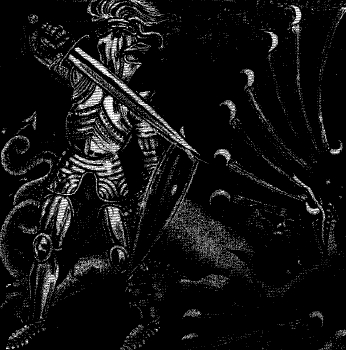
The busy pillagers could pick and choose,
After the battle, what they best could use;
And so befell that in a heap they found,
Pierced through with many a bloody,
grievous wound,
2 young knights lying together side by side. . . .
Not fully quick nor fully dead they were
But by their coats of arms and by their
gear
The heralds readily could tell withal
That they were of the Theban blood royal,
And that they of two sisters had been
born.
Out of the heap the spoilers had them torn
And carried gently to the tent.
Geoffrey Chaucer, "The Knight's Tale"
Those two Thebans faced many more
dangers in Chaucer's tale, but for the
moment they were saved by their heraldry.
In a feudal world, family achievements
are far more than colorful symbols.
A coat of arms indicates the bearer?s entire
legal identity: rights, honor, and power.
The complex rivalries of chivalry and
descendency created a cadre of scholars
who dominated all contests of prestige or
diplomacy. These were the heralds, and
they can profoundly influence the
career?and indeed the life?of a fantasy
adventurer.
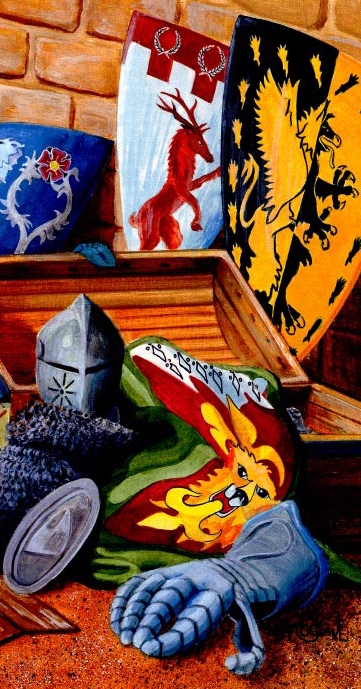
Most nobles appoint experts in heraldry
to serve them as officers of arms. An
officer usually inherits his position from
his father, but a ruler may appoint anyone
he chooses to this station. The officer of
arms serves as an envoy, an expert on
heraldic matters, a propagandist, a communications
officer, and a counter of
corpses after a battle. He can be identified
by his decorated smock, which is called a tabard.
The king or queen of a realm chooses
the most brilliant and loyal officers of
arms from the land to form a college of
heralds. This bureaucracy wields incredible
power in a feudal world. Any commoner
who aspires to nobility must apply
for a grant of arms from the college of
heralds; in this way, the college appoints a
land?s government. Furthermore, whenever
two nobles merge their estates, they
must join their coats of arms, too, and the
college of heralds regulates all such alterations.
The college can thus indirectly veto
a noble?s military alliances?and even
marriages.
A typical college would include three
kings of arms, who are served by a body
of six heralds and four assistants called
pursuivants. These ranks are assigned by
seniority and last until the herald resigns,
dies, or angers the crown. Most colleges of
heralds own a fortress, where they defend
their genealogical records and documents.
When the college of heralds deliberates a
case, the kings of arms can overrule heralds,
and they outrank pursuivants. The
college of heralds usually follows directions
from the king or queen of the country.
In matters of little political weight, the
college will usually approve any legitimate
request. If the DM does not know how the
college will decide a case, have the character
who wants something from the court
roll against his heraldic law proficiency
(described later in this article). Characters
without this proficiency cannot influence
the college to do anything unusual. This
system may be modified for PCs who
make exceptionally convincing speeches,
and any character may hire a counselor
with more knowledge of heraldic law to
argue before the college.
It may be interesting to let PCs become
officers of arms or members of the college
of heralds. These ranks make interesting
rewards for successful quests. They confer
great prestige, but do not require fulltime
work and have no effect on game
balance. Better yet, DMs will find many
chances to plunge PC-heralds into devious
intrigues, as nobles vie for honors and try
to disgrace their foes.
Heraldic proficiencies
Most of a herald?s abilities involve legal
powers and simple skills, not complex
training. Rather than treating heralds as a
separate NPC class, one can list the arts of
heraldry as nonweapon proficiencies; if
the DM permits, PCs may study them. NPC
heralds may be 0-level craftsmen,
as
described in the Dungeoneer's Survival
Guide, page 24, or members of a
character
class. Hiring an NPC herald costs 200 gp
per month. The primary heraldic skills are
noted in Table 1, and they require one
proficiency slot each. These skills have
their own uses, and some must be used to
design or alter a coat of arms.
Blazoning: A blazon is a formula describing
exactly what a certain heraldic device
looks like. Characters with this proficiency
can reconstruct a coat of arms from its
written description or encode an image in
blazon form. This skill must be used to
perform several other heraldic arts.
Boasting: Heralds use this seeming simple
skill to proclaim their lords ancestry
and triumphs. By making a successful
boast, a herald can improve the morale
of
one unit of troops by 5% (1 point under
1st or 2nd Edition BATTLESYSTEM
miniature
rules). A boast can also impress
other nobles in diplomatic missions. When
a herald successfully boasts for his liege,
give the noble a + 10% on reaction rolls.
One cannot use boasting without a history
proficiency that applies to the noble who
is the subject of the boast. A person who
studies both boasting and family history
can boast effectively for himself.
Differencing: Since there may be thousands
of shields in use in a campaign
world, distinguishing between them requires
great skill. To understand differencing,
a character needs the blazon
proficiency; records of arms are kept in
this written code, and characters need
access to the college of heralds library to
use this proficiency properly. Without a
library, penalize differencing checks by an
additional modifier of +3. A successful
differencing check lets a character identify
a given achievement and its bearer. Once a
differencing check has succeeded on an
insignia, the herald can always recognize
that particular insignia.
Draftsmanship: This skill is used to
physically draw the coat of arms. It is
most useful when combined with a blazoning
proficiency, since the character can
then create a perfect achievement from
written records. Without blazoning, the
draftsman must work from a perfect copy
of the achievement and is penalized by a
+2 modifier on the dice roll. Draftsmanship
requires a set of paints and brushes,
as well as the shield or other materials to
be emblazoned. If the color ?or? (gold) is to
be used, a jeweler must be employed to
apply gold leaf.
History: This proficiency allows a character
to understand the genealogy and
great deeds of a certain noble family. A
separate proficiency slot must be used for
each family studied, although this skill
applies even to very distant relatives of the
same house. History can be used as a
minor, nonmagical form of legend lore.
which is useful only for researching ancestors
of the appropriate family. The character
must make a successful roll to learn
accurate information, modified by + 1 for
every 100 years old or 100 miles distant
the subject of research is.
Heraldic law: A character uses this proficiency
to understand the nuances of custom
and law that govern heraldry.
Heraldic law not only controls heraldry
but also regulates jousts and lethal duels.
Whenever a character requests a special
favor from the college of heralds or is
summoned before a court of chivalry, the
heraldic law skill becomes vital. Characters
who do not have it may hire NPC
lawyers to argue for them.
REVELATIONS: Coats of arms reveal a myriad
of details about their owners, and this
skill lets a character learn them. A character
who makes a successful revelations
check can learn about any of the following
features of an arms-bearer: alliances,
marriages, conditions of birth (rank of
family and order of birth), disgraces, magnitude
of political authority (offices held,
size of lands, etc.), and triumphs. This
includes any major exploits of the armsbearer
or his ancestors. For game purposes,
it lets heralds roughly determine a
character?s experience level.
Signaling: Heralds play a vital role in
war. A shouting army commander cannot
be heard on a battlefield, so orders must
be broadcast to the units with flags,
drums, and shrill horns. A herald with this
proficiency can communicate over a distance
of one mile, or as far away as banners
can be seen, whichever is greater.
The Wilderness Survival Guide has
rules
for range of visibility on pages 72-75.
Obviously, big banners can be seen from
far away, so many kings regulate the size
of their vassals' standards to hinder rebellion.
In the BATTLESYSTEM rules, it is
easiest to simply assume that signaling
always works, unless there is some interference
such as an imposter herald |or| bad
weather. However, when an army is being
raised in the campaign world, each brigade
commander or army commander
must find someone with the signaling
proficiency. Signaling might also be useful
during any standard adventure.
The heraldic privilege
To receive a coat of arms, a character
must either be born into nobility or perform
a special service for. the crown. If the
social status table from page 82 of Unearthed
Arcana is used, all members of the
upper classes automatically own an
achievement, and the middle to uppermiddle
classes have a 30% chance of owning
arms. Any 0-level cavalier from
the
AD&D 1st Edition Game who lacks a coat
of arms will certainly apply for one. Without
arms, the warrior might gain a cavalier
?s fighting skills, but he can never
demand a knight's hospitality or training
to raise ability scores.
All legitimate children receive their
father's arms. Parents must pass their
arms on, even to disinherited children,
and all heirs are forced to display either
their father's shield or none at all. The
only alteration children may make is a
mark of cadence that lets them be recognized
in battle. After an arms-bearer dies,
his eldest son abolishes all differencing
and carries the father's shield. Basterds
may inherit their fathers' arms if they
prove paternity. Otherwise, an illegitimate
child is either denied any noble rank at all
|or| is allowed to design a completely new
coat of arms. The college of heralds decides
what armory that offspring may
wear.
There is no harm in letting players
whose characters inherit arms decide
what their shields look like, but the DM
may design any features that might affect
the Game. PCs might have ancestral dishonors
to overcome or reputations to
maintain. One could run an interesting
campaign in which all the PCs are children
of the same noble family. This gives them a
legitimate reason to adventure together, as
well as network of friends and enemies. It
also motivates PCs to follow certain character
classes. The heirs, the elder children,
will strive for military glory, while younger
PCs may seek power in magic or the
clergy.
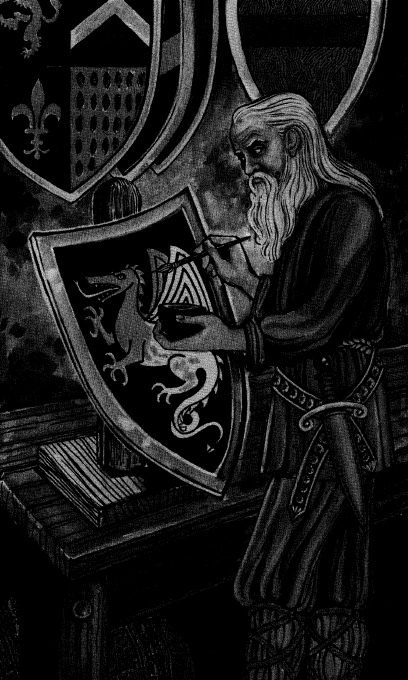
Any commoner who aspires to the noble
classes must apply to the college of heralds
for a grant of arms. Then the aspirant
must perform some heroic service for the
crown to become worthy of heraldry.
When the character finally becomes an
arms-bearer, he will have to create the
shield. Designing a new coat of arms requires
the help of experts with proficiencies
in blazoning, heraldic law, REVELATIONS,
and differencing. One of the participants
must have studied the history of the armsbearer
?s family, and since few people study
commoner?s ancestors, the new noble
house may have to train its own heralds. A
draftsmanship proficiency is needed to
draw the arms.
One of the heralds overseeing the new
shield must roll against his heraldic law
proficiency, and if this check fails, the
shield will be flawed in one of two ways.
There is a 70% chance that the shield will
merely be poorly designed, resulting in
confusion and ridicule whenever it is
examined by someone with a proficiency
in differencing, revelations, heraldic law,
or blazoning. A 30% chance exists that an
illegal shield insults some other person. At
the DM?s option, this can result in a blood
feud or dispute of arms (as follows).
A differencing check must also be made
for the new coat of arms. If it fails, the
new achievement duplicates another family
's emblem. Subtract the number of
points by which the check failed from 20.
This number, multiplied by 10, equals the
number of miles away that the bearer of
identical arms lives. For example, a PC
cavalier creates a new coat of arms, and
his herald, who has an intelligence of 10,
rolls a 13, modified to 15. Fifty miles away,
an NPC cavalier carries an identical
achievement. If this PC travels 50 miles, he
may meet this "double" and be accused of
copying arms.
A coat of arms can be altered to reward
or punish the arms-bearer. A king can
honor a truly glorious act by having the
college of heralds design an augmentation
for the hero. This is an extra symbol that
the heroic arms-bearer may incorporate
into his coat of arms. No one may revoke a
grant of arms altogether, but the college
can condemn arms-bearers to carry "rebatements
" over their insignia. A rebated
shield is a disgrace, and any character
who carries one will be jeered away from
most civilized tournaments and castles.
After four generations, the heir to rebated
arms may petition the college of heralds to
revoke this punishment. The offenses that
warrant these rebatements include:
General dishonor: delve. This is a tiny
square with concave sides that represents
a shovelful of dirt, thrown at the dishonored
person.
Desertion from battle: reversed inescutcheon.
This looks like a tiny upside-down
shield.
Deliberately lying to a commander: a
wavy line, colored chestnut (tenne).
Killing a prisoner: a downward arc,
called point champion.
Failing to fulfill an oath: a diagonal line
from the shields center to one side.
Licentiousness: a tall, thin rectangle
(gusset) on the dexter (right side).
Drunkenness: a tall, thin rectangle (gusset)
on the sinister (left side).
Characters can never voluntarily alter
their shields except for the following reasons.
Whenever two estates are joined, for
reasons of marriage or military alliance,
the two owners must marshall their
shields and display sections of each other?s
armory. The husband might simply adopt
one charge from his wife?s shield, in a
procedure called composing, or the two
might use dimidiation and cut their shields
in half diagonally, then join the two (no
matter how odd they look together). Children
do not marshall their arms to reflect
actions of their parents. While the parents
are alive, all children bear their father?s
original, unmarshalled shield. Once a
father dies, his heirs quarter their shields
and display their father?s arms in one
corner, with their mother?s in another. A
coat of arms is allowed to have more than
four ?quarters.? Since both the father and
mother have probably quartered their
armory too, official coats-of-arms often
accumulate hundreds of individual shields
over the generations, although warriors
usually bear only the most glorious selection
of their literal shield, the one that is
carried into battle. Marshalling requires a
charter from the college of heralds and all
the proficiency rolls needed to create a
new shield. After a war, the victor may
adopt sections from the vanquished lord?s
arms as trophies. This also requires permission
and proficiency checks.
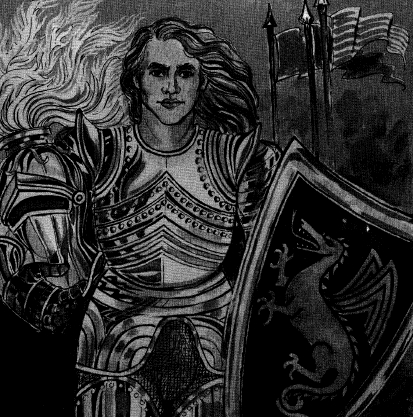
Conflicts arise when 2 coats-of-arms
look alike or seem to cast aspersions on
each other. When 2 arms-bearers disagree,
they can either fight a duel or submit
the case to a court of chivalry. Most
nobles sponsor such a court to prevent
their knights from killing each other and
because they collect any fines the court
imposes. A court of chivalry consists of
three judges: a marshall, a constable, and
an officer of arms. Courts of chivalry not
only decide questions of heraldry but may
judge any other disputes of honor.
Characters who lose cases before the
court of chivalry must pay fines or be
imprisoned until someone pays for their
release. The exact amount depends on the
dishonor of the infraction. A fee for accidentally
duplicating some distant noble?s
shield might be only 100 gp. However, the
court might demand 10,000 gold coins
from a common-born forger who wore a
fake coat of arms as a disguise. The college
of heralds may overturn any decision of a
court of chivalry.
The heraldic field
DMs and players may use as much or as
little detail as they want when simulating
coats of arms. A few common terms and
heraldic devices have been listed here for
those who want to know what their
achievements look like. You might also
consult Lewis Pulsipher's article, "Understanding
Armory," in DRAGON® issue #53.
The primary design of a coat of arms is
emblazoned on a shield, but an entire coat
of arms often includes drawings of helmets,
wreaths, crests, surcoats, scrolls
with mottoes, animal supporters, and
other decorations. Only nobles carry
coats-of-arms on their shields. Their elite
retainers have blank shields, but they do
wear badges with their lord?s crest and
dress in a livery of certain trademark
colors.
Heraldic symbols have some relationship
to the family that they represent, epitomizing
virtues that the household cherishes
or great deeds its members have
performed. Some meanings seem obvious,
but others are less so. Dolphins imply
speed, diligence, and compassion; boars
indicate aloof independence. Pentagrams
indicate wizardry; constellations imply
that the house is the subject of a certain
prophecy; an acorn indicates the god
Thor; a crown with radiating spikes, like
the one on the Statue of Liberty, means
contact with elves; and a red oriflamme
(banner) proclaims that the gods themselves
have aided that noble house. Plants
each have some significance. Trees signify
fruitfulness and fertility; the fir implies
royalty; cypress and pine indicate death;
and oaks express military virtue and fortitude.
Grapes and vines represent joy;
roses express youth and beauty; violets
and pansies both mean piety or charity;
and sunflowers indicate virtuous behavior.
Arms-bearers indicate their social rank
w/ the image of a crown. Mere knights
employ a circlet with 3 pearls above it;
patricians use a coronet between two
pearls; and members of the baronial class
employ crowns amid larger numbers of
pearls, the number depending on their
power. A naval crown, of three ships in a
circle with masts between them, indicates
service on the ocean, and gryphons indicate
observant vigilance. Only the royal
family may use lions in its armory. Certain
blazons are intended as puns or jokes. A
knight named Sir Cox might bear a rooster
on his shield, and a Lord who tended to
drunkenness might have a bottle in his
achievement.
Heraldic terms
Players who are truly interested in heraldry
should consult the books listed in the
bibliography, where they will find countless
examples of shields along with the
complete laws governing inheritance,
marshalling, and cadence. To visualize
these symbols, you will need to understand
heraldic directions. These terms
assume that one wears the shield on the
left arm; under those circumstances, dexter
is right, and sinister is left. To an enemy
facing a shield, or to an artist
drawing it, these directions are reversed.
The shield?s center is called ?fess,? its bottom
is ?base,? and its top is ?chief.? Thus, a
heraldic shield can be divided into nine
parts, with three vertical coordinates and
three horizontal ones.
Heralds also use a complex system of
coloring summarized in Table 2. Tincture
may never rest on tincture, nor metal on
metal, nor fur on fur. Furs are always
drawn in patterns over another color. Vair
looks like a field of tiny bells, and ermine
appears to be a series of tiny arrowheads,
with three dots forming a triangle over
each one. Vair can be used in ?T? shapes,
and this is called ?crutch.?
Exotic heraldry
The Oriental Adventures book lists
heraldry
as a court proficiency. This one
entry replaces all the heraldic proficiencies
listed in this article except for signaling
and draftsmanship, since heraldry is
one of the few arts that involve more
intricacy and courtesy in the west than
the Orient. Oriental blazons were round
and worn on clothing, not shields. An
Oriental coat of arms appears once on the
back of a jacket, on each sleeve, and twice
on the chest. Historical Oriental heraldry,
which is called mons, was practiced only
in Japan. DMs who base their Oriental
adventures in Kara-Tur might rule that
only Kozakura and Wa recognize heraldry.
The other Oriental nations would consider
it meaningless and slightly barbaric.
Like gajin, Orientals receive the right to
display heraldry for distinguished service,
and counterfeiting arms is a severe crime.
However, there is no Oriental equivalent
of the college of heralds, and arms are as
likely to indicate civilian work as military
prowess. Samurai had no monopoly on
mons. Instead, a noble warrior expressed
his status with his kabuto (helmet), and
these sculpted headpieces often became
quite bizarre. Powerful daimyos decorated
their helms with great collections of
statues, masks, and false rabbit ears. This
last symbol indicated longevity, due to the
Oriental belief that the dark maria on the
moon depict a rabbit compounding elixirs
of immortality.
Orientals often used extremely abstract
symbols, but their insignia usually had
some meaning. During the period when
Christianity was illegal in Japan, Christian
arms-bearers developed many ways to
hide crosses in their mons. If religious
conflict is important in an Oriental campaign,
players may consult the DEITIES & DEMIGODS book for symbols
to disguise.
<Chinese Mythos>
<Japanese Mythos>

Another form of heraldry was practiced
by amirs in ancient Islam. The Saracens
did not have a heraldic system like that in
Europe or Japan, but they did employ
family symbols. These could be bounded
by almost any shape, including circles,
octagons, squares, diamonds, and ovals.
Almost all of these symbols were quite
explicit in their meaning: a scribe might
display a pen box, while the royal cupbearer
might carry the picture of a drinking
glass. When two achievements had to
be distinguished, each family would add
new devices to their symbol. In a fantasy
world, the DM might create any number
of variant heraldic systems for different
cultures. This can create interesting cultural
clashes. What will gajin cavaliers
think of samurai who wear bunny ears?
Bibliography
Franklyn, Julian. Heraldry, Cranbury, N.J.:
A. S. Barnes and Company, 1968.
Franklyn, Julian. Shield and Crest. Baltimore,
Md.: Genealogical Publishing
Company, 1967.
Uden Grant. A Dictionary of Chivalry. New
York, N.Y.: Thomas Y. Cromwell Company,
1968.
Table 1
Heraldic Proficiencies Table
| Proficiency | Ability | Dice modifier |
| Blazoning | Intelligence | +1 |
| Boasting | Charisma | +3 |
| Differencing | Intelligence | +2 |
| Draftsmanship | Dexterity | 0 |
| History | Intelligence | 0 |
| Heraldic law | Intelligence | -1 |
| REVELATIONS | Intelligence | 0 |
| Signaling | Wisdom | -2 |
| Tinctures | - |
| Azure | blue |
| Gules | red |
| Purpure | purple |
| Sable | black |
| Sanguine | mulberry |
| Tenne | chestnut |
| Vert | green |
| - | - |
| Metals | - |
| Argent | silver |
| Or | gold |
| - | - |
| Furs | - |
| Ermine | white |
| Vair | light blue |
FEBRUARY 1990
THE FORUM
I would like to add to the bibliography of
Thomas
Kane's "All in the Family" (issue #153),
especially
as some of these works are easier to
locate
than those referenced in the article?it
took
a specialist in used books six months to
locate
a copy of Shield and Crest, whereas most
of
the books in the list that follows were obtained
via
Barnes & Noble or similar clearance
catalogs
during the past few years.
Fox-Davies,
Arthur Charles. A Complete Guide
to
Heraldry London: Orbis Publishing Limited,
1985
(original copyright 1909).
Fox-Davies,
Arthur Charles. The Art of
Heraldry
London: Bloomsbury Books, 1986
(original
copyright 1904).
Friar,
Stephen. A Dictionary of Heraldry. New
York:
Harmony Books (a division of Crown
Publishers,
Inc.), 1987.
von
Volborth, Carl-Alexander. The Art of Heraldry
Poole,
Dorset, England: Blandford
Press,
1987.
Woodcock,
Thomas, and John Martin Robinson.
The
Oxford Guide to Heraldry. Oxford:
Oxford
University Press, 1988.
Either
of Fox-Davies?s works would serve as a
reference
to the art. The ?revision? of the Complete
Guide
consists of footnotes pointing out
errors
or differences from current practice. The
Dictionary,
while quite complete, is not suitable as
a text.
The Art of Heraldry (von Volborth?s) and the
Oxford
Guide offer historical perspectives on the
art,
but without the details and rules available
from
Fox-Davies; von Volborth, in fact, emphasized
?art?
over ?heraldry.?
In a
way, I was surprised at not finding Fox-
Davies
listed in the original article. I was under
the
impression that his Complete Guide was
practically
the textbook for heraldry.
Table
2 of the article requires some clarification.
While
the metals argent and or do translate
to
silver and gold, they are commonly
rendered
as white and yellow! The furs are
better
described in the text, the table being
highly
misleading. Ermine, to be properly described,
consists
of black ermine tails on a white
field
(the shape of the tail spots varies with
period
and artistic taste; also, the field is white,
not
silver). Vair consists of alternating patches of
blue
and white. To the tinctures I would add
proper,
which is the term used to indicate
natural
coloration?and about the only way to
get
the color brown into a device (a bear
proper.
. .).
Mr.
Kane?s article leaves the impression that
only
nobles were authorized to use arms. It
should
be pointed out that heraldic devices (as
opposed
to grants-of-arms) were used in other
areas.
Inn and guildhall signs were quite often
heraldic
devices; when few can read, pictures
are
often useful identification marks. A shovel
and
pickax crossed in saltire could easily represent
the
local mining guild, while a loaf of bread
would
identify a baker. (I do wonder, though,
how
the blazon for the Vulgar Unicorn [of the
Sanctuary
fantasy series] would read.) A further
source
of heraldic devices would be the church.
Clerics
might be granted arms by the upper
hierarchy
of their church.
This
last possibility brings up the subject of
heraldic
jurisdictions. For purposes of example,
let
us visualize a medium-size island kingdom, a
kingdom
located on a continent with coastal
access
to the island, and a religious hierarchy
common
to both. It is possible, though perhaps
unlikely,
that the same device could be granted
to
a noble of the island (by that kingdom?s
college
of arms), a knight of the continental
kingdom
(again, by a local college of arms), and
to
a high priest of the church (by the church?s
college
of arms). All three bear legally granted
arms!
Yet a conflict could ensue should all three
meet
on a battlefield or at a tournament.
More
likely, the church would examine the
books
of the two kingdoms in an attempt to
avoid
a conflict before granting a device. Better,
the
church may actually attempt to register the
device
with the colleges of both kingdoms,
avoiding
the possibility of a conflict should the
priest
be reassigned.
Dennis
Lee Bieber
Sunnyvale
CA
(Dragon #158)