-
| The Campaign (DMG) | - | - | - | Starting From Scratch (WSG) |
| Campaign Design | - | - | - | - |
| - | - | - | - | Dragon |
Plan Before You Play : Think it over, then map it out (63.50)
The Making of a Milieu : How to start a world and keep it turning (93.12)
Some
Universal Rules : Making your own campaign -- and making it work (53.22)
Getting
a World into Shape (49.28)
Blueprint
for a Big Game : How to accomodate a world's worth of players (97.44)
Detailing
a Fantasy World : After mapping comes mixing and fixing (98.22)
Standardization
vs. Playability (30.20)
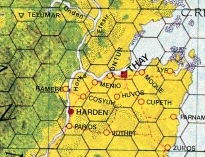
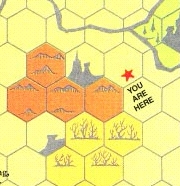
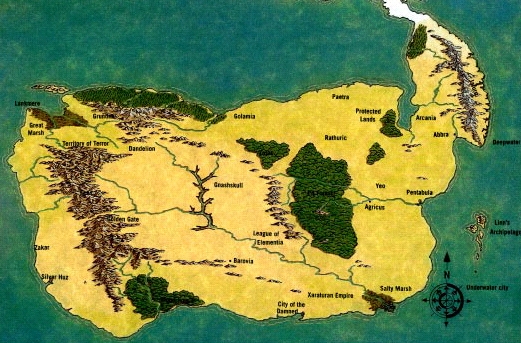
Source: Regional map of
Harn
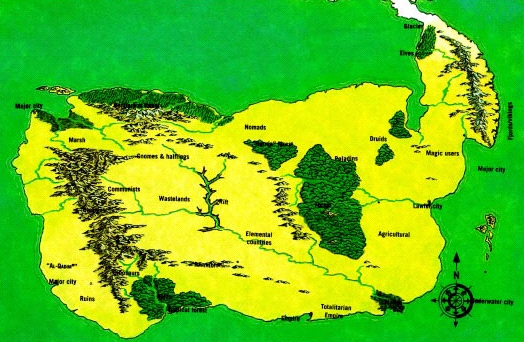
Source: The Known World
(D&D)

THE FORUM
Can a medieval fantasy world
be sheltered?
Several of DRAGON's recent
artilces have said
that features of the middle
ages, such as disease,
poverty, and overcrowding
need not exist in
AD&D. Magick
would replace technology.
Through spells, the average
character could be
healthy and pampered.
It might be nice if such a
world existed. But
AD&D is an adventure game;
you cannot adventure in luxury.
I am reminded
of a cartoon in a recent
DRAGON
where 2
warriors face a box.
On the box is written,
"Contains 1 minotaur:
For 300 XP insert sword
in slot." 1 warrior
says, "Kind takes the Fun
out of it.: He is right.
The point of most
scenarios is to overcome
difficulties.
In a primitive world, The
Game need not end
when the dragon is dead.
Everyday life presents
adventurers and complications.
The PC must
work with corrupt government
officials or evade them.
They must deal with teeming
mobs, avoid or
help beggars, and strive
for every comfort they
desire. Long journeys
might be made to avoid a
plague. More scenarios,
and more exciting ones
are possible in such a world.
There is also more
motivation to adventure.
If you can get a plush
job in a pleasant city, why
risk your life in a
dungeon?
A case can be made that magic
would not
change a world much. After
all, there are a few
people with the power to
be wizards, and each
one knows only a few spells.
Some misuse even
these. Disasters can eliminate
huge stores of
knowledge. Thus, magic does
little to affect
daily existence. Certainly,
fantasy citizens will
improve their lives with
magic, but it should be
rare — a sign of power and
mystery. Technology
suffered a similar problem
for many centuries.
A steam engine was invented
in ancient Greece!
However, it was only used
in a toy, and never
developed any further.
I’ll grant that whatever a
DM wants in his/her
campaign should be there.
If the DM and players
enjoy a game, it is good.
Some people may
like a world where magic
solves all common
problems. It could serve
as a release, as a vision
of utopia. Still, think twice
before discarding
your primitive world.
Thomas Kane
Farmington, Me.
(Dragon
#113)
I would be interested in finding
out when
most players of the AD&D
game consider their
campaign worlds to be set.
I have always assumed
that the game was set in
the 20th Century,
in a world like that of Lord
Darcy's in the
Randall Garrett stories.
Although the setting is
medieval, my reasoning is
that a world of magic
would not develop much technology.
Magic, whether by mage or
cleric, is spectacular.
A single person can use it
to perform feats
that would require a hundred
men otherwise.
This power would be jealously
guarded by its
practitioners, and rival
skills, such as technology,
would be suppressed. Technology
would
also have the stigma of being
messy, dirty and
hard work. A mage mutters,
waves a few
leaves, and produces a piece
of cloth. A weaver
bends over a loom for days
to do the same
thing, then dyes it, cuts
it, and tailors it.
But not everyone can perform
magic. Magic
would be practiced by anyone
capable of it but
less intelligent beings would
develop technology,
which can be used by anyone.
Some technology would be developed
to
handle simple tasks that
magic-users and clerics
would consider beneath their
dignity. More
technology would be developed
by envious
persons who, being unable
to perform magic,
wanted power of their own.
Still more would be
developed because of to the
small number of
spells available. When plague
comes along, some
people are going to go without
healing spells.
Then medicine is going to
be developed.
James R. Collier
Georgetown, Ontario
(Dragon
#152)
In regard to Craig Hardie?s
letter of issue #166
concerning his annoyance
with TSR?s preoccupation
with pregenerated campaign
worlds,
especially the FORGOTTEN
REALMS setting, I
agree completely. I, too,
am annoyed at the
preponderance of prepackaged
products produced
by TSR?products that, while
sounding
interesting, I would never
buy since I don?t
follow the milieu.
I imagine it makes economic
sense for TSR to
attempt to consolidate its
products under one
(or three) banners, but then
TSR loses its most
attractive quality: its support
for Dungeon
Masters? own individually
created game worlds.
Unlike such role-playing
games as Iron Crown?s
MERP* game, where the players
and game
master are limited to one
world, TSR allows for
an endless variety of options,
and the only
limiting factor is your imagination.
TSR?s recently released Ruins
of Undermountain
boxed set for the Realms,
is a perfect example.
It sounds interesting, and
I?ve always been
partial to underground campaigns,
but it?s not
worth the effort to adapt
the boxed set to my
own milieu. I don?t know
who the Lords of
Waterdeep are, let alone
the Harpers, the Red
Sashers, or Force Grey. I
don?t particularly care
to find out. Even ignoring
individuals, politics,
and cultures peculiar to
the Realms, the Ruins
would still have the ?feel?
of the Realms. An
infinitely more useful cavern
campaign, from
my point of view, is that
of the Underdark from
the Dungeoneer’s
Survival Guide; lacking specifics
such as politics, it is easy
to cut and paste
whichever part appeals to
you, and place it
easily into your own campaign.
The creation of
more generic adventures would
be useful to a
much greater number of Dungeon
Masters, no
matter what campaign world
they use.
Again, if I don?t care for
these products, I can
simply ignore them. This
is not the case with
DRAGON Magazine; articles
devoted to the
FORGOTTEN
REALMS, DRAGONLANCE,
WORLD
OF GREYHAWK®, or the D&D® game?s
Known World settings are,
usually, so much
wasted space. I wish DRAGON
Magazine would
devote more space to articles
concerning game
mechanics, advice to Dungeon
Masters, and new
PC and NPC character classes.
?The Dragon?s
Bestiary,? new spells, and
new magical items are
always useful; the shared
ideas of the ?Forum?
especially so. In that way,
issue #167 was very
nearly perfect; almost every
article could be
adapted to suit your own
campaign.
Robert W. Heym
Murray Hill NJ
(Dragon #174)
In response to Craig Hardie?s
letter to ?Forum?
in DRAGON #166, I
can say no less than ?Bravo!?
I am glad someone has finally
come forth with
the points that Craig raised
as to the overwhelming
amount of material that is
slanted
toward pregenerated worlds.
I have been DMing for 12 years,
and I have used
pregenerated worlds, namely
TSR?s WORLD OF
GREYHAWK
setting and the less-well-known
HARNWORLD* from Columbia
Games. However, I
have always used a world
of my own creation for
my regular gaming sessions.
It is my experience that all
the people with
whom I have played get more
enjoyment out of
the game when playing in
a world that is specifically
tailored to bring them the
most enjoyment
possible. Also, there is
much more mystery and
adventure involved in a world
that only the DM
has access to. Everyone is
familiar with many
aspects of the FORGOTTEN
REALMS world
even if they have never played
in them. Doesn?t
familiarity take away some
of the mystique of
playing? And isn?t the mystique
part of what
makes the AD&D game enjoyable?
Another negative aspect of
using a pregenerated
world I have found is that
the DMs running
them do not know everything
that is contained
in the source books for these
worlds. It is terribly
frustrating to players when
the DM is constantly
pausing for 15 minutes to
look up that
?one little thing? that he?s
forgotten. I have
played in games where players
got so bored
during these pauses that
they were falling
asleep.
If one is DMing with his own
world, there is
rarely, if ever, a need to
look things up. When
you create something, it
comes out of your head
and will always be there.
I heartily agree with Craig?s
idea of running
more articles in DRAGON
Magazine on original
AD&D campaigns and ideas
for creating and
running them. I, too, am
tired of endless articles
centered on the same old
campaign worlds. In
fact, although I have recently
resubscribed to
DRAGON Magazine, I
hadn?t read the magazine
in three years because I
got tired of the same
old stuff. I wanted (and
still want) to see more
articles that are designed
for helping DMs be
more creative. It seems that
most articles in
DRAGON Magazine are
there so that DMs
needn?t be creative at all;
they can just take
ideas from the pages of the
magazine.
I do believe, however, that
pregenerated
worlds are essential and
that DRAGON Magazine
should continue to devote
some space to
articles on these worlds.
The reason for this is
that very few beginning DMs
would know
where to begin in creating
their own worlds.
They can go out and buy FORGOTTEN
REALMS
products and be DMing in
a few days. There are
not enough DMs as it is,
and without pregenerated
worlds there would be a lot
fewer.
Not only is it ridiculous
to expect beginners to
create their own campaign
settings, it is just as
ridiculous to think that
all DMs, no matter how
experienced, have the time
to do so. For these
DMs, pregenerated worlds
are a godsend. And
Craig, you have to admit
they have done an
excellent job in making pregenerated
worlds
both exciting and very flexible.
I, however, will stick to
my own world of Marid
Dun that currently fills
four three-ring binders and
has taken 3½ years
to complete (in fact, I wouldn?t
say it is really complete
yet). How about it: Should
DRAGON Magazine give the
more creative AD&D
game players equal time?
Shawn A. Chesak
Milwaukee WI
(Dragon #174)