| What is healing? | Why no healing? | Magic-user healing | New magic-user spells | - |
| Dragon #148 | - | - | - | - |
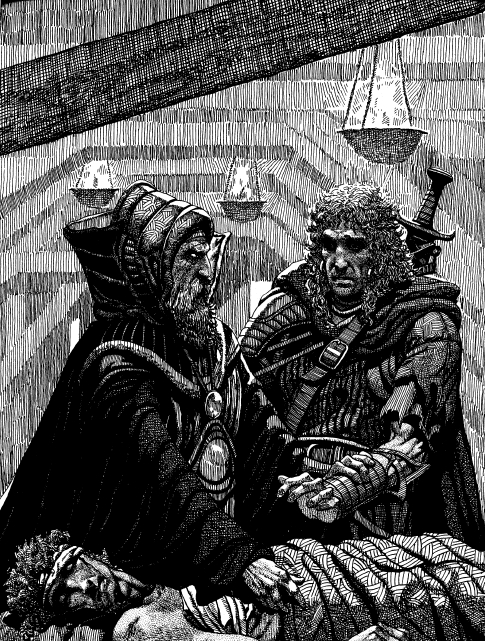
Villem was dying. His
breathing became ragged and irregular, and his
eyes glazed over as
he muttered a prayer to Tyr. His grasp on
Renfrew's forearm loosened.
"Can you do something
to heal him?" Renfrew cried, turning on
Fratakara.
The mage took a step
back, stroking his chin slowly. His eyes were
hooded by shadow,
and the others could not read his expression. He
shook his head.
Renfrew knelt over
Villem, checking the bandages with which he had
crudely bound his
brother's wounds. He cursed himself for not listening to
Villem's lessons,
being more interested in the arts of combat than the arts
of healing. The young
priest had taken the brunt of the dragon's attacks,
holding the monster
off so that the others could pull Renfrew from
beneath its claws.
Now Villem was paying for his bravery with his life.
As the last breath
slipped from Villem's slim body, a rage grew within
Renfrew, a senseless
rage that he could not hold back. "Damn you,
Fratakara!" he shouted.
"All your books, all your knowledge, all your
spells, and you can
do nothing to save my brothers life! Your magic is
worthless!"
It is
by design that magic-users have
no healing abilities in
the AD&D® 1st
Edition game. Were
they able to heal
as well as they harm, they
would be
invincible indeed. Game
balance dictates a
separation of powers. But
must the answer
to the question, ?Can you
do something to
heal him?? always be negative?
Three typical
responses from magic-users
are:
1. ?Alas, no,? the low-level
mage replies.
?I am not trained in the
healing arts!?
2. ?Alas, no,? the high-level
mage replies.
?But after he dies, I can
reincarnate him as
a bugbear.?
3. ?No problem:? the very
high-level
mage replies. ?I can wish
him back to full
strength, but I?ll age three
years in the
process. Got a potion of
longevity??
None of these options is
particularly
heartening to the player
whose character
has no hit points left to
his name. Is it
possible for magic-users
to heal others? Is
it desirable?
What is healing?
When we speak of healing,
we mean
restoring hit points that
a character has
lost due to damage. The
powers that affect
healing are represented
by: the clerical
spells cure light wounds,
cure serious
wounds, cure critical wounds,
and heal;
the potions healing and
extra-healing; and
the elixir of life. It is
also possible to give a
character more hit points
than his maximum,
by means of the clerical
aid spell
and the potions of heroism
and superheroism.
Other forms of healing that
most clerics
have access to can: restore
functions to a
damaged character (spells
like cure blindness,
cure disease, restoration,
and regenerate,
and the elixir of health
and ring of
regeneration); negate the
effects of poison
(slow poison, neutralize
poison); bring the
dead to life (raise dead
and resurrection,
and the rod of resurrection);
and prevent
death (death’s door). Other
forms of clerical
healing include a full-spectrum
immunity
energizer (heroes’ feast)
and your
basic snake-oil (Keoghtom’s
ointment).
One could argue that magic-users
can
already heal, because they
(along with
alchemists and other spell-casters)
are the
manufacturers of potions?and
potions
are, after all, spells in
a bottle. This begs
the question, though, because
mages cannot
carry their laboratories
when they go
adventuring. But it does
point out that
magic-users can heal. Why,
then, can they
not cast spells that have
the same effects
as the clerical healing
spells?
Why no healing?
Magic-users and clerics
(including
druids) share many spells.
Most of the
detection spells are common
to both character
classes (detect evil, detect
magic,
know alignment, etc.). Some
combat and
person-affecting spells
are the same or
very similar: hold person;
quest and geas;
and flame strike and fireball.
Many
general-purpose spells are
also held in
common, such as light, animate
dead,
protection from evil, and
rock to mud.
The magic-user?s arsenal
generally packs
more powerful punches when
it comes to
damage (e.g., the clerical
flame strike does
an average of 27 hp damage,
whereas the
equivalent 9th-level magic-user?s
fireball
does 31.5 hp), while the
cleric?s arsenal
generally offers longer
spell durations
(e.g., the clerical protection
from evil at
one turn per level, while
the magic-user?s
is two rounds per level).
As far as casting
time goes, magic-users are
quicker on the
draw than are clerics?but
not always
(e.g., know alignment).
There is a philosophical
difference between
mages and priests that is
reflected
in their abilities. Magic-users
are interested
in abstract knowledge, personal
gain, and shaping the universe
to fit their
whims. Clerics desire to
serve a deity, aid
and serve those who share
this desire,
further a particular ethos,
and gain converts
to their beliefs. Clerics,
by virtue of
their relationships with
higher powers,
have a closer connection
to the origins of
life. Thus, they have a
wide range of healing
and detection abilities
to help further
those goals. Magic-users,
on the other
hand, have many spells that
allow them to
dominate the physical world.
Not all magic-users are selfish,
powermad
individuals lusting for
control of the
universe. The question is,
then, how can
we give magic-users spells
that heal without
disturbing game balance?
It would
help to see what magic-users
can already
do to heal themselves and
their fellows.
Magic-user healing
"Magic-user healing" sounds
like a contradiction
in terms, but magic-users
(including
illusionists) do indeed
have
rudimentary healing powers,
though it
may not seem that way at
first glance.
Here?s the rundown by spell
level:
Find
familiar (first-level spell): This
double-edged spell allows
the magic-user
to add the hit points of
a familiar (2-4 or
more hp) to his total when
the familiar is
within 12". Unfortunately,
if the familiar is
killed, the magic-user loses
double the
number of its hit points
Feign
death (third-level spell): This is a
useful but underused spell.
It can produce
the same effect as slow
poison (though for
a lesser duration), because
poison does not
affect a person under the
effect of feign
death. It might also be
used to prolong a
character?s life when he
has been brought
to zero or fewer hit points.
Dispel
exhaustion (fourth-level illusionist
spell): This spell temporarily
restores 50%
of lost hit points. However,
the character
loses those magical hit
points at the end of
the duration of the spell
(thus, if he is
"running on empty," he will
collapse).
Polymorph
self (fourth-level spell): This
spell heals only the magic-user
who casts
it. When he finally reverts
back to his
original form, the spell-caster
is cured for
l-12 hp. Many mages keep
this spell memorized
only for this reason!
Dream
(fifth-level illusionist spell): This
spell is similar to the
limited wish spell but
is a little more flexible.
Reincarnate
(sixth-level spell): This spell
brings someone back from
the dead in
much the same way as the
clerical raise
dead spell. No system-shock
or resurrection
survival roll is required.
There is, of
course, a drawback: The
recipient of the
spell most likely will not
return as his
original race. On the positive
side, there is
a 48% chance of returning
as a humanoid
(so for a fighter, this
might not be a terrible
option if no others are
available).
Tenser’s
transformation (sixth-level
spell): This spell temporarily
doubles the
mage?s hit points, giving
a kind of healing.
It has many drawbacks, though.
It makes
the mage berserk and unable
to cast
spells. If he is damaged
beyond the added
hit points, the mage takes
double damage.
And to top it off, the material
component
for the spell is a potion
of heroism!
Limited
wish (seventh-level spell): This
spell cures the mage of
some of his hitpoint
loss, or all his hit-point
loss temporarily.
As with all wishes, the
wording of
the wish is critical and
is subject to the
interpretation of the Dungeon
Master. It is
also an expensive spell
to cast, for it ages
the caster by one year.
Alter
reality (seventh-level illusionist
spell): This spell is similar
to the limited
wish spell.
Clone
(eighth-level spell): Though not as
obvious as the other spell
choices, this
spell is an excellent replacement
for raise
dead (albeit a less-convenient
replacement).
When combined with the preserve
spell, an effective life-insurance
policy can
be taken out with a high-level
magic-user.
A character need only donate
a bit of flesh
to the mage (who preserves
the flesh) at
regular intervals. If the
character meets an
untimely end (such as disintegration),
he
can be restored to life
as he was when the
last donation was made.
The character
loses some memories and
experience
points, but he will at least
be alive. Be
forewarned: Some DMs may
not be amenable
to this sort of bending
of the rules.
Temporal
stasis (ninth-level spell): Similar
to the feign death spell,
temporal stasis
might be used to defer curative
action to a
later time when a cleric
is available.
Wish
(ninth-level spell): This is the ultimate
spell, the one every mage
itches to be
able to cast (but is afraid
to cast). This is
the magic-user?s cure-all:
It can restore lost
hit points, remove diseases,
raise the dead,
etc. It has the drawback
of aging the
caster by three years, and
it is subject to
the interpretation of the
DM. But healing
is the most benign use of
the wish (as it
has no debilitating side
effects other than
the aging) and will most
likely be granted
by all but the most heartless
DMs.
There may be other conniving
schemes
by which magic-users can
obtain healing
powers, but this list is
sufficient to draw a
few conclusions. These conclusions
are as
follows:
1. Spells that mages can
use to heal are
higher level (none below
4th).
2. The amount of healing
is either small,
temporary, or the by-product
of another
effect.
3. There is a substantial
cost for casting
the spell (e.g., aging or
an expensive material
component).
4. There are often undesirable
side
effects.
5. Increases in hit points
are generally
confined to the spell-caster.
6. No new life essence is
created. Healing
is accomplished by accelerating
normal
processes or by transferring
hit points
from another source.
This last point (#6) shows
the key difference
between the clerical and
magic-user
spells: The former produce
a net increase
in life-force while the
latter maintain a
balance.
New magic-user spells
Keeping the above guidelines
in mind,
we can design curative spells
for the
magic-user that do not disrupt
game balance
or anger the gods.
Arnvid's
Unseen Limb
(Conjuration/Summoning)
Level: 4
Range: Touch
Duration: 6 turns/level
Components: V, S, M
CR: 1 round
ST: None
AE: Creature touched
When Arnvid’s
unseen limb is cast, the
magic-user causes
an invisible limb (arm,
hand, leg, or foot)
to come into being. This
limb may replace
a missing limb, or it may
be used to create
an extra one. The invisible
limb functions
exactly as a normal limb,
except that, at
the option of the recipient
of the spell,
parts of it may become immaterial
so as to
pass through solid objects.
For example,
the limb could be used to
uncork a potion
inside a closed chest and
dump the bottle
out, but it could not remove
the potion
from the chest. The limb
has normal touch
sensations. It may be used
to wield a
weapon only if the limb
is replacing a
missing arm or hand. The
limb bestows no
extra senses other than
touch, so it cannot
be used, for example, to
add a second
shield arm in the middle
of the recipient?s
back. The invisible limb
has no hit points
or armor class as such,
and it cannot be
harmed unless it is dispelled.
MC: The tail of a lizard
(any type that regenerates
lost body parts). This is
touched to the
place on the body where
the limb is to be
restored.
Empath
(Necromantic/Alteration)
Level: 4
Range: Touch
Duration: Permanent
Components: V, S, M
CT: 5 rounds
ST: None
AE: Creature touched
The empath
spell enables the caster
to transfer a certain
loss in hit points from
another creature
to himself, thus curing
the recipient.
Up to 2 hp per level of
the spell-caster may
be transferred, so a 10th-level
magic-user
could cure his friend of
a 20-hp wound
(but the magic-user will
then take 20 hp in
damage himself). The hit-point
loss could
have originally resulted
from physical
attacks, certain poisons,
spell effects,
diseases, or curses (except
those that cannot
be removed by remove
curse). This
spell cannot restore amputated
limbs,
drained life levels, or
death. It also cannot
undo any continuously acting
poison or
disease, so the spell only
temporarily
reverses such harm, which
will then con-
tinue to affect the victim.
If the caster is brought
below zero hit
points by use of empath,
he begins to die.
No effect results from casting
empath on
the deceased character.
MC: Hair and blood from both
the recipient
and the caster, two newt
eyes, and two
wolf teeth (each from a
different animal).
The components disappear
in the casting
of the spell.
Life
Force Transfer (Necromantic)
Level: 4
Range: 12"
Duration: Instant
Components: V, S, M
CT: 4 segments
ST: None
AE: 1 creature
This spell
allows the caster to transfer
some of his
life-force to another creature.
When cast,
the spell transfers 1 hp/level
of the caster
to the target creature,
plus an additional
1-4 hp. The hit points are
added to the
target's current hit-point
total and deducted
from the spell-caster's.
Thus, <an Enchanter> can transfer
8-11 hp from
himself to another creature.
The caster
can transfer only as many
hit points as he
currently has; if he purposefully
or accidentally
transfers more, his current
hitpoint
total plus 1-4 hp are transferred
to
the target, while that amount
is subtracted
from the caster?s total
(and the caster
begins to die). The target
creature cannot
gain more hit points than
its full normal
total; such extra hit points
are merely lost.
The magic-user?s hit-point
losses can be
regained by normal healing
or magic.
After the transfer is complete,
the
magic-user loses four points
of constitution
temporarily; each point
may be recovered
by six turns of rest. If
the caster's
constitution drops below
3, unconsciousness
results and full constitution
is not
regained for 24 hours. The
material component
of this spell is a glass
tube filled
with the caster?s blood,
which disappears
when the spell is cast.
Dispel
Exhaustion
(Illusion/Phantasm)
Level: 5
Range: Touch
Duration: 2 turns/level
Components: V, S
CT: 5 segments
AE: 1-3 persons
Except as
noted above, this spell
is the same as the
4th-level
illusionist spell of the same name.
Accelerated
Metabolism
Level: 6
Range: Touch
Duration: 1 turn/lvl. +
1d6 turns
Components: V, S, M
CT: 6 segments
ST: None
AE: 1 creature
This spell
speeds up the life processes
of the recipient
at a rate of 1 day/turn
for the duration
of the spell. All life processes
(sleeping,
eating, healing, etc.) progress
at this accelerated
pace. If insufficient nourishment
is
provided, the recipient
suffers from thirst
and starvation. Three rounds
of rest per
turn must be allowed, otherwise
exhaustion
results and no healing is
possible. The
other seven rounds per turn
must be
spent eating and drinking
a day?s rations.
The recipient regains 1 hp/turn
for the
first seven turns (minus
any penalty due to
poor constitution). In subsequent
multiples
bf seven turns, characters
with constitution
bonuses additionally receive
their
constitution bonus score.
In any case, 28
turns of accelerated metabolism
heal a
character completely.
However, each turn ages the
recipient a week (as opposed
to a
day), due to the stresses
of the
artificially high metabolic
rate.
Note that the character
does not move or
fight any faster than normal:
Also, if the
recipient of the spell is
unwilling, a saving
throw is applicable.
MC: A candle, which must
be lit at both ends.
The candle must burn for
the duration of
the spell; if it is extinguished,
the spell
ends prematurely. The candle
is completely
burned if the spell runs
its normal
course.
Vampire
Dagger (Necromantic)
Level: 6
Range: 0
Duration: 1 round/level
Components: V, S, M
CT: 6 segments
ST: Neg.
AE: Personal
By casting this
spell on a specially prepared
nonmagical
dagger,
the magic-user is able to drain hit
points from other creatures
that he strikes
with it and bestow those
hit points on
himself. The magic-user
must attack the
creature normally with the
dagger. If the
hit is successful, the creature
takes normal
damage from the dagger (l-4
for smalland
man-sized creatures, l-3
for largesized
creatures, plus any strength
bonus),
plus bonus damage of 1 hp
for every two
levels the spell-caster
has. The magic-user
in turn gains this bonus
damage as cura-
tive hit points. If the
victim makes its
saving throw vs. death magic,
it takes
damage from the dagger but
no hit points
are transferred to the spell-caster.
If the
save is a natural 20, the
magic-user takes
the bonus damage instead
of the victim. If
this spell drains more hit
points from a
victim than remain in that
victim, the
victim dies; only those
hit points left to the
victim after the dagger?s
damage (with
strength bonuses) is subtracted
are transferred
to the magic-user. The magic-user
cannot gain hit points above
his normal
hit-point total; all extra
hit points are lost.
For example, a 16th-level
magic-user hits
a minotaur with 26 hp and
rolls a 2 for
damage, doing a total of
10 hp damage.
The minotaur fails its saving
throw, and
the magic-user gains 8 hp
(he lost 10 hp in
a previous fight). The next
round, the
magic-user hits again and
does 1 + 8 = 9 hp
damage. The minotaur makes
its save, so
no hit points are transferred.
On the next
round, the magic-user hits
again and does
2 + 8 = 10 hp damage. The
minotaur fails
its save and dies, having
had only 7 hp left.
Thus, only 7 - 2 = 5 hp
can transfer to the
caster. The caster gains
only 2 hp, however,
since this increase puts
him at his
maximum hit-point total.
This spell is ineffective
against creatures
that can be harmed only
by magical weapons
(undead excluded) and creatures
that
have no blood (e.g., golems).
If the dagger
is used in an attempt to
drain an undead
being, the magic-user must
save vs. death
magic with each strike or
die himself; the
undead being only takes
damage from the
dagger and associated strength
bonuses.
One of the material components
of the
spell is a dagger that has
a channel inside
it running from the tip
through to the
handle. The dagger must
be forged from
an alloy of silver and steel
that has been
mixed with the crushed bone
of a vampire.
The minimum cost of such
a dagger
is 2,000 gp. Blood from
the dagger?s
wound must travel through
the channel
and touch the bare flesh
of the magicuser
?s hand for the hit points
to be transferred.
The dagger remains after
the
completion of the spell.
The other material
component of this spell
is the claw of a
vampire, which disappears
after the spell
is cast. The effects of
this spell do not
protect the caster from
any unusual effects
of the victim?s blood.
Exchange
(Necromantic/Alteration)
Level: 8
Range: Touch
Duration: Permanent
Components: V, S, M
CT: 5 rounds
ST: Neg.
AE: 2 creatures
This spell is
similar to the empath spell,
except that it
allows the caster to transfer
a hit-point
disability (of up to 2 hp/level
of the caster)
between any two creatures,
excluding the
caster. The magic-user must
be able to
grasp both the creature
with the disability
and the creature about to
receive the
disability without having
to make to-hit
rolls, so the two beings
involved must
either be willing to undergo
the spell or
else be sleeping or unconscious.
The recipient
of the disability is entitled
to a saving
throw vs. spells if unwilling.
If the recipient
?s saving throw succeeds,
the exchange
is incomplete and nothing
further happens.
If the recipient fails the
saving throw,
the disability passes through
the magicuser,
inflicting him for an instant.
If such a
wound would normally place
the magicuser
below zero hit points, it
immediately
does so, and the spell ceases;
the creature
that first bore the hit-point
loss is healed,
and the recipient is unharmed.
The material components for
the spell
are the same as the empath
spell, except
for a ruby (worth at least
5,000 gp), which
is shattered as the disability
passes
through the caster.
If the risks of some of these
spells seem
to outweigh the benefits,
remember that
these spells deal with life
and death?
dangerous territory for
magic-users. But
these spells offer new options
in roleplaying.
Empath and life force transfer
allow magic-users to perform
heroic acts
of self-sacrifice without
stepping on the
hem of the cleric?s cloak.
Arnvid’s unseen
limb allows limbless victims
to limp along
until a high-level cleric
can be found. With
exchange, black wizards
can trade lives
and white wizards can save
them.
Can your magic-user do something
to
heal his wounded comrades?
Perhaps
now, the answer is yes.