| Dueling room house rules | The Challenge procedure | Rule changes | Examples | - |
| 1st Edition AD&D | - | Dragon #40 | - | Dragon magazine |
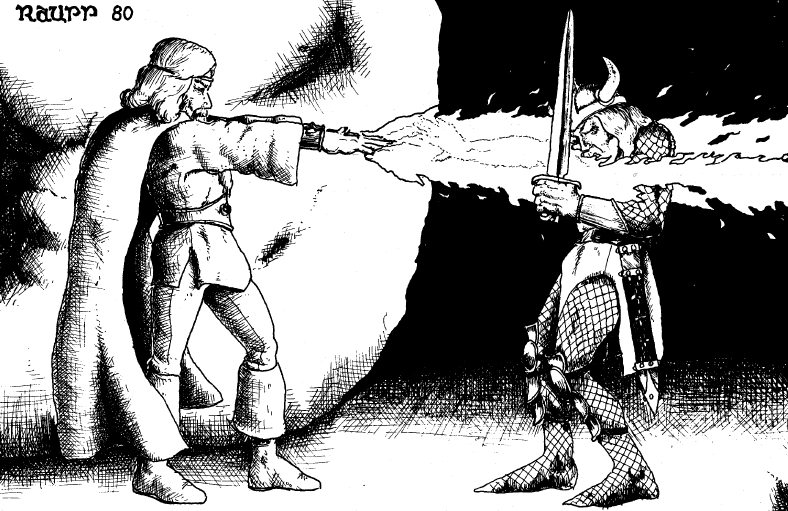
“Exnur, you’re the clumsiest
thief I’ve ever seen.”
‘“Yeah,
well, you couldn’t even remember a Forget
spell.”
“I know a spell that will
make you beg for mercy.”
“Bah!
I will bury my dagger in your back!”
“Posh! You couldn’t sneak
up on a tree, let alone me!”
“Let’s
settle this once and for all!”
“Is that a challenge?”
“Indeed
it is! I'll meet you at. . .”
The Dueling Room
Jeff Swycaffer
It is 1:28 on a Friday night
(or Saturday morning). Hal, Didi and
Chet have been playing D&D
since 6:30 the previous evening.
Chaim, the referee, is in
the bedroom, hastily adding onto the 5th
level of his latest dungeon
so the adventure may continue. Roberto,
the FAT
MAN, and Gerry—the kibitzers—have long since stopped
talking about the election
and are now arguing about gold futures
and the dollar overseas.
Surveying the litter of soda
cans and candy wrappers, cigarette
butts and scrap paper overflowing
the 3 strategically placed trash
baskets, and in his mind’s
eye reviewing the depleted contents of the
refrigerator, Chet makes
a daring MOVE.
He sits back, stretches, and
looks sidelong at Hal. With the
proper proportions of challenge
and boredom in his voice, he
speaks.
“Hal, my magician can beat the snot out of your fighter.”
Hal flushes, stung as deeply
as he can be. Didi and the kibitzers
whirl to watch the confrontation,
as the yen, mark and pound
sterling fall forgotten.
In the night sky, a falling star streaks across the
heavens, a celestial portent
of Earthly upheavals to come. The cat
sleeps on, unmoving.
“That’s easy for you to say,”
Hal retorts, eventually, after regaining
control over his blood pressure.
“You with your Staff of Wizardry. <Ring
of Wizardry>
Leave that behind, and what
are you?” He considers adding a
subtle insult, based on Freudian
symbology and a book he knows
Chet has just read, but decides
against it.
All eyes in the room, save
those of the cat, turn to Chet in
anticipation of his reponse.
“Lock both characters into
a sealed room,” sneers Chet, “and
see who walks out.”
Triumph! Everyone who is paying
attention can tell that Chet has
scored an important POINT.
“How big a room?” replies
Hal weakly. “And how far apart do
we START?’
“We roll for it randomly,” smiles Chet. “From 30 to 180 feet.”
“Can I . . .” Hal begins,
stalling for time. “Can I bring my bow
and arrow?’
Chet’s face twists into a
grimace. He hadn’t thought of that. The
cat wakes up, realizes exactly
what must happen next, and disappears
behind the stereo.
When Chaim eventually comes
out from seclusion with the
completed 5th level, he is
appalled at the sight of Chet and Hal
strangling each other admist
the overturned table and upset chairs. It
happens every week, he
muses, and goes to the closet for the fire
extinguisher.
* * *
The peaceful (relatively)
solution to such questions of power
would be found within a closed
room, sealed against outside interference
or escape from within the
room, in which no character class
would have any innate advantage
over another class. This room,
available for use in resolving
challenges of the sort Chet made to Hal,
is called the Dueling Room.
One can be found in any large city.
The Dueling Room is, simply,
a room roughly 250 feet by 250
feet in size—which can (and
does) CHANGE shape. It has 4 configurations,
and a set of rules for changing
from one form to another.
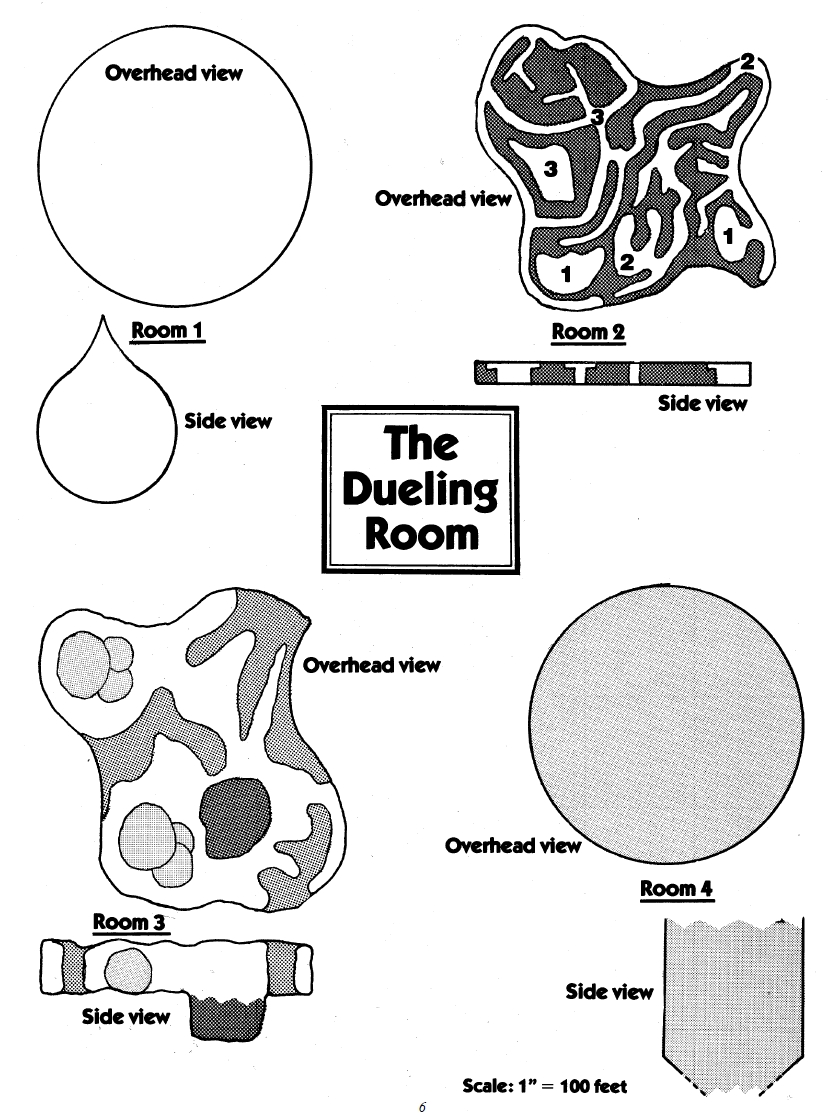
Form 1 is a teardrop-shaped
room with no features. It has
sharply sloping
sides and a bowl-shaped bottom, with nowhere to
hide.
Form 2 is a complex
maze with 3 pairs of teleport systems.
Anyone stepping onto a teleportal
will teleport to the location which <teleport
without error>
matches that one after a
1-turn delay. During this delay, the
character cannot leave the
teleportal he/she is in. There are open
spaces along ledges at the
tops of the walls which are useful for
hiding in and pouncing from,
and the convoluted passageways
make ambushes inevitable.
Form 3 is a less complex
maze, more resembling a cavern with
multiple passages leading
through it. In the center of the room is a
large pit which contains
a roaring fire. The flames cause 5 pts.
of
damage
each time they are passed through by a character, and a
character will suffer 3-18
pts. damage per turn if he/she falls or is cast <per round>
into the pit itself. There
is a base 60% chance of being able to climb
out of the pit of flames,
plus or minus 10% per point of DEX
more than 12 or less than
9.
Form 4 is a shapeless
room with no floor. Occupants of this
room, upon being transported
to it, will begin to fall (at a normal rate
of acceleration) and will
fall for ½, 1, 1½ or 2 seconds (determined
randomly for each occupant
separately). Characters who are flying,
levitating,
or otherwise negating the effects of gravity do not fall. All
other characters will suffer
damage from the fall—and after all nonflying
characters have impacted,
the room changes shape to either
Form 1, Form 2 or Form 3.
DUELING ROOM TABLES
(Roll every turn)
| 00-49 | No change |
| 50-69 | Form 2 |
| 70-89 | Form 3 |
| 90-99 | Form 4 |
| Odd Event | 30% |
| 00-88 | No change |
| 89-90 | Form 1 |
| 91-94 | Form 3 |
| 95-99 | Form 4 |
| Odd Event | 35% |
| 00-88 | No change |
| 89-90 | Form 1 |
| 91-94 | Form 2 |
| 95-99 | Form 4 |
| Odd Event | 35% |
| 00-24 | Form 1 |
| 25-64 | Form 2 |
| 65-99 | Form 3 |
| Odd Event | 100% |
Length of fall, impact damage (d6) :
| Roll of 1 | ½ sec., 1 pt. |
| 2,3 | 1 sec., 4 pts. |
| 4,5 | 1½ sec., 9 pts. |
| 6 | 2 sec., 16 pts |
| 1-3 | ½-die fireball or lightning bolt to both duelists |
| 4-6 | 3-18 points healed for each duelist (roll separately) |
| 7-12 | All magick negated for this turn |
| 13-15 | Stone wall appears midway between duelists,
remains
in place for 1-6 turns |
| 16-17 | Anti-magic shell between duelists (invisible and undetectable) |
| 18-20 | Absolute, unalterable darkness for 6-11 turns |
Dueling
Room house rules
The Dueling Room is operated
by the Room Master, an impartial
person who oversees various
aspects of the encounter.
Each of the duelists is provided
with a copy of the room maps, <cf. duelist>
but no duelist may know the
position of another until they actually
make contact. All coordination
will be done by the Room Master,
who will carefully position
characters in reasonable locations after
room CHANGES.
The Room Master is aware of
all the conditions of the duel, and of
everything that occurs within
the Dueling Room. Minor instances of
cheating will be promptly
penalized by a 4d6 lightning bolt—and
there is an immediate and
automatic death penalty for killing an
opponent by cheating. The
word “cheating” only applies if the
duelists have previously
agreed on some rules of conduct (see Rule
changes, below).
A purse of 150
g.p. per level is put up by each participant, to be <$1500>
shared by the winner and
the Room Master on a 75-25 proportion.
The 75% winner’s share of
the purse may be split between more
than 1 character if agreed
upon beforehand, but the Room Master
must always receive at least
25% of the purse. If the duelists wish to
battle with no purse at stake
for themselves, the Room Master must
still be paid 500
g.p. before the match can take place. <$5000>
Spectators may watch—and usually
are encouraged to do so—at
a cost of 2
g.p. apiece. Proceeds from spectators may be divided any <$20>
way the participants see
fit. (There is almost always a good crowd;
however, spectators may be
excluded, by agreement of the duelists,
if the Room Master is paid
5,000
g.p.) <$50,000>
Odd
Events: In each room, there is the possibility each turn of the
occurrence of an Odd Event.
The events can be harmful, but they
can also provide CHANGES
in the ebb and flow of a battle, or offer one
duelist an advantage— if
it can be exploited quickly and properly.
Note that Room Form 4 will
never be the battleground for more than
1 turn at a time, but an
Odd Event will occur every time the
duelists are transported
to this room.
Weapons: Each duelist may
bring 1 magic item of any type,
but only if all duelists
have at least 1 magic item to bring; otherwise,
no magic items may be used.
Each duelist may bring up to 2
non-magical weapons. Most
missile weapons (bows, crossbows,
slings) are prohibited, although
throwing daggers is allowed.
The Challenge
procedure
Any person may challenge
any other person to a duel, for any
reason at all, by filing
a challenge with the Room Master and then
delivering notice to the
challenged party. After this, the Room Master
will rule on whether the
reason for the challenge is sufficient to
warrant a duel—but the challenger
is not informed at this time of the
ruling.
Any character who is challenged
may refuse to duel, and will not
be forced to fight. However,
the Room Master will also rule on the
reason given for refusing
to duel. If a challenge made with good
reason is refused without
good reason, the one who refused is
assessed an XP penalty of
50 × the square of the total
levels of experience of the
parties involved. For instance, a second-level
character who turns down
a worthy challenge from a third-level
character without sufficient
reason will be penalized 50 × (3+2) ×
(3+2), or 1,250 XP.
Note that it is never possible
to decline a duel for a bad reason
when the challenger is 2
or more levels higher than the challenged
party; the difference in
levels alone is sufficient reason to refuse to
fight.
If a challenge is refused
for good reason, but the Room Master
has ruled that the challenge
itself was made without good reason, the
one who challenged is assessed
an XP penalty of 25 ×
the square of the total of
the levels. For instance, a 3rd-level
character who issues an improper
challenge and is properly refused
by a 2nd-level character
will be penalized 25 × (3+2) × (3+2),
or 625 XP.
These XP penalties are assessed
in the form of
cursed items that the Room
Master will somehow manage to get into <cursed
items>
the intended victim’s possession.
The other possible combinations
of challenge and refusal will not
cause the parties to incur
any penalties. These include a worthy
challenge refused for good
reason, and an improper challenge
which is likewise refused
for bad reason. A new challenge may be
issued by either party to
begin the challenge procedure anew.
Acceptance: If a challenge
is accepted, the parties involved will
meet on the 3rd day following
the delivery of the challenge. Any
rulings by the Room Master
as to the reasons for challenge and
acceptance are immaterial,
since it has been agreed that a duel will
take place. The party accepting
the challenge is allowed to select an
initial room configuration
(after all parties have received sketchy
maps of the rooms) to begin
the conflict.
Rule
changes
Almost every rule outlined
above can be changed by mutual
agreement on terms of the
battle, which can be arrived at before or
after a challenge is accepted.
All parties may wish to fight in only one
of the room configurations;
they may wish for the pit in Room 3 to be
filled with green
slime instead of fire; they may elect to fight until one
or the other has 10 HP, as
opposed to a fight to the death.
Unless stated otherwise,
all duels are fatal to at least one participant.
Perhaps a surrender will
be accepted; perhaps not. All such arrangements
must be agreed upon before
the 1st room is entered. All
rule CHANGES
must be approved by the Room Master, but if all parties
are already agreed to a CHANGE
there is rarely any problem obtaining
that approval.
Examples
Rutherford B. Loathaur, an
abominable Wizard,
has incurred the wrath of
Saladh-ed-din, also known as Saladin the
Paladin, who is at 12th level.
Saladin challenges Loathaur
to a duel for having turned his liege
lord, Abu-ben-Bubi, into
a she-goat. (Good reason.) Loathaur refuses,
but the best reason he can
come up with is “I don’t feel like it.”
(Not good enough). There
is no duel, but in the next morning’s mail,
Loathaur receives a curse
for 26,450 XP (a letter
bomb, of sorts).
Saladin delivers another challenge,
stating the same reason.
Loathaur does not want to
lose another 26,450 XP,
nor does he wish to leave
town, so he reluctantly accepts the
challenge.
On the 3rd day afterward,
they meet at the Dueling Room.
Loathaur is carrying a Staff
of Wizardry, and Saladin brings a +3
sword. Realizing that the
staff is more than a match for the sword,
Saladin puts down the magic
sword and brandishes his normal,
non-magical sword instead.
Loathaur is thereby required to set
down his staff, since his
opponent is not also using a magic item.
Loathaur will still be able
to use spells which he may know.
Loathaur asks that the duel
be staged until one or the other
surrenders. The Paladin refuses.
Loathaur asks to delete the
teleportals from Room 2. Saladin
agrees: no teleporting. Then
Saladin requests that Room 4 be
deleted from the duel. The
magician, who can fly, says no; room 4
stays.
There are no more issues to
reach agreement on. Loathaur sighs
and plunks down 1,650 g.p.
(150 × 11th level). Saladin puts up <$16,500>
1,800 g.p. (150 × 12th
level) as his contribution to the purse. <$18,000>
After commending his soul
to his deity, Loathaur asks that the
duel begin in Room
Form 2. The Room Master places his hands on
the controls, and Loathaur
and Saladin disappear from sight, to
reappear an eyeblink later
in Room 2.
The 312 spectators get their
money’s worth.
AUGUST 1980