| Introduction | Giants in the Earth (D37) | Giants can be awful or awe-ful | Island Enchanters | The Four Lords of Demonland |
| Appendix | Submission Guidelines | - | DDG (Dragon) | Dragon |
GIANTS IN THE EARTH:
Giants can be awful or awe-ful
by Roger Moore
One of the frequently appearing columns
in DRAGON™
Magazine is Giants
In The Earth, which started many moons
ago in issue #26
(June 1979). It features
characters from popular fiction and fantasy,
and many from historical myths
and legends, who have been translated
into D&D®
and/or AD&D™ game terms.
While the series is fascinating to read
for
its own sake, the question naturally
arises as to what sorts of things one can
do with it in real game situations. Obviously,
the “Giants” would make highly
entertaining encounters in any game
universe; the problem is how DMs can bring
this about.
There are several problems inherent in
using GITE characters (or heroes and
heroines from other sources, like the
DEITIES
& DEMIGODS™ Cyclopedia, or
other GITE -like articles in DRAGON
Magazine) as NPC’s in a campaign. The
first problem is that the Dungeon Master
might start bringing all sorts of extremely
powerful characters into the game just
to
impress the players, or to emphasize the
player characters’ relative puniness in
the scheme of things. If every time the
group goes into a bar they meet John
Carter, Conan and Belit, or Kane, then
the game is going to take on a distinctly
unrealistic tone.
Even worse is the possibility that the
DM has brought these super-toughs into
the game to trash the players out. I heard
of one game in which several characters
got together and began mugging people
who were walking through an alleyway.
The third potential victim was a huge
barbarian from Hyborea, who proceeded
to slay everyone present. This was entertaining
as a story, but it might not have
been so entertaining to the players involved.
Certainly the DM can introduce a
“ringer” among a group of common
NPC’s, but using Conan for this purpose
is like using an H-bomb to kill flies.
The
group had no chance of winning. Before
long in games like this all the characters
are dead, the players get frustrated, the
referee gets bored, and the game goes to
pot. This leads to Rule One for using
super-NPC’s: There should be a reason
for the NPC to be in a scenario, beyond
that of satisfying the DM’s ego.
Another possible difficulty is what we
could call the Player Power Trip Problem.
What if, thinks the player, I slip
something into Conan’s drink, or if I
bump off Elric and get his sword Stormbringer?
. . . Sometimes, of course, it’s
not just one player but the whole group,
all of them (for one reason or another)
having decided that they want to kill or
capture a GlTE character. Usually the
group is motivated by greed and a childish
desire to claim that their characters
are tougher than this hero or that one.
This is stupid beyond description, but
unfortunately it is often not discouraged
by the game referee properly, and is
sometimes even encouraged by the DM.
At this point we should make a distinction
between two types of game situations.
It isn’t wrong to set up a scenario in
which, for example, an evil character like
Maal Dweb, Iucounu, or the like makes
some attempt to do something nasty to
the characters or to their world; someone
could make a fascinating campaign
around a premise like this, and it wouldn’t
be wrong to allow for the possibility that
the good characters of the players might
not only defeat the evil leader but might
also slay him or her. The problem comes
when the referee decides that it would
be
great to let Chuckie get Stormbringer
because he’s my friend and he’s begged
and pleaded with me for months to do it,
so maybe if Elric turns his back for a
minute. . . you get the idea. The referee
creates the scenario for the purpose of
letting the GlTE character get killed,
so
the players will come to think they are
really hot stuff.
There’s nothing that can be said about
this sort of game if people are determined
to play it that way. Before long, of
course, everyone will have all the known
artifacts, they will slay everything they
meet to keep getting those Almighty
Experience Points, the referee will get
frustrated (what can stand up to Stormbringer?),
the players will get bored, and
so on, until. . . no more game. Rule Two
(actually a variant of Rule One) goes like
this: Super NPC’s are not for satisfying
player egos, either.
So, what’s left? You can, after looking
over a list of super NPC’s, make some
distinctions in the ways these characters
could be used. There are three ways to
classify characters in terms of how frequently
they will be used in a campaign:
They can appear as one-time-only’s, as
infrequent passers-by, or as frequently
encountered, live-just-down-the-street
sorts. When using NPC’s that will appear
only once in your campaign, you could
structure a particular adventure around
the group’s meeting with that NPC and
use the NPC as written up in the GlTE
column or elsewhere. Infrequently encountered
NPC’s might live some distance
away from the player characters
and would only now and then make their
presences known; they might hire or
briefly be hired by the player characters,
might compete or fight against them, or
briefly join them on adventures. Finally,
some NPC’s might serve as the players’
henchmen, or take the players on as
permanent assistants, or just live in the
immediate area where the player characters
live.
This is interesting, but there is still
one
problem. Famous NPC’s from fantasy
and literature are automatically more
intimidating then other NPC’s because
they have their names behind them.
Conan sounds like a much tougher opponent
than Tosok or Xatha. There also
is a problem in trying to role-play the
NPC when the DM hasn’t read the books
the character was drawn from, or cannot
remember particular details of that character’s
life; often the players, to the DM’s
embarrassment, know more about a particular
fictional NPC than the DM does.
And there is the problem of Big-Name
People attracting all the immature sorts
who want to bump them off and steal
their magical items. The simplest solution
is to change the NPCs’ names and a
few details in their backgrounds, so that
they “belong” strictly to the referee’s
game universe and no other.
Consider this example: In a particular
campaign, a referee has set aside an area
inhabited by bandits who oppose a local
evil lord. Having access to DRAGON
issue #55, in which Katharine Kerr outlined
Robin Hood and his
Merry Men as
AD&D characters, the referee adopts
the
group for use in his game. However,
because it could be tricky trying to explain
how Robin Hood and company got
into that particular game universe from
England, the DM simply changes Robin’s
name to, say, Arlan
the Red (giving
the NPC red hair and beard at the same
time), and similarly renames the whole
gang. To further close the link to the
AD&D environment, the referee
gives
her name, of course: She is Jelala. Ka-
Gola now, queen of the sea-rovers. Her
first mate is her current lover, Xarmak
One-Eye (actually Caranga, renamed).
The DM decides to discard the possibility
of a high-level mage teleporting in to
help Jelala, instead allowing the ship
to
have a fairly powerful illusionist aboard.
Jelala gains Tiana’s bonuses with rapier
and dagger, a bit of her personality (with
a nasty touch to it), plus her ship and
crew, and now the player characters
have a tough adventure ahead of them,
not impossible to win against but sure
to
be a challenge.
Example three: One lucky DM has
access to DRAGON issue #36, in which
Conan the Barbarian
was described in
the Sorceror’s Scroll column. However,
for her own reasons, the DM decides to
make Conan a female NPC: Ferra Whiteflame,
so named for her pale skin and
hair (she comes from the very far north).
Some of the statistics need to be adjusted;
Ferra only made it to 4th level as a
thieving little kid before taking up the
life
of a warrior. When introduced into the
campaign, Ferra will be 30 years old, and
highly experienced in fighting. Having
fought gnolls most of her life in the frozen
wastes, as well as rare tribes of arctic
hobgoblins, Ferra is made a ranger of
16th level. Ferra gets all of Conan’s statistics,
except for strength (reduced to
18/43, but the DM gives her a girdle of
frost giant strength to make up for it).
Conan’s other special abilities, as many
as possible, are also transferred to the
“new” character. Ferra, when completed,
is introduced as a neutral good warlord
who rules a small northern kingdom of
generally peaceful but potentially fierce
people. She may hire player characters
to go on special missions for her if they
are deemed trustworthy, or she might
send warriors after the group if they are
harassing caravans going into Ferra’s
kingdom. If the player-character group
is of exceptionally high level, they may
meet Ferra herself; male characters who
try to get too familiar might discover
that
she (like Conan) is a master of unarmed
combat, and they might require time to
recuperate before going on to other
matters.
Certainly, some famous NPC’s may be
used just as they are. For years I wondered
just what sort of magic-user Baba
Yaga (a legendary witch of ancient Russia)
would actually be. The DMG lists
Baba
Yaga’s walking hut as an artifact, and several of my
friends in various gaming groups have
more than once commented that they’d
love for their own high-level characters
to get hold of it. Well, if you’re a Dungeon
Master who likes to discourage this sort
of thing, it might not hurt for the player
characters to get just a little taste of
what
Baba Yaga is like, and the fascinating
article by David Nalle on the Bogatyrs
(superhuman warriors of old Kiev) in
DRAGON issue #53 also includes Baba
Yaga’s statistics.
She is a true high-level
character’s nightmare as described, and
probably too strong for any group but
those characters in giveaway campaigns.
However, an adventure could be created
in which Baba Yaga and her walking
hut might cross planes into the current
campaign out of curiosity; her coming
would be preceded by hundreds of grave
omens, fearful prophesies, and other
unsettling happenings. The PCs
might be hired to discover the
source of these evil omens, and might
eventually discover the walking hut. The
DM could allow Baba Yaga to let the
characters into the hut (which has as
much room within it as a gigantic castle),
but she will send minor servants of hers
— demons, undead, and the like — to try
to trap the party. If the group manages
to
escape, Baba Yaga will let them go, since
she likes the idea of tales of her powers
being spread across the universes. While
Baba Yaga probably cannot be stopped
by most groups, some of her plans might
go astray if player characters catch on
to
them (perhaps they might free some prisoners
within the hut, or manage to take
some magical items that she might not
miss immediately, and so on).
Even if the players earn Baba Yaga’s
hatred, that isn’t necessarily the end
of
them. Baba Yaga has more things on her
mind than crossing planes to catch some
5th-level thief who took some jewels of
hers. Instead, once every so often she
might send a minor demon or undead
creature to track the character down.
This provides a long-playing scenario in
a campaign that may run through many
adventures. It may be interrupted by different
adventures, but it should provide
some additional excitement for the player
characters’ lives. It isn’t everyone who
can claim that they are hunted by an
ogre-witch; after all, only important
people have important enemies.
The important point to remember is
that famous NPCs, renamed or not,
should not be used to batter helpless
parties, and should hot allow themselves
to be battered by parties, either. Special
NPC’s are there to give a campaign spice
and flavor, to make things more exciting
for the players and the DM, and should
be treated and played with care. Renaming
such characters does remove the
possibility of running an adventure in
which Conan actually gets killed, which
can prove rather embarrassing for the
DM; in addition, players will react differently
to NPC’s they know little or nothing
about. The Giants In The Earth column
provides a long list of useful NPC’s for
DMs to integrate into their games, and
should serve as a guideline for making
up unrelated characters as well.
Another possible use for characters
from the GITE series is as role models
for
PCs. Someone may have a
female magic-user with the personality,
if not the same name and statistics, of
Circe the Beast-Mistress (from DRAGON issue
#52). <DDG>
Another player may have a
bard and may want to role-play the character
after Muirtagh
the Bowman (issue
#35) or Myal Lemyal
(issue #64). Characters
from literature can be invaluable as
aids in defining different player-character
personalities.
Yet another use, but one that isn’t
necessarily recommended for regular
play, is to allow players on a one-time
basis to take one GlTE personage and
role-play that character as described,
using whatever sources the character is
drawn from, in a special adventure. If
this
is done, the DM had better take the time
to come up with an adventure that will
be
a challenge for very powerful characters
(some GITE’s range up to the 30th level
of ability), unless the DM restricts the
list
of heroes that may be chosen.
In any case, in games using GITE’s as
player characters, it might be advisable
to declare that if a character is knocked
below zero hit points, or similarly put
in
danger of immediate death (like touching
a sphere of annihilation), then the
character is teleported out of the game
and back to his or her home universe for
good, leaving the other characters. to
carry on.
No matter how you choose to use the
“Giants,” always remember that they are
provided for game participants to enjoy
— not as a source of frustration (for
some) or ego gratification (for others).
Players and DMs who keep this “rule”
uppermost in their minds probably won’t
go wrong.
APPENDIX
Past Giants In The Earth & other heroes
Following is a list of famous characters
from myth, legend, and popular fantasy
literature who have appeared in the pages
of DRAGON Magazine. While some of the
issues mentioned are now out of print,
some people may have access to early copies of
the magazine, and this listing will at
least help them. Along with the Giants In The
Earth personages, other articles that have
described similar heroes and heroines are
mentioned as well. Most GITE’s are male
humans; exceptions are noted.
Giants In The Earth
| Issue | Characters |
Level, class, alignment, etc. |
| 26 | Cugel the
Clever
Kane Tros of Samothrace |
14-thief, N
30-fighter/20-magic-user/14-assassin,CE 15-paladin, LG |
| 27 | Durathror
Fafhrd (DDG) The Gray Mouser (DDG) John Carter of Mars |
13-paladin, LG (dwarf)
20-fighter/8-thief, NG 16-fighter/16-thief, CN 30-fighter, LG |
| 28 | Eric John Stark
Welleran |
15-fighter, CG
high-level fighter (no info given), LG |
| 29 | Shadowjack
lucounu |
25-thief/9(18)-fighter/9(18)-magic-user,
CE
20-magic-user, NE |
| 30 | Sol of All
Weapons
Zorayas Maal Dweb |
20-fighter/14-monk, LN
23-magic-user, LE (female) 20-magic-user, LE |
| 35 | Muirtagh
the Bowman
Umslopogaas Edward Bond Ganelon |
16-bard/7-fighter/6-thief, CG
15-fighter, N 9-fighter, LG 25-fighter, CE |
| 36 | Captain Blood
Richard Upton Pickman Silver Bells |
17-fighter/10-thief/8-cleric, CG 9-fighter, CN 15-ranger/13-paladin, NG (minotaur) |
| 39 | Bodvar Bjarki
Egil Skallagrimson |
16-fighter, CG (werebear) 14-fighter/14-magic-user, CN |
| 41 | Jirel of Joiry
Ayesha Valeria Sigurd Fafnirsbane Starkad |
14-fighter, NG (female) 27-cleric/9-fighter, LN (female) 17-fighter/9-thief, CN (female) 20-fighter/12-magic-user/8-cleric, LG 23-fighter, N (part giant & elf) |
| 42 | Tauno Kraken’s-Bane
Sir Geros Lahvohettos James Eckert/Gorbash Orvar-Odd Heidrek |
8-ranger, CG (half-elf)
9-fighter, LG 0-level/10-HD monster, NG (dragon) 21-fighter, LG (part sea-troll) 15-fighter, LE |
| 44 | Reepicheep
Professor Challenger |
7-fighter, LG (mouse) 16-fighter, LN |
| 47 | Camilla
Medea |
10-fighter, CG (female)
18-magic-user, CN (female) |
| 48 | Sparrowhawk
Tiana Highrider |
21-illusionist/20-magic-user/14-druid,
N
12-fighter/12-thief, CG (female) |
| 49 | Holger Carlsen
Hugi Ellide |
14-paladin, LG
5-fighter, NG (gnome) 6-fighter, N (female) |
| 52 | ISLAND ENCHANTERS
Prospero Circe (DDG) |
14-magic-user, LG
18-magic-user, CN (female) |
| 54 | FOUR LORDS OF DEMONLAND
Juss Spitfire Goldry Bluszco Brandoch Daha |
15-fighter/14-magic-user, LG (“demon”) 16-fighter, LG (“demon”) 20-fighter, LG (“demon”) 18-fighter, LG (“demon”) 11-fighter, LG |
| 57 | Morgaine
Vanye Rifkind Belit Dark Agnes |
17-fighter/3-m-u, CN (female half-elf)
7-fighter, LN 14-fighter/16-cleric, LN (female) 10-fighter, CE (female) 11-fighter/9-thief, CN (female) |
| 59 | Sir
Roger de Tourneville
Harold Shea Anthony Villiers Mark Cornwall Sniveley |
10-fighter, NG
7-fighter, CG 10-ranger/7-thief, NG 4-fighter, LG 3-fighter, LG (gnome) |
| 61 | Deucalion
Tarl Cabot Dossouye |
10-cleric/18-fighter, LN
20-fighter, LE 7-ranger, NG (female) |
| 64 | Myal Lemyal
John Henry Finn MacCumhal |
9-bard/5-fighter/8-thief, CN
7-fighter, NG 15-ranger, NG |
Other DRAGON articles featuring heroes and
heroines are listed below:
“Conan!” in the
Sorceror’s Scroll column, issue #36, by E. Gary Gygax.
“The Bogatyrs
of Old Kiev” in issue #53, by David Nalle.
“The Righteous Robbers
of Liang Shan P’o” in issue #54, by Joseph Ravitts.
“Robin Hood”
in issue #55, by Katharine Kerr.
“Four Myths From Greece”
(Atalanta, Daedalus, the Sybil of Cumae, Chiron) in
issue #58, by Katharine Kerr and Roger
Moore.
“Elfquest” in
issue #66, by Karl Merris.
26, 27, ea.
GIANTS IN
THE EARTH
CLASSIC HEROES FROM FICTION AND LITERATURE
INTRODUCTION
The purpose of this article is to add an
element of novelty
and unknown danger to the DM’s high-level
encounter table,
and to give players a chance to actually
meet up with heroes
from their favorite fantasy books. The
referee is advised to use
these characters with discretion. They
are a lot of fun to run, and
the players should have an interesting
time dealing with them.
These heroes are all in some fashion exceptional,
and thus
they deviate a bit in their qualities and
capabilities from standard
D &
D. Also, most originated in other universes or worlds,
and so were not bound by the same set of
restrictions that apply
to the average D & D character. Some
are multi-classed, for
example. This system has been used to describe
the skills and
abilities of the characters as they appear
in the literature, even
though some of these combinations and conditions
are not
normally possible. In addition, some minor
changes have been
made in order to bring them in line with
the game and to enhance
playability.
Note: For the game purposes of these
heroes: Dexterity 18
(00) gives +4 on Reaction/Attacking, -5
Defensive adjustment
and three attacks per round for high level
fighters. Constitution
18 (00) gives fighters +4.5 per hit die
bonus.
GIANTS IN THE EARTH: ISLAND ENCHANTERS
Author’s introduction
Often, in the course of a long campaign,
a party of PCs will
take a long journey aboard ship to reach
a goal. While it is possible to say something
like: “After sailing for four weeks,
you reach the harbor,” many Dungeon
Masters prefer to stick more strictly to
the time sequence and the campaign
map. It can get quite boring for players
and DM alike if the DM rolls the dice
every so many hexes only to say: “No,
nothing encountered.” The non-player
characters described below have been
designed to fill this kind of gap in a
campaign.
Their islands can be placed wherever
the DM wishes.
GIANTS IN THE EARTH: FOUR LORDS OF DEMONLAND
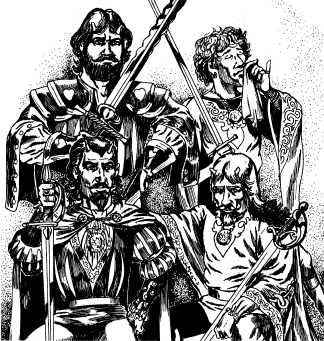
(Top left: Lord
Goldry Bluszco)
(Top right: Lord
Spitfire)
(Bottom left: Lord
Juss)
(Bottom right: Lord
Brandoch Daha)
On an alternate prime material plane,
on a counterpart of the planet Mercury,
is a country peopled by various humanlike
beings unlike those described in the
AD&D™
rules. Some of these beings are
known as demons, though they have no
relation whatsoever to the demons of the
Abyss in an AD&D game, and they tend
to be fervently lawful good in nature.
Their mountainous kingdom by the
shores of a great sea is fertile, wealthy
and free. They are ruled by Lord Juss,
his
brothers Spitfire and Goldry Bluszco,
and their cousin Lord Brandoch Daha.
They are the greatest warriors of their
country, all wise and skillful in the arts
of
war, horsemanship, and sailing. Like all
demons, these four Lords have small
horns upon their heads (not used for
fighting, however); otherwise they closely
resemble normal humans.
These four Lords are aristocratic and
courteous in temperament, always treating
their most dire enemies with honor.
Their language and manner of speaking
is rich and archaic in flavor, and conveys
their noble status clearly. They are fond
of jests and may make humorous commentary
even under the most trying
circumstances. Demons do not lie; they
tend to be extraordinarily brave and
fearless, standing up against the most
dangerous opponents with confidence.
These traits are magnified further in the
four Lords described here.
The four Demon Lords have alabasterwhite
skins, adorned with mustaches
and neatly trimmed beards, and dress in
beautiful and valuable garments. Each
has a set of golden byrny equivalent to
+3 chainmail, and each wears an Amulet
of Protection from Enchanted or Conjured
Monsters, made by Lord Juss.
Although highly unlikely, it is possible
for these Lords to be encountered on
planes and universes other than their
own, perhaps when they are on some
form of quest for the sake of their kingdom
and homes. When they behave as
friends, their aid cannot be matched; as
enemies, they may well be the last ones
an adversary will ever have.
<original: summary, et al.>
GIANTS CAN BE AWFUL OR AWE-FUL
(by Roger Moore)
One of the frequently appearing columns in DRAGON magazine is Giants In The Earth, which started many moon ago in issue #26 (June 1979).
Having access to DRAGON issue #55, in which Katherine Kerr outlined Robin Hood and his Merry Men as AD&D characters, the referee adopts the group for use in his game.
To futher close the link to the AD&D environment, the referee gives out several magical items to the gang (a +2 longbow to Rob - uh, Arian the Red; some clerical items to Bubba the Monk; and so on), and changes the Sheriff's name and the name of the local town to something else as well, like Lord Qor of Wildland's Edge.
The DM picks up DRAGON issue #48, notes Tom Moldvay's version of Tianna Highrider, and sets to work.
One lucky DM has access to DRGON issue #38,
in which Conan the Barbarian was described in the Sorceror's Scroll
column.
Some of the statistics need to be adjusted;
Ferra only made it to 4th level as a thieving little kid before taking
up the life of a warrior.
When introduced into the campaign, Ferra
will be 30 years old, and highly experienced in fighting.
Having fought gnolls most of her life in
the frozen wastes, as well as rare tribes of arctic hobgoblins, Ferra is
made a ranger of 16th level.
Ferra gets all of Conan's statistics, except
for strength (reduced to 18/43, but the DM gives her a girdle
of frost giant strength to make up for it).
Well, if you're a Dungeon Master who likes
to discourage this sort of thing, it might not hurt for the player characters
to get just a little taste of what Baba Yaga is like, and the fascinating
article by David Nalle on the Bogatyrs (superhuman warriors of old Kiev)
in DRAGON issue #53 also includes Baba Yaga's statistics.
Baba Yaga has more things on her mind than
crossing planes to catch some 5th-level thief who took some jewels of hers.
Someone may have a female magic-user with the personality, if not the same name and statistics, of Circe the Beast-Mistress (from DRAGON issue #52).
Another player may have a bard and may want to role-play the character after Muirtagh the Bowman (issue #64).
If this is done, the DM had better take the time to come up with an adventure that wil be a challenge for very powerful characters (some GITE's range up to 30th level of ability), unless the DM restricts the list of heroes that may be chosen.
In any case, in games using GITE's as player characters, it might be advisable to declare that if a character is knocked below zero hit points, or similarly put in danger of immediate death (like touching a sphere of annhilation), then the character is teleported out of the game and back to his or her home universe for good, leaving the other characters to carry on.
Giants in the Earth
| Issue | Characters | Level, class, alignment, etc. | Source |
| 26 | Cugel the Clever | 14-thief, N | - |
| 26 | Kane | 30-fighter/20-magic-user/14-assassin, CE | - |
| 26 | Tros of Samothrace | 15-paladin, LG | - |
| 27 | Durathor | 13-paladin, LG (dwarf) | - |
| 27 | Fafhrd | 20-fighter/8-thief, NG | - |
| 27 | The Gray Mouser | 16-fighter/16-thief, CN | - |
| 27 | John Carter of Mars | 30-fighter, LG | - |
| 28 | Eric John Stark | 15-fighter, CG | - |
| 28 | Welleran | high-level fighter (no info given), LG | - |
| 29 | Shadowjack | 25-thief/9(18)-fighter/9(18)-magic0user, CE | - |
| 29 | Iucounu | 20-magic-user, NE | - |
| 30 | Sol of All Weapons | 20-fighter/14-monk, LN | - |
| 30 | Zorayas | 23-magic-user, LE (female) | - |
| 30 | Maal Dweb | 20-magic-user, LE | - |
| 35 | Muirtagh the Bowman | 16-bard, 7-fighter, 8-thief, CG | - |
| 35 | Umslopogaas | 15-fighter, N | - |
| 35 | Edward Bond | 9-fighter, LG | - |
| 35 | Ganelon | 25-fighter, LE | - |
| 36 | Captain Blood | 17-fighter/10-thief/8-cleric, CG | - |
| 36 | Richard Upton Pickman | 9-fighter, CN | - |
| 36 | Silver Bells | 15-ranger/13-paladin, NG (minotaur) | - |
| 39 | Bodvar Bjarki | 16-fighter, CG (werebear) | - |
| 39 | Egil Skallagrimson | 14-fighter/14-magic-user, CN | - |
| 41 | Jirel of Joiry | 14-fighter, NG (female) | - |
| 41 | Ayesha | 27-cleric/9-fighter, LN (female) | - |
| 41 | Valeria | 17-fighter/9-thief, CN (female) | - |
| 41 | Sigurd Fafnirsbane | 20-fighter/12-magic-user/8-cleric, LG | - |
| 41 | Starkad | 23-fighter, N (part giant & elf) | - |
| 42 | Tauno Kraken's Bane | 8-ranger, CG (half-elf) | - |
| 42 | Sir Geros Lahvohettos | 9-fighter, LG | - |
| 42 | James Eckert/Gorbash | 0-level/10-HD monster, NG (dragon) | - |
| 42 | Orvar-Odd | 21-fighter, LG (part sea-troll) | - |
| 42 | Heidrek | 15-fighter, LE | - |
| 44 | Reepicheep | 7-fighter, LG (mouse) | - |
| 44 | Professor Challenger | 16-fighter, LN | - |
| 47 | Camilla | 10-fighter, CG (female) | - |
| 47 | Medea | 18-magic-user, CN (female) | - |
| 48 | Sparrowhawk | 21-illusionist/20-magic-user/14-druid, N | - |
| 48 | Tiana Highrider | 12-fighter/12-thief, CG (female) | - |
| 49 | Holger Carlsen | 14-paladin, LG | - |
| 49 | Hugi | 5-fighter, NG (gnome) | - |
| 49 | Ellide | 6-fighter, N (female) | - |
| 52 | Prospero | 14-magic-user, LG | - |
| 52 | Circe | 18-magic-user, CN (female) | - |
| 54 | Juss | 15-fighter/14-magic-user, LG ("demon") | - |
| 54 | Spitfire | 16-fighter, LG ("demon") | - |
| 54 | Goldry Bluszco | 20-fighter, LG ("demon") | - |
| 54 | Brandoch Daha | 18-fighter, LG ("demon") | - |
| 54 | Gaveral Rocannon | 11-fighter, LG | - |
| 57 | Morgaine | 17-fighter/3-m-u, CN (female half-elf) | - |
| 57 | Vanye | 7-fighter, LN | - |
| 57 | Rifkind | 14-fighter/16-cleric, LN (female) | - |
| 57 | Belit | 10-fighter, CE (female) | - |
| 57 | Dark Agnes | 11-fighter/9-thief, CN (female) | - |
| 59 | Sir Roger de Tourneville | 10-fighter, NG | - |
| 59 | Harold Shea | 7-fighter, CG | - |
| 59 | Anthony Villiers | 10-ranger/7-thief, NG | - |
| 59 | Mark Cornwall | 4-fighter, LG | - |
| 59 | Sniveley | 3-fighter, LG (gnome) | - |
| 61 | Deucalion | 10-cleric/18-fighter, LN | - |
| 61 | Tarl Cabot | 20-fighter, LE | - |
| 61 | Dossouye | 7-ranger, NG (female) | - |
| 64 | Myal Lemyal | 9-bard/5-fighter/8-thief, CN | - |
| 64 | John Henry | 7-fighter, NG | - |
| 64 | Finn MacCumhal | 15-ranger, NG | - |
"Conan!" in the Sorceror's Scroll
column, issue #36, by E. Gary Gygax.
"The Bogatyrs of Old Kiev" in issue #53,
by David Nalle.
"The Righteous Robbers of Liang Shan P'o"
in issue #54, by Joseph Ravitts.
"Robin Hood" in issue #55, by Katherine
Kerr.
"Four Myths From Greece" (Atalanta, Daedalus,
the Sybil of Cumae, Chiron) in issue #58, by Katherine Kerr and Roger Moore.
"Elfquest" in issue #66, by Karl Merris.
<Source column was added>
C16/F14 = Rifkind
C27/F9 = Ayesha
P13 = Durathor
P14 = Holger
P15 = Tros
F3 = Snively
F4 = Mark
F5 = Hugi
F6 = Ellide
F7 = Harold
F7 = John
F7 = Reepicheep
F7 = Vanye
F9 = Edward
F9 = Richard
F9 = Sir Geros
F9+ = Welleran
F10 = Belit
F10 = Camilla
F10 = Sir Roger
F11 = Gaveral
F11/T9 = Dark Agnes
F12/T12 = Tiana
F14 = Jirel
F14/MU14 = Egil
F15 = Heidrek
F15/MU14 = Juss
F15 = Umslopogaas
F16 = Bodvar
F16 = Professor Challenger
F16 = Spitfire
F16/T16 = The Gray Mouser
F17/MU3 = Morgaine
F17/T9 = Valeria
F17/T10/C8 = Captain Blood
F18 = Brandoch
F18/C10 = Deucalion
F20 = Goldry
F20 = Tarl
F20/T8 = Fafhrd
F20/MU12/C8 = Sigurd
F20/M14 = Sol
F21 = Ovar-Odd
F23 = Starkad
F25 = Ganelon
F30 = John Carter of Mars
F30/MU20/A14 = Kane
Bar15 = Eric John Stark
R7 = Dossouye
R8 = Tauno
R10/T7 = Anthony
R15 = Finn
R15/P13 = Silver Bells
MU14 = Prospero
MU18 = Circe
MU18 = Medea
MU20 = Iucounu
MU20 = Maal
MU23 = Zorayas
I21/MU20/D14 = Sparrowhawk
T14 = Cugel
T25/F9(18)/MU9(18) = Shadowjack
B9/F5/T8 = Myal
B16/F7/T8 = Muirtagh
0 level/10-HD monster) = James Eckert/Gorbash
GIANTS IN
THE EARTH
by Tom Moldvay
| Dragon | - | Dragon 46 | - | 1st Edition AD&D |
Contributions for the Giants in the Earth
feature in Dragon
magazine are now being accepted from readers.
The following
information will be of use to persons who
intend to write one or
more articles for consideration.
All contributions should be typed, double-spaced
and in a
legible fashion. For particular information
on physical requirements of a manuscript, send a SASE to Dragon Publishing
with
a request for writers’ guidelines.
To qualify for inclusion in Giants in the
Earth, the contribution should depict a character from legendary sagas,
classical
literature, or modern fantasy literature.
It should follow the
traditional Giants in the Earth format
(detailed below) as closely
as possible. It should include the name
of the author and a
bibliography of the book(s) the character
appeared in, or a
traditional source material where the reader
can find out more
about the legends the character comes from.
Lastly, the article
should depict a character which can be
useful in the playing of a
D&D®
or AD&D™ campaign.
Individuals who write the contributions
will receive full credit
for authorship of the articles. Authors
will also receive payment
at the normal rate for written contributions,
with the understanding that payment may be adjusted downward to account
for a great amount of editing and/or revising
which may be
necessary to bring the contribution into
publishable condition.
Contributions should not be depictions of
PCs,
monsters,
mythological creatures, or heroes from an individual’s
D&D or AD&D campaign.
Characters who appear in sources to
which Dragon readers have easy access will
be preferred over
those from more obscure sources.
A general format follows:
Author’s name
Character’s name
Level and Class
ALIGNMENT
HIT POINTS
ARMOR CLASS
NO. OF ATTACKS
DAMAGE/ATTACK
HIT BONUS
MOVE
PSIONIC ABILITY
PSIONIC STRENGTH (if any)
STRENGTH
INTELLIGENCE
WISDOM
DEXTERITY
CONSTITUTION
CHARISMA
<COMELINESS>
<PERCEPTION>
The body of the contribution should include
at least a physical description of the character, a short history of the
character,
any special abilities the character possesses,
an outline of the
character’s personality,
and tips for the DM which will help
him/her run the character as a NPC. Whenever
possible,
instructions should give specific details
rather than generalizations: For example, “the character does 3-30 points
of damage,”
not “the character does a lot of damage.”
The body of the article is followed by the
author’s credit, then
the bibliography.
“Giants in the Earth” is my all-time favorite
feature in TD.
There are still scores of characters to
cover from fiction and literature. The
Hobbit and
Rings books will require careful
planning and some
time. “Sword of Shanarra” and “Urshurak”
are
two distinct possibilities. The many books
of E. R.
Burroughs
have many mighty and well-known
warriors. Conan
is not the only famous fighter to be
presented by R.
E. Howard. Red Sonja, Belit, and <link>
even Thoth Amon should be attempted. What
of <link>
Ivan Hoe, or Sinbad?
As I do not have every issue of The Dragon,
there is no way I can know what characters
have
been dealt with in “Giants in the Earth.”
I, for one,
would like to see some of the heroes
and villains
from myth and legend attempted in this
manner.
Robin Hood
and companions, King Arthur, Lancelot,
Merlin,
Galahad, and Modred [sic] await
encounters
in ancient
Britain. Chu Chulain, Nuada,
and others
do battle in Celtic
Ireland. The
Norse sagas contain
countless heroes such as Siegfried, and
countless
villains such as Fafnir the giant/dragon.
The myths
of the Mediterranean area are perhaps the
most
populous when it comes to mighty heroes.
The
Argonauts (including Jason,
Heracles,
Theseus,
and the witch
Medea), Bellerophon,
Perseus,
Atalanta. <link, link>
Orion, and the many heroes of the Trojan
War (Achilles,
Odysseus, Diomedes, Hector, big
and little Aias, Paris, and hundreds more).
Heroes
abound everywhere you look and most
deserve more than mention here.
Mark White
Kodiak, Alaska
(Dragon #41)