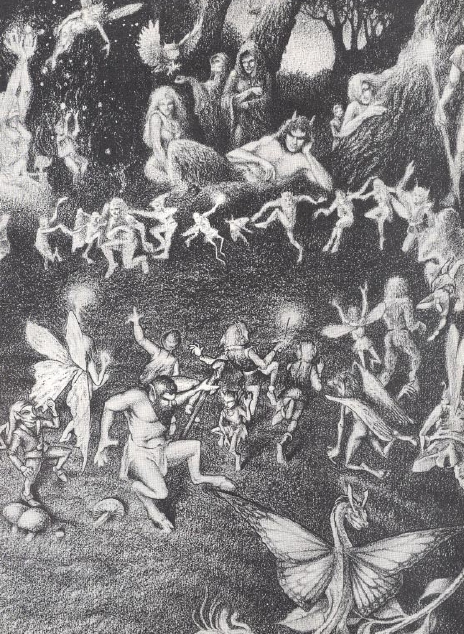
| Atomie | Boggart | Booka | Brownie | Buckawn |
| Dryad | Faerie Dragon | Gray Elf | Grig | Killmoulis |
| Korred | Leprechaun | Pixie | Quickling | Satyr |
| Sprite | Swanmay | Sylph | - | - |
| 1st Edition AD&D | - | Dragon #155 | - | Dragon magazine |
The FOLK of the FAERIE
KINGDOM
A full list of faeries and faerie-folk
by Vince Garcia
Art by Robert Klasnich
| Some of the most
fascinating creatures within the AD&D
game include the diminutive and
magical faerie folk. And while their place within any number of outdoor adventures should be guaranteed, fairies rarely appear in campaigns. One reason, perhaps, is that the faerie folk do not lend themselves easily to adversarial encounters. Orcs, ogres, dragons and the like are easily cast in such roles, but the reclusive faeries require more thought on their handling. To offer the DM
a few ideas on making greater use of these creatures, a brief ecology of
each
|
Atomie
(MM2).
The typical atomie
resembles a 1'-tall,
lanky humanoid with
greenish skin and
a narrow head whose
dominant feature
is a pair of oversized,
green-pupiled eyes.
Atomie attire is simple,
yet practical: a
skirt made of plant fiber.
Atomies often carry
small crossbows or
spears. These frolicsome
creatures are
found in mountain
lowlands within pleasant,
green meadows, usually
near large
oaks and a pond,
stream, or other water
source. Within the
hollows and branches
of the great trees
they favor, atomies build
comfortable chambers
and stout tree
houses in which they
sleep during the
hours of daylight.
These outer dwellings
are almost always
camouflaged to hide
their presence from
observers below. At
other times, when
there is a lack of large
trees, atomies may
build underground
burrows with entrances
through the hollow
trunks of trees.
At dusk, the atomies
awaken and spend
the evening gathering
food or frolicking
about in the moonlight.
The eyesight of
these creatures in
darkness is comparable
to that of normal
creatures in daylight.
Atomies greatly resent
the intrusion of
strangers (excepting
their cousins, the
grigs) into their
meadows, and they usually
make a combined attack
to drive away
unwelcome guests
by summoning a horde
of mosquitoes, flies,
ants, and other bothersome
insects, followed
by a meeting
with nearby animals--wild
cats, badgers,
raccoons, bears,
etc. The atomies themselves
may attack with their
small weapons,
making good use of
their invisibility,
pass plant, and blink
powers.
Set up:
On the first leg of a trek into the
mountains to find
the lair of a green
dragon, the adventurers
make camp in a
small meadow as dusk
approaches. As
dinner is prepared
and night falls, the
party is set upon
by a voracious horde of
stinging, biting
insects that chase off the
horses (which were
believed to be securely
staked down), then
turn on the PCs,
possibly causing
the group to abandon
equipment (which
is not to be found upon
later search) as
it retreats to safety and
seeks the recovery
of the steeds.
Boggart
(MM2).
It is said by some that <find boggart in Dragon>
boggarts begin as
buckawns who, turning
to evil at death,
fall into this transitional
state between their
previous lives and the
ultimate form of
a will o? wisp. Whether
true or not, the
malevolent boggarts are a
serious danger for
parties traversing dark
forests or swamps
(the boggarts? preferred
hunting grounds).
The sly creatures, who
sometimes band together
in small groups
for protection, frequently
approach travelers
in their humanoid
form, offering
their services as
guides through the lands
with which they are
familiar. Those accepting
this assistance are
led immediately
into some sort of
trap, for the creature
cannot retain a single
form for long. The
boggarts may lead
their charges to several
hidden confederates,
who attack with
their ability to
cause confusion, or they
may drive the PCs
into pits or ensnare
them in nets.
In their semi-undead
form, boggarts
require not only
the life-force of living
creatures, but meat
as well to survive.
Thus, the primary
attack of the boggart is
through a touch that
delivers an electrical
charge. The waning
life-force of the attacked
creature strengthens
the boggart,
giving it 1 HD for
each two levels of a
human or humanoid
it manages to slay.
Upon reaching a total
of 9 HD, the boggart
leaves behind its
immature form and
becomes a full-fledged
will o? wisp. Falling
short of this in
a battle, the boggart devours
its prey to nourish
its corporeal
body. A less-popular
mode of attack is
made by discharging
a small lightning bolt
every other round.
While this may suffice
to obtain meat, the
boggart does not absorb
the life energies
of its prey if this
attack is used.
Set up:
While trying to find their way
out of a marsh, the
adventurers meet up
with a shabbily dressed
halfling who volunteers
to lead them out
in return for a
week's rations. He
then takes the group
into an area of quicksand,
where two
other boggarts and
a mature will o? wisp
wait to attack. [See
also “The Rotting Willow,”
in DUNGEON®
Adventures issue #5,
for another boggart
set up.]
Booka
(FF).
A popular legend, not given
much credence by
sages, is that booka are
the spirits of scullery
maids who were lax
in their duties during
life. Perhaps this
story came about
through the booka?s
habits, which include
a curious devotion
to secret, nocturnal
cleaning and straightening
of the homes of those
of good
disposition.
For whatever their
reasons, these helpful,
inoffensive, spritelike
creatures have
been encountered
virtually everywhere,
from forests and
fens to large cities. In
return for taking
up lodgings in the eaves
or attic rafters
of a home, the shy booka
(acting only when
things are dark and the
inhabitants are asleep
or away) do such
things as sweep,
polish, and mend. They
ask nothing else
in return, although persons
aware of their presence
do well to
leave small snacks
for them, which are
eaten, and the plates
washed and put
away afterward. Booka
are so shy that it is
said that if an occupant
of a home so visited
tries to find or
catch them in the act
of cleaning, they
will immediately depart
and will not return.
Set up:
Soon after a PC builds a house,
she is informed by
the DM that an unknown
being is apparently
picking up and
cleaning the residence
while the character
is asleep or out
adventuring. The unknown
?being? is a pair
of booka, who will
continue to do so
unless they are actively
sought out.
Brownie
(MM).
These halflinglike faeries
dwell most often
in isolated lowland
meadows often bordered
by forests or
groves. Brownies
are shy creatures; their
hidden dwelling places
are somewhat of a
mystery, although
it is believed that the
clandestine creatures
reside in comfortable
ground burrows.
Unlike some faeries, brownies do express
a curiosity about
strangers in spite
of their shy nature,
observing passers-by
from a state of invisibility
or concealment.
They appear to be
particularly well disposed
toward small groups
including elves
or halflings. In
such cases, there is a 20%
chance they will
cautiously advance and
try to make friends.
At other times, when
they are less eager
to make their presence
clearly known, brownies
secretly make
themselves useful
by repairing equipment
or mending leather
goods as the owners of
the goods sleep.
When a group of PCs makes FRIENDS
with brownies, the
group will find the
faeries extremely
friendly and helpful.
Brownies offer their
services as guides
through the areas
they know in such
cases. It has even
been known that a particularly
adventurous brownie
has left his
home and attached
himself to an elf or
halfling of good
alignment, willingly accompanying
the character on
one or more
adventures.
As a general rule,
when faced with
adversaries, brownies
do not often fight.
Instead, they use
their abilities to hide or
escape, resorting
to a small sword only as
a last resort.
Set up:
Making camp in a small meadow,
the adventurers awaken
the next morning
and discover that
someone has mended a
broken saddle stirrup
and polished a rusty
suit of chain mail
during the night. Depending
on the party?s actions,
it may be
possible to coax
the shy brownies into the
open.
Buckawn
(MM2).
Long ago (some bards
say), after Rhiannon,
Queen of the Faeries,
created the faerie
folk, she received gifts
from her children.
From the leprechauns,
she was given a fiddle
and flute that would
play themselves.
The sylphs gave her a
pair of wings. The
elves gave her magic
and poetry. And when
their turn came,
some of the brownies
offered up gifts
from the forest ?fruits,
nuts, wreaths of
holly, and a magical
oaken ring conferring
power over the grass
and trees. Other
brownies stepped
forward with nothing,
and Rhiannon asked
why they bore no
gift. To this they
answered that their gift
was the love they
had, for her. The first
brownies jeered at
their brothers, but
Rhiannon was pleased
with their answer,
and turned with displeasure
to those who
had mocked them.
These jeering brownies
withered and became
buckawn.
Buckawn are a selfish
and xenophobic
form of brownie.
Their usual habitat is
similar to that of
their cousins, although
they favor more isolated
mountain mead-
ows where they are
less likely to be disturbed.
Unlike the curious
and friendly
brownies, buckawn
resent any intrusion
into their territory;
travelers who do so
may face attack initially
by a horde of
summoned insects,
then by the poisoned
darts of the buckawn.
Failing this, the
buckawn may use their
magical powers
and cunning to steal
small goods or cause
mischief.
Set up:
Arriving at a green meadow at
one side of an isolated
mountain lake, the
adventurers make
camp. That evening, a
hidden buckawn uses
a dancing lights
spell to cause a
guard to investigate a
small, glowing light
in a bush. In the meantime,
invisible buckawn
quickly rummage
through the party?s
baggage, making off
with coins, gems,
and equipment. An
insect attack follows
shortly thereafter.
Dryad (MM).
One legend of the druids
is that the Queen
of Faeries planted many
gardens during the
worlds creation. At
the center of each
grew a great tree holding
a seed of Rhiannon?s
essence. The
physical manifestation
of this essence was
the dryad, a tree
nymph watching over
the garden. Whether
this tale is true or
not, most druids
look upon dryads as the
spiritual essence
of a forest. As such, they
are sacred, and no
druid will allow a
dryad to come to
harm.
Perhaps as a result
of Rhiannon's mothering
of the forest, dryads
are somewhat
lustful. They are
known to seek mates
from human and demihuman
males of
exceptional beauty.
Those falling prey to
the charm of a dryad
have reported sinking
into a fog to become
one with the
forest around them,
seeing and feeling all
that befalls it.
This sensation was reported
to last up to several
years, after which the
male was returned
to the world in possession
of exact knowledge
regarding the
forest in which he
was captured.
Some stories suggest
that a tie between
the dryad and her
consort remain after
this. One legend
is told of a ranger who
was summoned from
a great distance by a
dryad to fight against
a black dragon that
had taken up residence
in her forest and
frightened its usual
inhabitants.
At other times, dryads
may not actively
seek a consort but
can aid an adventuring
party if the forest
is to be benefited by
doing so. Thus, while
dryads usually remain
close by their trees,
it is possible for
them to traverse
the length of their woods
to lead helpers to
a camp of enemies.
Set up:
While traveling through a forest,
the party is approached
by a dryad who
asks them to attack
a small tribe of goblins
that have fortified
a hill near her tree. The
dryad may even use
her charm power to
help convince the
dominant male in the
fellowship to assist
if his group seems
reluctant, though
she will not steal the
male away. [See
also “The Ecology of the
Dryad,”
in DRAGON® issue #87, and
“Hooves
and Green Hair,” in DRAGON issue
#109, for
more information on dryads.]
Faerie
dragon (MM2).
Among the most
unusual of dragons
is this mischievous
creature, the origin
of which has long
been in doubt. Some
believe the faerie
dragon is merely
an unusual cousin of the
pseudo-dragon, while
others believe it a
creation of the Faerie
Queen. Most of
Rhiannon's druids,
however, consider
faerie dragons to
be creatures usually
native to the Realm
of Faerie; just how
they get to the Prime
Material plane is still
a mystery. It is
believed by some that
faerie dragons are
part of the Faerie
Queen's troupe when
she leaves her realm
to visit some of
her ?children.? These curious
little dragons probably
wander off
from the gathering
and merely forget to
return home.
Having thereby found
a new place to
live, faerie dragons
either frolic about for
a time or spend a
few days enjoying the
sun. Eventually,
they build lairs within the
hollows or branches
of large trees. As
their sense of humor
is foremost among
their talents, faerie
dragons often choose
to dwell with a group
of fun-loving pixies,
increasing the effectiveness
of their jokes
on outsiders all
the more.
Unlike others of dragonkind,
faerie
dragons do not covet
large amounts of
treasure. To be sure,
they delight in sparkling
objects such as jewels,
but such
treasures take second
place to the faerie
dragon?s first and
greatest love-baked
sweets. Just as leprechauns
fancy fine
wines, faerie dragons
have sweet tooths
that often prove
to be too much for them.
The lengths to which
faerie dragons will
go to get at these
delights (pure honey for
one, or baked apple
pie, which is the ultimate)
are legendary.
Set up: Having
spotted a group of adventurers
heading in the direction of a bee
hive, a hungry faerie dragon casts a phantasmal
force spell over the hive, causing it
to appear as a chest. As an unsuspecting
thief approaches and draws away the
angry bees, the chuckling faerie dragon
flies down to have a quick snack.
Gray elf (MM).
The rarest of elves,
gray
elves have been traditionally
known as
faeries. This may be less for their similarity
to traditional faerie
creatures and more
for their mystique,
rarity, and beauty.
Most of these elves
trace their origin not
to the Queen of Faeries,
but to other deities,
casting doubt that
they should be
linked with the faerie
folk. Yet there are a
few ancient legends
asserting that at the
dawn of time, a goddess
created a race of
immortal elves very
similar to the gray
elves, but possessing
vastly different and
more powerful magics.
These elves fell
from grace, the legends
state, and became
the mortal gray elves
of today. Perhaps it
is from these ancestral
elves that the linking
to the faerie folk
comes.
Set up: Many weeks from home, in a
magical and unexplored
forest they?ve
discovered, the fellowship
comes upon the
ancient ruins of
a beautiful stone city of
elven design. Archaic
lettering within a
temple offers clues
where artifacts and
documents may be
found.
Grig
(MM2).
Grigs are an unusual
but
good-natured sort
of sprite with an insectoid
appearance. Just
how they acquired
legs similar to those
of a grasshopper has
always been a mystery.
Some believe grigs
are not actually
faeries but came about
through the experimentations
of some
wizard. Others believe
their appearance
can be traced to
some transgression
against the Queen
of Faeries. Still others
consider their appearance
an example of
Rhiannon?s sense
of humor. The grigs
themselves, however,
seem neither to
know or care, spending
their lives contentedly
frolicking about
pleasant lowland
meadows, often with
a colony of atomies.
Their dwelling places
are similar to those
of the atomies, although
grigs often prefer
building small, comfortable
hollows in the
sides of small hills.
Unlike atomies, the
usually friendly grigs
are prone to play
jokes. A group of adventurers
who wander into an
area where
grigs reside is as
likely to be the butt of a
prank as it is to
get a friendly greeting.
Grigs usually spend
the daylight hours
asleep in their hollows,
venturing forth at
night to gather mushrooms
(their favorite
food), or to play
and dance. On this last
note, it is said
that only the renowned
leprechauns are able
to put on a more
splendid fiddle performance.
Set up:
Making camp in a small forest,
the party begins
cooking dinner but is
distracted by a whistling
emanating from a
bush (actually a
ventriloquism effect from
an invisible grig).
While the party?s attention
is momentarily diverted
from the
food, a few invisible
grigs make off with
dinner and any other
small items left in
the open. As the
group begins a fruitless
search, the grigs
carefully replace the
items, have a good
laugh on the party?s
rediscovering them,
and make their presence
known. If the group
laughs along
with them, the grigs
spend the evening
with them, subjecting
at least one of the
fellowship to Otto’s
irresistible dance.
Killmoulis
(FF).
Some doubt killmoulis
are actually faeries,
for they appear to
possess no innate
magical abilities as do
the rest of the faerie
folk. The small size
and behavior of the
killmoulis, however,
are similar enough
to other faeries that
the common people
accept them as such.
Killmoulis dwell not
in isolated wooded
areas, but in cities
and townships in or
near mountains or
forests. For reasons
unknown, they prefer
lairing in locations
where industry or
technology may be
found, such as in
lumber or flour mills. As
do the booka, killmoulis
make themselves
helpful by mending,
polishing, or cleaning
items, or killing
small rodents. In return
for these gestures,
they appropriate whatever
foodstuffs are handy.
Like the booka, killmoulis
are shy and
retiring, hiding
in rafters and beneath
floorboards. Unlike
the former creatures,
however, they appear
to be less likely to
move on if discovered,
and are more
prone to playing
jokes. Likewise, if disturbed,
the killmoulis do
not leave the
area of their lair,
but fight back with increasingly
baneful tricks (depending
on
how actively others
seek to root them out)
The greatest banes
to these creatures
are cats, dogs, and
rats, all of which will
kill and eat killmoulis
on sight. When
possible, killmoulis
will slay these creatures,
hiding the remains
in secure places.
Set up:
On passing through a small
mountain town, the
adventurers hear that
the owner of the
local lumber mill has
offered a reward
for someone able to
exorcise ?spirits?
that haunt the place.
Upon investigating,
the party is told that
small items have
been disappearing and
then showing up again
the next morning.
Food and drink left
out in the open have
vanished. In addition,
the cat that was
once used to catch
mice is nowhere to be
found. If they hide
themselves in the mill
that evening, the
PCs may catch sight of
one of the creatures
sharpening a saw,
thus realizing that
the situation is not
baneful. The PCs
may relay the information
to the mill owner
or may seek to rid
the place of the
creatures? presence?but
not with ease.
Korred
(MM2).
Korreds are among the
most unusual of the
faerie folk, uniquely
possessing both great
strength and powerful
magical abilities
with natural stone.
Their origin is,
of course, traced to the
Queen of Faeries.
One song of the bards
claims the korreds
were created when
Rhiannon and her
troupe visited a forest.
Some dwarves, hoping
to observe the
faeries? dance, had
hidden themselves
around the glen where
the Faerie Queen
held court. Discovering
their presence,
Rhiannon turned them
into cloven-hooved
faeries, and the
unlucky dwarves joined
the get-together
properly, dancing for the
entire company?s
enjoyment.
Since then, korreds
have proven to be
some of Rhiannon?s
most privileged servants,
frequently being
sent by her to aid
her druidic followers
when they face some
great struggle, or
to fashion a druids?
circle as a place
for her druids to gather
during special times
of worship. Korreds
are further said
to roam the earth, observing
its events and reporting
them to their
Queen.
Each seven nights,
the korreds in an
area gather in a
secluded glen to play
music and dance in
Rhiannon?s honor
(which perhaps is
a lingering penance for
their original intrusion).
Those who make
the same mistake
as they -- investigating
something in which they have no part --
must save vs. spells or JOIN in the dance;
druids of Rhiannon are immune to this
sort of charm. Victims suffer 1-4 HP damage
Each round due to the dance's physical
demands. The korreds maintain the dance
for 3-18 rounds, then flee, leaving the
intruders either dead or exhausted.
Those who attack the korreds face a
tough fight and can
count on little help
from their charmed
comrades. Even if the
dance is interrupted,
those charmed by
the korreds remain
disoriented for one
turn and are unable
to take any action
Set up:
Having made camp in the foothills,
the group hears the
eerily beautiful
sounds of korred
flutes. Investigating, the
PCs mount a small
hill to observe four
korreds playing and
dancing around a
roaring fire in a
wooded glen below. If the
party immediately
departs, no harm will
befall them. If they
continue to watch,
however . . . [See
also “The Ecology of the
Korred,”
in DRAGON issue #119, for more
information.)]
16
Leprechaun
(MM).
The best known of
faeries, leprechauns are some of the most
fascinating of Rhiannon's creations. A
lejend claims that a group of hobbits
once sought to steal the Faerie Queen's
treasure. Caught in the act, the tiny
thieves pleased Rhiannon with a performance
of storytelling, rhyme, and music,
allowing themselves
to continue living. As
the Faerie Queen
seems wont to do, the
intruders were transformed
into faeriesin
this case, leprechauns.
These creatures are
almost always encountered
in the most idyllic of woodlands
and meadows, and their most common
dwelling places are hollows at the bases of
large trees, about which are large patches
of shamrocks. Renowned for their musical
talents with fiddles (quite a few of which
are magickal), leprechauns have spawned
many tales from humans who have observed
the leprechauns dance and play
around a roaring fire (where ale and food
flow freely). A few lejends relate that
mortals invited to attend these feasts have
found a year or more has passed when
they left the gatherings, believing only a
night had gone by! While usually quite
good at keeping their PRESENCE hidden,
one clue that leprechauns have passed
through an AREA is the PRESENCE of faerie
rings--circles of mushrooms and other
fungi 10-20' wide that are left behind after
a gathering of leprechauns have played
and danced through the grasses.
Most often when leprechauns are met,
the mischievous creatures
either play a
joke or else steal
some small item of value.
Nevertheless, there
are tales of mortals
who, having aided
the ?little people? in
some way, were rewarded
with a portion
of gold or a magical
shamrock, which is
sure to bring good
luck (treat as a doublestrength
luckstone). In all
such cases, the
reward was unexpected.
It is the leprechauns?
love for and hoarding
of valuables that
has often caused
them to be on the
defensive against the
greed of those who
covet their treasure.
As a result, all
leprechauns are said to
have buried one or
more pots filled with
gold, jewels, and
other goods (value
1d100 X ldl00 gp).
These caches often
include magical rings,
potions, or scrolls. It
is said that one
who manages to capture a
leprechaun can force
it to reveal the
whereabouts of its
treasure. Catching one,
however, is difficult
as leprechauns are
glib, wiry, and skilled
in using the powers
of invisibility and
illusion to their benefit.
Some can even turn
pine cones and stones
into gold or jewels
in order to gain freedom
(a total of 100 gp
in value), although
these creations revert
to their original
form a day later.
And woe is said to follow
one who kills a leprechaun,
for reportedly
a curse of bad luck
befalls such characters
( -2 to all saving
throws until an atonement
is made).
If leprechauns have
a weakness, it is a
fondness for fine
wines, especially those of
halfling vintage.
It is possible to coax a
leprechaun into the
open by tempting him
with an uncorked
bottle of fine liqueur.
Set up: Spotting a small item of value he
covets, a leprechaun
cheerfully approaches
the adventurers from
the side of
a trail, making small
conversation until
within reach of the
object he wants. He
then makes a grab
for it (treat as pickpocketing
attempt by a 10th-level
thief) and
disappears in a flash
back into the forest.
The party may be
able to coax the leprechaun
back out or follow
him to his lair,
where they may observe
others of his kind
in a dance and are
invited to join in the
fun?to find a year
has passed at the
dance?s end. [See
also “Huddle Farm,” in
DUNGEON Adventures
issue #12,
for
another set up
involving a leprechaun.]
Pixie
(MM).
Pixies may be found in
isolated sylvan woodlands
at all elevations.
Playful creatures,
they bear no ill will
toward anyone and
are very curious folk
as a general rule.
The tricks for which
they are famous are
never calculated to do
great harm, but are
only meant to provide
amusement or to lead
enemies away. If
forced to actually
harm a creature, pixies
(who are able to
attack and remain invisible)
employ small bows
from a maximum
distance of 30?.
Apart from the normal
war arrow, there
are 2 special ones
they may use if the
need arises, as noted
in the Monster
Manual.
<Pixie
arrows>
Due to their ability
to cast ESP and know
alignment, pixies
always know when an
enemy is present.
Likewise, they always
know the best sorts
of jokes to play. Pixies
are particularly
adept at creating an illusion
of someone?s heart?s
desire, only to
have it melt away
when touched. Those
who heartily accept
the pixies? jokes can
often make friends
with the little creatures
after their initial
pranks. These
patient individuals
are made guests of
honor at pixie feasts
of nuts and fruits.
24
Pixies usually dwell
in small, balconied
twig-houses that
hang from the branches
of large trees (although
pixies in colder
climates often place
their homes in handy
caves). They are
certainly among the most
magical of faeries,
and pixie royalty is
especially so. Pixie
kings are said to be
able to use one magic-user
spell each of
levels 1-7, while
pixie queens may do
likewise with druidic
spells.
Set up:
In a high mountain glen, the
adventurers are discovered
by a group of
invisible pixies.
While a fighter in the front
rank catches sight
of and climbs up to
fetch a magnificent
sword stuck high in a
tree (an illusion,
of course), a magic-user
observes his dagger
floating up just out of
arm?s reach. All
hear the giggling voices of
many small creatures.
If the group handles
the encounter with
a sense of humor, the
pixies can make up
for the incident by
providing information
on ruins or a monster
?s lair the party
seeks within the
forest?after a proper
period of feasting,
that is.
Quickling
(MM2).
The most common
legend regarding
the origin of these baneful
faeries is that they
were once brownies
who dabbled in magics
best left alone.
Some druids, however,
tell a slightly different
story?one which is
tied to the creation
of the buckawn (detailed
earlier).
Their legend states
that, having earned the
scorn of Rhiannon
for mocking other
brownies who pleased
her, some of the
buckawn rebelled
against their chastisement
and left the gathering
of faeries.
Upon their departure,
these defiant
brownies stole a
book of dark magic
brought to the Queen
by the elves. Studying
the book, they learned
some of its
secrets, and became
the cursed and evil
outcasts from the
faerie folk they now are.
While scornful of
other races, quicklings
particularly hate
all creatures of faerie
(including gray elves),
and they will not
hesitate to attack
them on sight. Druids,
especially those
of Rhiannon, are special
targets of quickling
wrath. It is said that
these creatures will
cooperate on a shortterm
basis with evil races
that seek to
harm their enemies.
Set up:
On their way to the lair of drow
recently terrorizing
other elves, the adventurers
discover the surrounding
woods
are guarded by quicklings.
These quicklings
assist the drow in
their fight against
the nearby gray elves.
[See also “Encounter
in the Wildwood,”
in DUNGEON Adventures
issue #19,
for an encounter with a
quickling-led
band of monsters.]
Satyr
(MM).
Also known as fauns, satyrs
are certainly accepted
as faerie creatures,
although it is universally
acknowledged
that they have no
ties to the Faerie Queen.
Instead, these faeries
trace their creation
to the Greek deity,
Dionysus. These beings
are most often found
in grassy lowland
meadows in areas
where worship of the
Greek pantheon of
gods once flourished.
Satyrs spend their
time tending goats,
making wine, frolicking,
or just playing
their wind pipes.
Their favored dwelling
places are old, abandoned
temples to the
gods, which they
jealously protect from
intruders.
Satyrs are both lustful
and sometimes
greedy, and have
been known to charm
attractive female
humans and demihumans
to be their consorts.
Through the
power of their bardlike
piping, they may
also cause creatures
to sleep, thereafter
filching a few valuables
and making off to
the safety of their
lair.
Set up:
As the group rests for the night,
a satyr who has discovered
their presence
attempts to lull
a guard to sleep and carry
off some treasure.
Whether or not he is
successful, the party
may trail the satyr
back to an old temple
he uses for a lair,
where he is aided
by a charmed druid of
Artemis. [See
also “The Ecology of the
Satyr,”
in this issue, and “The Chest of
the Aloeids,”
in DUNGEON® Adventures
issue #21,
for more on satyrs.]
32
Sprite
(MM).
Some believe sprites are
cousins of the pixie
race, although they
are not as magically
versatile as and are a
bit larger than pixies,
as well as more shy.
It is a common myth
that sprites, who
are able to detect
good/evil, slay evil creatures
on sight. It is more
typical of them to
fire envenomed arrows
at such intruders,
putting them to sleep.
The sprites then
remove the creature?s
goods and leave the
creature bound some
distance away.
Sprites have also
been known to bring evil
intruders to a local
druid or dryad that
they trust, leaving
disposition of the sleeping
prisoner to him or
her. Only under
extreme circumstances
will sprites kill a
helpless creature
of any sort.
Sprites aren?t much
more enthusiastic
over good creatures
who venture close to
their glens; they
will almost always hide,
resorting to their
sleep arrows only if
disturbed. Sleeping
victims are then removed
from the sprites?
lairs (which usually
consist of large
hollows carved into
great trees) in the
hope they will go elsewhere
upon awakening.
Set up:
An adventuring party containing
an evil character
wanders too close to a
meadow frequented
by sprites. As a result,
all are put to sleep
by invisible
archers. The good
or neutral party members
later awaken in a
valley a mile away
to find their comrade
gone. They eventually
discover the evil
compatriot held
securely by a nearby
treant, whom they
must deal with in
order to free their
companion.
Swanmay (MM2).
More than one story
has been told of
a person who wandered
into the land of
Faerie and never more
sought to return
to the world of mortals.
Swanmays are said
to have originated in
much this way. The
most common tale is
that swanmays were
once maidens of pure
heart who, after
many adventures and
encounters, made
their way to the court
of the Faerie Queen.
There, they pleased
the Faerie Queen
with either a story or
song and were granted
a wish, which
(according to legend)
was usually a request
to remain within
Rhiannon?s enchanted
realm. But alas,
that is the one wish even
the Faerie Queen
cannot grant, for the
Realm of Faerie is
closed to mortals but
for short visits.
Instead, Rhiannon presented
these mortal women
with a token
of some sort?a ring,
magical feather,
gown, etc.?which
granted the ability to
become a beautiful
swan. Many maidens
thus honored have
chosen, because of
their love of nature,
to remain in a forest
as its protector
and as a representative of
the Faerie Queen.
Many people falsely
believe that the
enchanted item presented
to the girl by
Rhiannon also confers
the knowledge and
abilities of the
ranger character class. It is
true, however, that
many of these maidens
in their mortal form
were themselves
rangers before undertaking
the journey to
the Queen?s court.
Likewise, some swanmays
with druidic powers
have even been
reported.
The gift is also thought
to allow the
swanmay, once each
new moon, to enter
the Realm of Faerie
for a short time if she
so desires. It is
also said that those with no
right to the item
who use it to venture into
Rhiannon?s realm
risk her unbridled wrath
at such an intrusion.
Set up:
Passing through a forest on their
way back home, the
adventurers are approached
by a swanmay in human
form.
The swanmay advises
them of the presence
of a nearby tribe
of orcs led by a
powerful witch doctor.
The girl represents
herself as a ranger
or druid and asks the
group to join her
in overcoming this bane
to the forest, keeping
her true nature a
secret if at all
possible.
40
Sylph
(MM).
Sylphs are perhaps the
rarest of faeries
and are certainly among
the most powerful
with respect to their
magical abilities.
These gossamer-winged
creatures of great
beauty function as
Rhiannon?s messengers
to her servants,
delivering her pronouncements
and summonings
as well as carrying
advice to her
druids. Because of
these duties, sylphs
may enter and leave
the Realm of Faerie at
will.
More than once, sylphs
have been
known to aid good
creatures in some
struggle against
evil. It has even been
rumored that, during
times of great cataclysm,
sylphs have brought
mortals to the
Faerie Queen to receive
counsel.
Set up:
With the odds stacked against
them in a tough outdoor
fight, the adventurers
are saved by a pair
of timely fireballs
from a sylph. The
creature then
makes her presence
known, informing the
group that this fight
heralds the rise of
great trouble across
the land. The party
then becomes involved
in a long campaign
and may even journey
into the Realm of
Faerie for a short
while to be told by
Rhiannon where an
artifact may be found
to aid in overthrowing
their enemy.
The Faerie Queen
Almost all faeries
trace their origin to
the Nature goddess
Rhiannon, who created
them in an ancient
time predating recorded
history. The Faerie
Queen dwells
within an alternate
Prime Material plane
consisting of endless
magical forests,
glens, and rivers.
The few mortals to have
journeyed there relate
that even the most
beautiful of sylvan
woodlands pale in
comparison to the
indescribable splendor
of Rhiannon?s kingdom.
No instances, for
example, are known
of anyone?s desiring
to return home after
having caught a
glimpse of the Realm
of Faerie, although it
is apparently impossible
for mortals to
remain there for
more than a short time.
There are said to
be many gates into
Rhiannon?s world.
For instance, a doorway
in the side of a
small hill that opens into
the sumptuous and
magical den of a leprechaun
is thought to be
one example of
how pockets of the
Faerie Realm coexist so
closely with the
world of mortals. It is
true, however, that
while faeries of all
sorts can see and
venture through the
otherwise invisible
gates into the Faerie
Realm, only Rhiannon?s
messengers (the
sylphs) may shift
between planes at will.
The path for mortals
to take into the
Realm of Faerie,
then, is most always
through a gate shown
them by a faerie
creature?none of
whom will do so except
under the most unique
circumstances.
RHIANNON (Queen
of Faeries)
Greater goddess
ARMOR CLASS: 0
MOVE: Infinite
HIT POINTS: 350
NO. OF ATTACKS: 1
DAMAGE/ATTACK: By
spell
SPECIAL ATTACKS:
Polymorph
SPECIAL DEFENSES:
Immune to natural
forces; never surprised
MAGIC RESISTANCE:
100%
SIZE: M
ALIGNMENT: Neutral
SYMBOL: Spiral
PLANE: Prime Material
(alternate)
PRIEST: 35th-level
druid
WARRIOR: Nil
MAGE: 35th-level
mage
ROGUE: 30th-level
bard
PSIONIC ABILITY:
Nil (immune to psionics)
S: 20
I: 25
W: 25
D: 20
C: 25
CH: 25
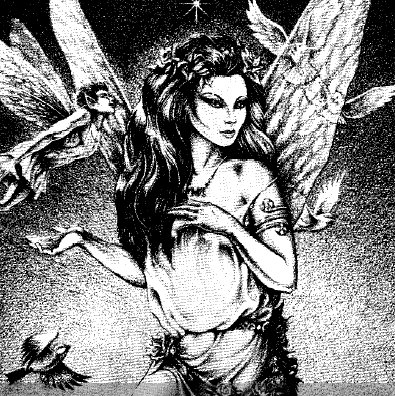
Rhiannon always appears as an indescribably
beautiful elven creature
with a
pair of gossamer
wings. She is adorned
with wreaths of holly
and floral garnishings,
and her most striking
feature is her
long, flowing hair,
which changes color
with the seasons:
yellow in spring, brown
in summer, red in
fall, and white in winter.
48
About her flitter
a number of songbirds
whose chirpings have
a calming effect on
all beings, making
even the most hostile or
evil creature passive
and docile when
within 20? of the
Faerie Queen. Rhiannon
is also attended
by a host of faerie creatures,
including: 2-8 faerie
dragons, 2-12
korred guards, and
3-18 sylph messengers
(all with maximum
hit points). No fairy or
normal animal will
harm her, nor is she
affected by any sort
of force found in
nature (fire, electricity,
etc.). At will, she
can summon or control
weather. She may
also summon 1-4 of
any sort of faeries to
aid her if she desires.
Rhiannon occasionally
leaves her realm
to hold court in
sylvan forests where
many of her ?children?
dwell. During
these visits, it
is a rarity that any but faeries
attend, although
she has been known
to favor a single
of her high-level druids
with an audience
at such gatherings.
The Faerie Queen greatly
resents uninvited
visitors to these
events, and the usual
fate of intruders
who tarry and observe is
to be turned to trees,
animals, or faeries at
her discretion (a
save vs. spells at -6 is
allowed?unless faced
on her own plane).
She does, however,
appear to show great
latitude toward maidens who are pure of
heart who seek her out. On rare occasions
when she is successfully found by a mortal
girl, there is a 5% chance that the maiden
is granted a wish if she pleases the Queen
of Faerie with a song or vivid tale of her
adventures while seeking her out. It is this
favor toward good-aligned maidens that
permits some druids of Rhiannon (all of
whom are female) to be of good alignment.
Druids of Rhiannon USE a slightly different
experience table than do normal
druids, and receive a number of special
bonuses and abilities in addition to losing
some powers usually gained by other
druids. See Table 1 and Table 2
for details.
Table
1
Druids of Rhiannon: Experience and Powers
| Experience level | Experience points | 8-sided HD for accumulated HP |
Special abilities |
| 1 | 0 | 1 | - |
| 2 | 2,500 | 2 | A |
| 3 | 5,000 | 3 | B |
| 56 | - | - | - |
| 4 | 10,000 | 4 | - |
| 5 | 18,000 | 5 | C |
| 6 | 28,000 | 6 | - |
| 7 | 50,000 | 7 | D |
| 8 | 80,000 | 8 | - |
| 9 | 130,000 | 9 | - |
| 10 | 190,000 | 10 | E |
| 11 | 270,000 | 11 | - |
| 64 | - | - | - |
| 12 | 500,000 | 12 | F |
| 13 | 900,000 | 13 | - |
| 14 | 1,300,000 | 14 | - |
| 15 | 1,700,000 | 15 | - |
| 16 | 2,100,000 | 15+1 | G |
| 17 | 2,500,000 | 15+2 | H |
| 18 | 2,900,000 | 15+3 | I |
| 19 | 3,300,000 | 15+4 | J |
| 20 | 3,700,000 | 15+5 | K |
| 21 | 4,000,000 | 15+6 | L |
| 22 | 4,500,000 | 15+7 | M |
| 23 | 4,900,000+ | 15+8 | N |
Key
to special abilities
A. At 2nd
level, the character receives the ability to turn away normal animals
(including huge species
such as mastodons, and giant but nonmagical
specimens
such as giant badgers)
in the same manner a cleric might turn undead. The range of
this effect is 30?,
and 2-12 creatures are affected each round until the druid fails her
roll. Table 2 is
used to determine success.
B. Like other druids of 3rd level, the character gains the knowledge
to identify
animal types and
pure water. In addition, the druid
gains the nonweapon proficiency
of plant lore.
C. At 5th level,
the druid acquires the healing nonweapon proficiency.
<cf. healer class>
D. Like other
druids, the character gains immunity to charm
spells thrown by all
woodland faeries
at 7th level. No other abilities are gained at this time.
E. At 10th
level, the druid gains the ability to shape
change once per day into any
normal fish, fowl,
reptile, or mammal as might exist in our own world. The transformation
takes one round and
lasts until the druid wishes to change back to her
normal form.
F. As druids
of Rhiannon are solitary, no necessity exists for them to best another
druid to advance
beyond 11th level. All such characters, however, defer to higher-level
druids, submitting
to their leadership when they meet.
G. At 16th
level, the character gains all abilities of ?normal? druids reaching this
level. Note that
her size decrease may be taken to one-tenth normal. She also may
ask a service from
faeries she meets, excluding satyrs,
swanmays, and quicklings.
H. At 17th
level, the character may summon a korred
to aid her for an hour. This
power is usable once
per week. No other abilities are gained.