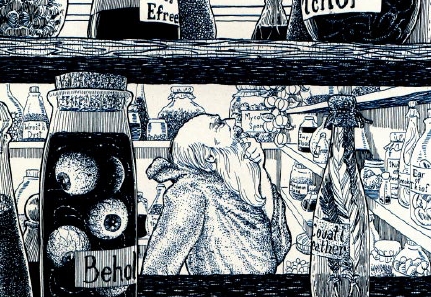
| Material components | - | - | - | - |
| 1st Edition AD&D | - | Dragon magazine | - | Dragon #147 |
As suggested in the AD&D 1st Edition
Players Handbook (page 64), a
M-U
or illusionist may use material spell
components
other than those listed in a particular
spell's description. This
may be
prompted by the lack of proper material
component; as a result, a substitute is used
which often results in an alteration of spell
efficency. Nevertheless, there are no clear
guidelines for the effects of component
substitutions. This article offers ideas to
enrich and define the place of material
compnents in spell casting.
When circumstances are such that a
spell-caster finds it necessary to resort to a
nonstandard material component, there
are 2 steps in determining to what
degree the functions of the spell are altered
and what chance (if any) there is
that the spell fails entirely. These steps and
their unique conditions follow.
Table 1
Alternative Spell Component Limitations
| Component type | Spell type | Failure1 | Range | Area of effect | Duration | SAVE |
| A | Offensive
Defensive Miscellaneous |
Special2
Special3 Special4 |
1/2
- - |
1/2
1/2 - |
1/2
1/2 1/4 |
+3
- - |
| B | Offensive
Defensive Miscellaneous |
30%
15% 10% |
1/3
- - |
1/2
1/2 - |
1/4
1/2 1/2 |
+4
- - |
| C | Offensive
Defensive Miscellaneous |
20%
15% 10% |
1/4
- - |
1/4
- - |
-
1/2 1/2 |
+3
- - |
| D | Offensive
Defensive Miscellaneous |
15%
20% 10% |
-
- - |
-
1/2 - |
1/2
- 1/4 |
+2
- - |
1. Note in what particular ways the
alternative substance differs from the
standard material component. In this
regard, there are several different categories
of component variance.
A. The component is of the proper
material type and form, but is of insufficient
value. (e.g., a <wizard>
who needs a gem worth no less
than 5,000 gp for a Drawmij's instant
summons spell tries the conjuration
with a smaller gem valued at 3,000 gp.)
B. The component is of the proper
material type and value, but is either
flawed or of an improper form. (For
example, a character requiring a jade
circlet valued at 5,000 gp to enact a
shape change spell attempts the spellcasting
with a jade figurine of equal
value.)
C. The component is of the proper
form and value, but is of the wrong
material. (For example, a wizard trying
to cast a Rary?s mnemonic enhancer
spell without the blood of a black
dragon resorts to the use of red dragon
blood instead, or perhaps casts a sleep
spell with marigold petals as opposed to
rose petals.)
D. The component is of improper
material or form (or both), but contains
the essence of the attempted spell. (For
example, a character in an ice cave
who lacks a carved crystal cone to cast
a cone of cold spell uses a cone of
carved ice as the spell component.
2. Determine the particular spell type as
listed below, thereafter referencing Table
1 to note spell modifiers.
A. Offensive: An offensive spell is one
that directly affects an opponent
through either damage or other baneful
effects, negating or reducing that
opponent's combat effectiveness (lightning
bolt, sleep, curse, etc.).
B. Defensive: A defensive spell is any
spel that affects the caster or his group
by providing either protective benefits
or greater combat potential (protection
from evil, shield, bless, etc.).
C. Miscellaneous: A misc.
spell is any spell that does NOT fit into
the other categories (fly, shape change,
spider climb, etc.).
If a proposed modification to the spell
function is inappropriate, it should be
ignored. For example, the duration of a
slow spell is 3 rounds + 1 round/level.
This figure may easily be halved or quartered
as indicated by Table 1. The instantaneous
duration of a fireball, on the other
hand, cannot be practically handled in the
same manner and thus is ignored if Table
1 indicates such a modification.
Is different better?
While the use of substitute material
components in an emergency can lessen a
spell?s effectiveness, it is also possible
that, by incorporating very rare and exotic
components, the functions of a spell can
be heightened in intensity. Exactly what
components accomplish this and to what
extent they do so is left to the discretion of
the DM. The following section offers some
suggestions on this matter.
The specifics of how a substitute or
additional material component is used
during spell-casting are not necessarily
important (although the DM might inform
the players of his own rulings in specific
cases). DMs can generally assume that the
exotic component is either mixed in with
the normal component prior to casting, or
that it is used in place of the typical material
component (for example, making use
of part of a sandman as the component for
a sleep spell rather than using normal
sand). There should always be at least a
5% chance of spell failure due to improper
mixing of the component, its innate magical
nature, etc. The spell malfunction
percentages given in the following sections
may prove helpful in arriving at a comprehensive
set of guidelines for this purpose.
Consider the following example. In this
article, bulette hide is listed as increasing
the potential of an armor spell. A piece of
finely cured leather blessed by a cleric is
the standard component. Using bulette
hide in place of this leather reasonably
places the substitute material component
in category C. As armor is a defensive
spell, we note that the failure percentage
totals 20% (the listed penalty modifier for
the spell?s duration is not considered).
One option the DM may wish to explore
when checking for spell failure is to deduct
1% from the spell-failure roll for each
level of the caster, thus reflecting his experience
in dealing with magical forces. Still,
a 5% chance of spell failure should always
exist, regardless of bonuses.
Most of the time, substitute material
components are acquired during the
course of adventuring, though it is possible
that an alchemist or component source
may have a stock of a particular item.
Table 2 shows the percentage chance that
an alchemist or component source may
have these ingredients, as well as how
many lots are available, their prices, and
the time between checks to see if more
such items have been obtained. The prices
paid by dealers for these items are usually
between 10% to 20% of the retail prices.
When these materials are obtained from
creatures slain during adventures, it is
suggested that each creature provide no
more than l-6 uses of the component. This
small amount can be justified by the fact
that a material component must be in
good condition, and only this many component
bits survive untouched by sword
blows, spell damage, etc.
Table 2
Special Component Availability and Cost
| Component | Availability | Number | Cost (gp) | Check time | - |
| Bat, fire (ichor, dram) | 10% | 1-4 | 500 | 1 per 4 months | Fireball
--Ph/3
A dram of fire bat ichor: Damage is calculated with + 1 hp/HD (30%). |
| Beetle, fire (glands) | 40% | 1-2 | 300 | 1 per 6 months | Dancing
lights --PH/1
Fire beetle glands: Duration of spell increased to 2 turns/level (15%). |
| Beholder (eye) | 12% | 1-4 | 500 | 1 per 6 months | Disintegrate --PH/6
Disintegrate ray beholder eye: Saving throw made at -3 (40%). Otiluke's telekinetic
sphere --UA/8
|
| Blink dog (heart) | 12% | 1-6 | 750 | 1 per year | Mordenkainen's faithful
hound --PH/5
Blink dog heart: Spell duration increases to 1 hour/level (35%). |
| Bulette (hide) | 12% | 1-3 | 500 | 1 per 6 months | Armor--UA/l
Bulette hide: Recipient gains AC 6 (20%). Phantom armor --UA/1
|
| Couatl (feather) | 5% | 1-4 | 1,000 | 1 per year | Feather fall--PH/1
A feather from a couatl: Spell duration increased to 1 round/level (5%). |
| Cyclops (eye) | 15% | 1 | 250 | 1 per 6 months | Wizard eye --PH/4
Eye of a cyclops: Duration increases to 1 turn/level (30%). |
| Devil, styx (talisman) | 1% | 1 | 5,000 | 1 per 2 years | Imprisonment --PH/9
A styx devil's talisman: Caster may cast this spell upon a target even if target?s name and background are unknown (55%). |
| Displacer beast (hide) | 12% | 1 | 750 | 1 per 4 months | <?> |
| Djinni (blood, vial) | 2% | 1 | 1,000 | 1 per year | Minor creation --PH/4
A vial of djinni blood: Items created with the spell gain a 25% chance of permanency (30%). |
| Doppleganger (pituitary gland) | 12% | 1 | 750 | 1 per 6 months | ESP--PH/2
Pituitary gland of a doppleganger: Spell duration increases to 1 turn/level (20%). |
| Efreet (blood, vial) | 5% | 1 | 1,000 | 1 per year | Advanced illusion
--UA/5
A vial of efreet blood: Duration increases to 2 rounds/level (40%). Programmed illusion --PH/6
|
| Eye of fear and flame (gem) | 2% | 1 | 7,000 | 1 per 2 years | Delayed blast fireball--
PH/7
Red gem from an eye of fear and flame: Damage is calculated at +2 hp/HD, not + 1 hp/HD (45%). |
| Eye killer (eye) | 12% | 1-2 | 500 | 1 per 6 months | Infravision --PH/3
An eye from an eye killer: Spell duration increases to 24 hours at any level of the caster (25%). |
| Flail Snail (shell) | 10% | 1-3 | 300 | 1 per year | Volley --UA/7
Powdered flail snail shell: Caster gains + 3 to saving throw (45%). |
| Gibbering mouther (lips) | 5% | 1-4 | 1,000 | 1 per year | Magic mouth --PH/2
Two lips from a gibbering mouther: The spell gains a permanent duration (20%). |
| Gloomwing (wings) | 20% | 1-2 | 500 | 1 per 6 months | Confusion --PH/4
Wings of a gloomwing: Duration increases to 2 rounds/level (35%). |
| Golem, iron (pieces) | 35% | 1-10 | 400 | 1 per 4 months | Enlarge--PH/1
A pinch of powdered iron from an iron golem: Growth potential increases to 25% per level of the caster to a maximum increase of 400% (5%). |
| Hollyphant (trunk) | 2% | 1-10 | 2,000 | 1 per year | Deafness --PH/2
A portion of a hollyphant's trunk: Spells area of effect increases to a cone 1" wide by 1" high by 3" long (20%). |
| Imp (blood, vial) | 5% | 1 | 750 | 1 per 6 months | Vision --PH/7
A vial of imp blood: Caster gains + 1 to any other modifiers if contacting an archdevil (35%). |
| Invisible stalker (ichor, vial) | 5% | 1 | 750 | 1 per 6 months | Invisibility --PH/2
A dram of invisible stalker ichor: Recipient gains a saving throw each round to avoid losing invisibility if making an attack (30%). |
| Lolth (spider silk) | 1% | 1-3 | 10,000 | 1 per 2 years | Web --PH/2
A portion of Lolth's spider silk: Duration of spell increased to 1 hour/level (15%). |
| Myconid (spores) | 15% | 1-6 | 1,000 | 1 per 6 months | Dream --UA/5
Myconid hallucinatory spores; If the spores are inhaled prior to sleep, the spell functions in 1/2 the Time normally required; there is, however, a 10% chance the dream is a twisted nightmare, thus perverting the intention (35%). |
| Necromancer/evil cleric (skull)1 | 5% | 1 | 5,000 | 1 per year | Animate dead --PH/5
Powdered skull of a necromancer or evil cleric, 10th level or higher: Animated creatures gain maximum hit points (25%). |
| Nightmare (hoof) | 5% | 1-4 | 5,000 | 1 per year | Phantom steed --UA/3
Hoof of a nightmare: Capabilities of the steed are improved by one level on the ability table (see Unearthed Arcana, page 68) (25%). |
| Obliviax | 5% | 1-6 | 500 | 1 per year | Dream --UA/5
Obliviax: An illusionist who eats memory moss prior to dreaming (if the saving throw is successful) increases the effectiveness of the spell to equal alter reality; failure to make the saving throw requires the illusionist to save vs. spells or be stricken with insanity (35%). |
| Para-elemental, smoke (smoke, vial) | 10% | 1 | 2,000 | 1 per year | Wall of fog --PH/1
Vial containing smoke from a smoke para-elemental: There is a 25% chance that the wall also duplicates a stinking cloud within its confines (20%). <smoke or steam> |
| Planetar (feather) | 1% | 1 | 5,000 | 1 per 2 years | Fly --PH/3
A feather from a planetar or solar: Spell duration increases to 1 hour/level (15%). |
| Sandman (sand, pinch) | 5!% | 1-20 | 300 | 1 per year | Sleep --PH/1
A portion of the sandman's body; All creatures of 8 HD or less within the AOE must SAVE vs. spells |or| fall asleep. |
| Soil (20 lbs., from druid's grove) | 10% | 1-2 | 500 | 1 per year | Conjure elemental
(earth) --PH/5
20 lbs. of soil from the grove of a druid not less than 12th level: The elemental conjured willingly serves the caster (25%). |
| Solar (feather) | 1% | 1 | 5,000 | 1 per year | Fly --PH/3
A feather from a planetar or solar: Spell duration increases to 1 hour/level (15%). |
| Son of Kyuss (skull) | 10% | 1-3 | 1,000 | 1 per year | Scare --PH/2
Powdered skull from a son of Kyuss: Duration increases to 2 rounds/level (25%). |
| Spectre (dust) | 40% | 1-6 | 500 | 1 per 3 months | |
| Spider, phase (web) | 20% | 1-4 | 1,000 | 1 per 6 months | Web --PH/2
Phase spider webbing: Web gains the potential of also entrapping astral/ethereal creatures, including noncorporeal undead (10%). |
| Telegraph vine | 10% | 1-6 | 500 | 1 per 2 years | Message --PH/1
A piece of telegraph vine: While not listed in any of the source books, telegraph vine is a plant existing in the real world; if it can be found in the PCs' plane of existence, it boosts the range of the spell to 1 mile/level(l5%). |
| Thief/assassin (ear)2 | 10% | 1-2 | 1,000 | 1 per 4 months | Clairaudience --PH/3
Ear of a thief or assassin not less than 5th level: Duration increases to 1 turn/ level (25%). |
| Troglodyte (pituary gland) | 35% | 1-4 | 250 | 1 per year | Stinking cloud --PH/2
Pituitary gland from a troglodyte: Duration increases to 2 rounds/level (25%). |
| Volt (tail) | 15% | 1-3 | 500 | 1 per year | Lightning bolt --PH/3
A volt tail: Area of effect is doubled (with regard to either width or length, as player chooses) (30%). |
| Wraith (dust) | 20% | 1-4 | 500 | 1 per 6 months | Wraithform --UA/3
A pinch of wraith dust: Duration increases to 5 rounds/level (25%). |
Alternate Components:
Magic-users
The following gives some alternate spell
components for magic-user spells, as
per
the 1st Edition Players Handbook (PH) and
Unearthed Arcana (UA). The book reference
and spell level follow the spell's
name; spell-failure chances are given in
(parentheses).
<Armor?>
Displacer beast hide: Recipient gains
benefits as though wearing a cloak of
displacement, including missed initial
melee attack; thereafter, armor class is
equal to leather armor +2 until dispelled
normally (20%).
Enchanted weapon--PH/4
Powdered magical melee weapon of + 1
or better enchantment: Imbues a nonmagical
weapon with equivalent bonuses
to hit and to damage (30%).
Alternate Components:
Illusionists
The following gives some alternate spell
components for spellls used by illusionists,
as per
the 1st Edition Players Handbook (PH) and
Unearthed Arcana (UA). The book reference
and spell level follow the spell's
name; spell-failure chances are given in
(parentheses).
JULY 1989