| - | - | - | - | - |
| 1st Edition AD&D | - | - | - | Forgotten Realms |
Some six hundred years ago, when
Myth Drannor
was a city of life and
splendor, certain of its citizens--
human, half-elven,
and elven-- who
were interested in learning more of the
natural habits and pursuits of wild
creatures styled themselves "The Guild
of Naturalists." Their studies resulted
in
much of what is now ranger-lore; they
traveled far in the Realms to observe
creatures in all lands, and when those
creatures easily studied had been dealt
with, they turned to more fearsome
beasts: the monsters of the Realms.
As the Naturalists were already disparagingly
termed "The Beast-Turners"
by those elves and humans of Myth
Drannor opposed to any interference
with wild creatures, the group decided
to conceal much of the extent of their
researches by enlarging the cellars
beneath their offices and working
there, underground, moving creatures
in and out by means of magickal gates
constructed by one of the foremost
members of the group, the mage Phe·
zult. This they did, maintaining relative
PEACE in their underground halls by
means of a
special stasis spell developed
by Phezult. Those of the guild who had
no other homes or pursuits lived there,
died there, and were buried there. The
fate of those Naturalists alive when
Myth Drannor was ruined is unknown,
but the halls today are all that remain
of
the Guild's achievements (the offices
above etre a perilous
ruin located on the
west side of a rubble-choked north·
south street in the eastern reaches of
overgrown Myth Drannor), and are a
dangerous place-the stasis created so
many years ago by Phezult is breaking
down, and beasts magically imprisoned
in the halls down the long years are
being freed again.
Key
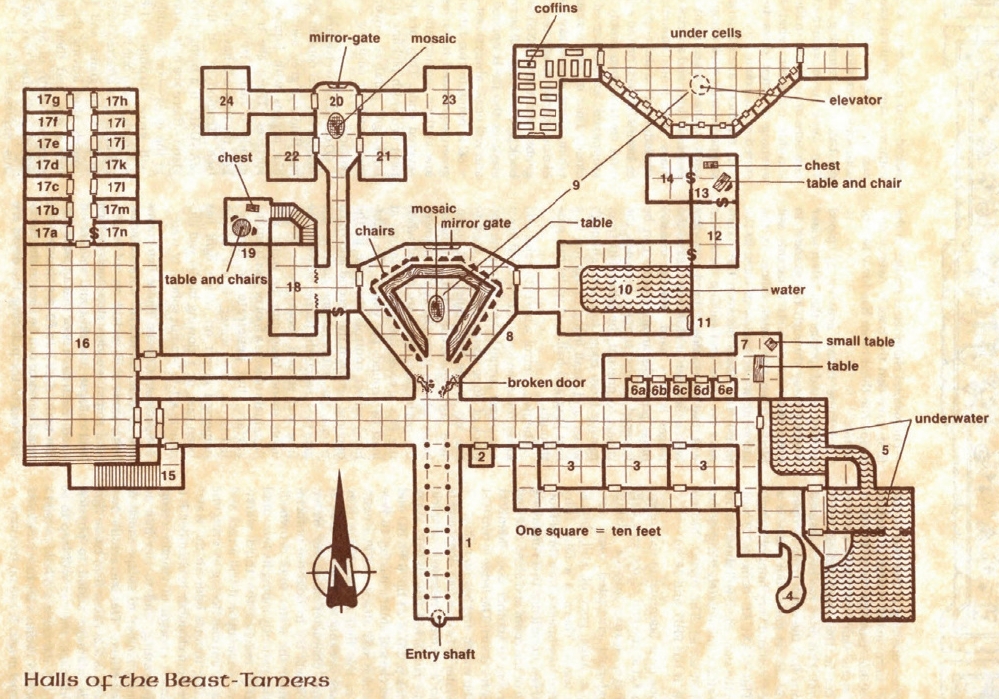
1. The halls are entered
by means of a
dust-choked, high-ceilinged building
with great cracks in its arched stone
ceiling, and scatterings of fallen rock
here and there where the walls or ceil·
ing have given way. It is strangely
devoid of animal life, and contains a
large stone seat or throne
of massive
construction, unadorned by inscription
or ornament. Behind the throne is a 10-foot
diameter shaft (without lid, lip or
other protection) opening in the floor.
This shaft has carved stone hand- and
foot-holds running down its southern
side, and drops 200 feet into
the lightless, damp solid rock beneath
Myth Di:annor.
The holds in the shaft
are themselves secure, but climbers in
the shaft will be attacked from above
(i.e. from the building on the surface
without warning when halfway down,)
by a volt
(see FIEND FOLIO® Turne, p.
94) of 12 hp, which will seek to slay all
intruders, and will attack tirelessly
until itself slain.
The shaft ends in an 80-foot-long,
arched-ceilinged hallway; the ornamental
arched ribs of its 30-foot-high vaulted
ceiling are supported by 2 rows of
smooth-cut granite pillars (carved of the
natural rock; the rest of the subterranean
Halls are also cut smoothly from this mot·
tled grey stone).
The hallway opens into a
junction with another large hallway; this
second hallway has massive
iron torch
brackets (now
crumbling into rust) set
high up on its walls down both sides, but
the torches themselves are long GONE. All
is dark and damp;
patches of harmless
mold grow here and there in the long
hallway, and the place seems deserted.
Only very careful examination will reveal
a faint circular
brown stain on the floor
where the two hallways meet (see #19).
2. A featureless, lockless
stone door
with a green-corroded brass pull-ring
handle opens (by turning in 2 stone
sockets, with a deep grinding noise)
into a 10' x 10' stone cubicle, which con·
tains three massive wooden casks, on
end, of oak blackened
with age, and
equipped with green brass spigots.
Above the casks a wooden shelf runs
from wall to wall, bearing lots of glass
flasks and a pile of sticks, all shrouded
in a thick grey web
of cobwebs and
dust. The
spigots can be turned with
difficulty. The casks all contain odd·
tasting, but safe, drinking water,
and
the 16 flasks are all stoppered jars of
lamp oil which of course can be hurled
as incendiary weapons, accompanied
by the sticks--20 wooden torches,
all wrapped in cloth rags soaked in
pitch. The torches
are not rotten (this
room is less damp than the hall), but the
casks will collapse into wreckage if any·
one tries to roll or lift them.
3. Stone
doors identical to that leading
into #2 open here into
3 identical
bunkrooms--all dusty, deserted living-
quarters, equipped with triple-tiered
bunks for up to 40 sleepers, and a
stone
table with
2 wooden benches and a
wrought-iron-with-glass-oil-bowl
table
lamp. The lamps in each room will
break if used, for the iron is crumbling
into rust. The wood of the bare bunks is
spongy with dry rot, but will burn. If
used as clubs,
pieces of this wood will
disintegrate at the first blow, doing
only 1-3 points of damage to any crea·
ture struck.
4. A narrow opening at the
end of the
corridor here leads down a
rough-walled
stone passage
to a toilet: a
smooth stone slab (with hole) set into
ledges cut in the surrounding rock,
above a pit. This privy has been disused
for so long that the smell from its open
cesspit is almost gone--but there is a
recently-freed and very hungry otyugh
(MM book p. 77) just
beneath the slab, and it will shoot out
its
arms to attack immediately (flinging the
stone shelf aside). The otyugh has no
treasure. It has 6HD, and 26 hp.

5. A
stone door (identical to that opening
into #12) at the end
of the long hallway
here leads into a damp,
moss-and-mold encrusted room containing
a huge
pool of still, black,
opaque
water.
There is a faint fishy
smell. The door opens onto a
3-foot-
wide carved stone
ledge that runs along
one side of the room and along one end
of the room to another door (identical
to the entry door). The ledge is 2 feet
above the water, and has no railing.
The water is 12 feet deep, and is
home to a recently-released vampiric
guardian
ixitxachitl (MONSTER MAN·
UAL book p. 55) of 21 hp, 6 + 6
HD and
6th level
clerical ability, having 16 Wisdom,
which will attack the PCs (with
spells) in this 1st room only if they
turn back (seeking to knock or drag at
least 1 character into the water,
where it will try to hold the unfortunate
under the water until drowned),
otherwise patiently biding its Time until
the party reaches the 3rd water-chamber,
whereupon it will attack and
then harry anyone fleeing by using the
connecting tunnels beneath the water
to MOVE from chamber to chamber. It is
quite smart enough to visually recognize
spellcasting,
and to slip into an
adjoining chamber to escape much of
the spell effects. The ixitxachitl's own
spells are: (5,5,2) cause
fear, cause light
wounds,
(damage added to physical
attack damage; the ray will leap to so
attack) x 2, darkness
x 2/hold person x
3, silence
15' radius x1, cause
blindness,
and dispel
magick. It has no treasure.
The 2nd chamber is similar to the
1st, save that the pool is 20 feet
deep. The 3rd room has 40 feet of
water.
All 3 rooms are fed by piped
underground springs that offset water
seeping away through the granite, to
keep the water levels constant; salt
blocks keep the water saline, as the
incoming water rushes of them in the
pipes). The doors between the rooms
have no locks, and spiking them shut
will take 4-7 rounds of hard pounding
with a hammer
or bat; the rock of the
ledges is very hard. Sturdy, massive
brass portcullis
arrangements can be
lowered in the tunnels between the
rooms to prevent the ixitxachitl from
moving from room to room, although
water and small living things (up to 1
foot long and 1/2 that wide) can pass
through.
The 2 control wheels to raise and
lower these devices are concealed (treat
as a secret
portal) behind a drop-hinged
block of stone
beside the entry door, to
the left in the first, outermost room.
2 stiff, green-corroded,
unlabeled
brass wheels turn clockwise to lower
the portcullises (they are raised when
the PCs arrive), the process taking at
least 2 rounds per wheel. The right·
hand wheel controls the gate in the
opening between the 2nd and 3rd
rooms, the left-hand one governs the
gate that bisects the tunnel between the
1st and 2nd rooms. Note: Bright
lights shone down into the water will
illuminate objects a foot or less from
the
surface, but penetrate no further;
lights in the water (such as an
immersed object on which light
has
been cast, or a glowing blade) will illuminate
a 1-1/2" -radius sphere of water.
6. Specimen Closets: These
5 rooms
are all identical 10'x10' stone
cubicles,
with stone shelves
laid on cut ledges,
and rotten wooden step-stools (which
will collapse into dust and splinters if
used). Each has a door that appears similar
to the door into #2, (see
above), but a
small key-hole can
be seen in the circular
boss of the pull ring; the doors are
locked, and must be picked or forced
with 2 successful lift
gates attempts
per door. They are stone
set in stone,
with solid stone
sills, and will resist simple
battering, ramming, and kicking.
The keys have vanished, and are
nowhere to be found in the halls. DMs
shoulds consider what each door opening
attempt does to the items
stored in the room.
In 6A there are 6 large
glass jars
stoppered with cork completely sealed
with melted wax; each contains a
greenish fluid,
and a wrinkled, circular
mass that looks something like a
shelled, intact walnut-pickled beholder
brains, in fact, 1 to a jar.
6B contains 2 empty jars,
and a
stoppered, sealed jar of yellowish,
cloudy fluid
in which rests a mass of
white, short, worm-like
things rather
like overgrown maggots--a jar of 63 rot
grubs
(see the MONSTER MANUAL
book pg 83) which will be released from
stasis as the jar is opened or broken,
and will be (as always) fast and hungry!
6C is home to 2 fat jars
of coiled,
green segmented tentacles,
waxy yellow
at their segmentations
and at the
severed ends.
They are preserved in
faint brownish pickling
fluid, and will
no longer paralyze anyone touching
them; each jar contains a single coiled
tentacle.
6D contains 12 jars, all
sealed and
stoppered. 2 contain greenish
pickling
fluid and
grey, leathery, oval sacklike
organs with bumpy,
misshapen
surfaces.
These are troglodyte scent
glands--if such a jar is opened or broken,
the reek will have its normal effect
(see "'Iroglodyte"
in the MONSTER
MANUAL). If a being carries around
a
gland--there are 9 in one jar and 6
in the other--continuously, the stench
will grow stronger (1·6 points of
Strength loss in 1 round, the loss last·
ing as long as affected victims are within
2" of the gland, and 10 additional
rounds after leaving the 2" AREA) for
1/2 a day, and then dwindle slowly
(shorten length of STR
disability
effect) until after 2 days of continuous
exposure to air,
the gland is
exhausted. 4 other jars contain
large, crcamy·white
feathers with a
slight silvery sheen,
and brown quills: griffon
feathers (a preferred ingredient
in the spell ink formulae for writing fly
spells) Another jar contains long, thick
spiderwebs from a giant
spider; they
have several magickal uses, but few
immediate, practical ones . 2 more
jars contain brittle, sharp, foot-long
manticore
tail -spikes, 20 to a jar. The
last 3 jars all contain pickled eye·
balls (no magical properties) of various
creatures, sorted roughly by size: tiny,
human-size,
and BIG.
6E contains only one jar.
It holds a sin·
gle larva
(q.v., MONSTER MANUAL) of
7 hp, which has just awakened from
stasis, and wants out of its sealed jar
(a
task it cannot accomplish without aid).
The jar has special tiny breathing holes
pierced through the cork. This larva
can speak and understand Common,
although he rarely tells the truth; he
will beg and cajole the PCs constantly
to
release him, offering to lead them to
nearby treasure
and so on. He will be
entertained by any suffering they
endure.
7. This 20'x30' room is
lit with a pale,
pearly radiance emanating from a
glowing globe (see col. 2) which hangs
<?>
above a stained and scarred slate-top
granite table (its top 5'x12', and littered
with dissecting knives and pins, all cov·
ered with dust). The globe can be
moved, of course, by a PC using the
proper method. In the NE corner of the
room is an obsidian plinth (itself worth
900 gp or so, if brought to a large trad·
ing city intact) on which sits a rather
dusty but well-preserved stuffed dragonne
(q.v., MONSTER MANUAL)
which will radiate its protective magicks
faintly if a detect
magick spell is cast on
it. The dragonne is stuffed with straw·
like reeds, and may (at the DM's option)
contain a map, note, or minor item lead·
ing to further adventures in Myth
Drannor.
Both doors to this room are
identical to the one leading into #2.
The glowing globe is a luminous magi·
ckal sphere which radiates light.
It will
follow the 1st person who touches it,
remaining just over his right shoulder.
These globes do not radiate any heat,
and cannot be rendered invisible
except by a wish.
The globe will remain
with its original owner until a wish or
remove
curse is cast on it, whereupon
the next person to touch the globe will
inherit it. This globe has a set light
level
(equivalent to a continual
light), but in
general 70% of the globes may have
their brightness controlled at the own·
er's mental command, from dark to a
blinding flash (effects of this flash last
for 1-6 rounds).
8. A pair of broken, splintered
wooden
double doors, eaten to almost nothing
by wood-worms, lies or hangs precari·
ously here, gaping open to reveal the
still-magnificent council chamber of the
Guild of Naturalists. A sandalwood
table, its top jet
black and glossy, polished
smooth under a layer
of thick
grey dust
is surrounded by 33 rather
rickety wooden chairs, filling the cham·
ber. Behind it, facing the entry door,
is a
gigantic, 10-foot-tall mosaic sigil (that
of the Guild), thus: with a match·
ing sigil of like size worked out in an
oval of mosaic tiles on the floor within
the arms of the council table. Nothing
else of interest is visible in this room;
it
has 2 lockable doors like those of the
specimen closets (see #6,
above); the
one on the E wall (leading to #10- 14)
is
locked and must be picked or forced;
the door in the W wall (leading to #20-
24) is unlocked and ajar.
Under the council table, in such a
place that it is near the feet of someone
sitting at the central chair of the 5
seats on the northernmost section of
the table but out of the way of inadver·
tent feet, is a 4-inch
square block of
stone raised
slightly from the surround·
ing stone. If depressed, it will sink
below the surrounding floor, and a faint
metallic squeaking and rattling will be
heard, as a long, disused winch causes
the floor mosaic to sink downwards in
the manner of an elevator, to convey
creatures upon it to the Undercells (see
#9 below). A 2nd firm
step on the
depressed stone will cause a loud click
and then the mosaic, which drops on
4 chains, will begin to rise again into
place. The stone will not move when
the elevator is part way up or down,
nor can the elevator be made to stop or
hesitate, except when fully up, flush
with the floor, or fully down. The mosaic
is solid; it will not quiver, shift, or
sound hollow when walked upon, so as
to betray its function .
Under the table, at the E end, is nailed
a pair of copper
straps, holding an ivory
tube. In the
ivory tube lies a foot long,
tapering wand of wood, with the word
"Eltzamm" engraved in Common at the
large end. It is a wand
of paralyzation
(see the DUNGEON MASTERS GUIDE,
page 136) of 3 charges, and the
engraving is its command word.
9. The Undercells, enterable
only via
the elevator described in #18 above
(note: the elevator can only be operated
from above; if no one is left up in #18
to
operate it, the 4 chains can easily be
climbed). The elevator can carry up to
14 persons, or their equivalent
weight (at approximately 200 pounds
each) of treasure
or accoutrements; if
this weight limit is exceeded, the stone
will simply lock in place and the elevator
will cease to work until the weight is
reduced to within the limit.
This lowest level of the halls is very
damp; the walls are stained by a recent
influx of at least 4 inches of standing
water here, although it has all gone
now, leaving only wet sand in patches
on the floor. A large central chamber is
lined on its southern walls with 18 small
cell-like rusty iron
cages. The bones of a
rat
lie in one, but the doors of all are
ajar; the locks have no keys and are
rusted solidly anyway.
At either end of the room the edges of
doors can clearly be seen; these are
closed, very solid
stone blocks that will
defy all forcing or lifting attempts;
when down, they drop below the level
of the chamber floor, so their bottom
edges are unreachable, and they weigh
close to a ton each. 2 raised stone
block controls (see #18,
above) are visible
upon the careful examination, near the
N wall beside each door; they will cause
the stone doors to grind slowly
upwards into the ceiling (they will not
fall again until the control is activated).
The door in the E wall leads into a
chamber once used to confine fearsome
beasts; it is now empty save for a
few very old bones in the corners.
Examinations will show that these have
been gnawed and split by a very large·
toothed animal or animals.
The western door leads into a charn·
ber containing sixteen stone coffins:
massive rectangular blocks of granite,
each holding a skeleton wrapped in a
disintegrating shroud, a lid in a
hollowed-out area, covered by a simple
slab lid (none are undead, and none
have treasure). In the center of the S
wall of the L-shaped room is an inscrip·
tion cut into the wall in Common. It
reads, "Here lie the 'Beast-Tarners: Natu·
ralists Most Noble, Resting From Their
Labors.'
10. This large chamber
contains a pool
of dark, still water, its surface 2 feet
below the unguarded edge of the floor,
which runs around 3 sides of the
pool, meeting the E wall of the chamber
in an apparently blank wall (actually
containing a secret
door) on the north
side of the pool, and ending in a 7' high,
dark oval mirror (actually a permanent
magickal gate; see below) on the south
side of the pool.
The pool is home to 2 fresh-water
scrags
(see MONSTER MANUAL II, page
121) of 41 and 36 hp, which will remain
concealed as much as possible until
they can reach up to snatch someone
on the edge of the pool into the water
with them. Treat all such attempts as
attacks, at + 2 to hit; if successful,
no
damage is done but the victim is
grasped securely. If not directly aided
by another character at the time of the
attack--not as an immediate reaction--the
grasped character must successfully
make a STR Check and a
DEX Check to avoid ending up in
the pool. If both checks are failed, 1
or more held weapons or items are
dropped or let go in the process.
11. The "mirror" will reflect
approaching
characters, and the room (#10), as a
normal mirror, but anyone touching or
striking the mirror with hand, weapon,
or any item will instantly be teleported
into (as a suggestion) the center of the
Court of Waterdeep, hundreds of miles
away. (The DM is free to choose his own
location in advance, even another
dungeon complex.) The mirror cannot
be damaged, and beings directly holding
the person touching the gate will
also be teleported instantaneously;
physical restraints or aid cannot pre·
vent this effect. (DMs may elect to have
the gate reach other destinations, per·
haps different ones in rotation or at
random, each time the gate is used;
note that this could well scatter a party
across a continent or even a score of
different planes, if desired.)
<The Theory and Use of Gates,
by Ed Greenwood>
The gate, or teleport node, was built <gates
& teleportation are different>
when Myth Drannor
flourished to give
the Naturalists--and those few elves
who aided them in the manufacture of
the gate--a secret connection to Waterdeep.
The gate is apparently a one-way
affair, having no corresponding visible
portal at the other end, although it may
once have been linked to magical items,
now lost or hidden, that permitted two-
way operation. Elves, at the time Myth
Drannor flourished, used Waterdeep as
the major port connection between
Evermeet and
Faerun. The mirror-gate
cannot be destroyed; it will defy any
attempts to physically move it by teleporting
those attempting, regardless of
the length or nature of the tools used,
and will reflect all spells cast at or
through it back, 100%, upon the caster.
If this is impossible due to the nature
of
the spell, it will merely be lost. Full
wish
spells will cause the gate to vanish (moving
elsewhere at random), even if the
wish is that the gate be destroyed or
moved to a specific location.
12. On the N wall of this
20'x30' chamber,
on shelves, are stored empty jars of varying
sizes with cork seals, dried, shrunken
things that were once blocks of wax
(identical to those found in the specimen
closets, #6), and rolled-up
weighted
capture-nets, coils of rope (both nets
and
ropes are rotting, and will be easily
ruined by any vigorous use), and catch·
poles: wooden poles with metal, mechanical
grasping arms on one end,
constructed so that pressure on a disc
at
the end of the pole will cause springs
to
close a quartet of surrounding large,
Metal fingers. The poles are 10 feet long
and have at their other ends metal sleeves
that allow a 2nd pole to be slipped in
and then turn-locked into place, to extend
the whole apparatus to 20'. These catchpoles
have survived the long years of disuse
well, and are still sturdy. As weapons,
however, they are quite unwieldy unless
one is especially skilled in their use
by
training and long practice.
A secret
door at the E end of the N
wall can be readily detected by the
seams in the shelves which run across
it, but as everything in the room is
thickly coated with dust, it will have
to
be looked for to be found.
13. The unlocked secret
door opens
into this hidden, musty-smelling
20'x20' chamber. On the N wall is a dis·
colored and mold-damaged map of the
Realms, painted on a wooden board (it
cannot be removed in an intact condition),
depicting the lost kingdoms swallowed
by Anauroch
as flourishing, far
fewer Dales than there are Now, a
smaller Sembia,
more Elven woods and
fewer northern cities everywhere
across Faerun. Arnn
is not named, having
not yet been founded as a kingdom
when the map was made. In front of the
map is a stout, iron-bound
oak chest, <size=x>
containing 1200 gp in 12 cloth bags).
The chest is locked, and well-preserved;
the key is missing.
Facing the map and chest obliquely in
the SE corner of the room is a wooden
desk, and seated at it, the collapsed skel·
eton of a man (not undead), Neziiral of
the Naturalists by name if spoken to
magickally; he knows little of the halls.
Neziiral has no treasure, but in the
drawers of the rickety desk are a potion
of healing
(q.v., DMG) in a glass vial
corked and sealed with wax, and a
potion
of speed (q.v., DMG), similarly
contained. There is also a small locked
coffer of silver,
tarnished black and
lacking its key. Within is a cloth·
wrapped item that will survive any accidental
battering or deliberate attacks: a
black obsidian talisman
that looks like
this: picture. It is an inch thick with
<fix>
rounded edges, is polished smooth, and
has a white ivory
inlay for the eye. On
the reverse is a word in Common,
"NAELOTH:' If spoken aloud, it will
summon the creature whose name it
is--a hellcat
(see FIEND FOLIO® Turne,
p. 50) of 50hp, who can be made to
serve the holder of its talisman for 9
days. The hellcat will seek to subvert
commands given to it, and lead the
talisman-holder into misfortune and
death,
unless the holder is LE
in alignment.
In the W wall of the room, a secret
door of greater-than-average width pivots
outward, to allow access to #14.
14. This 20'x20' room contains
only a
xorn (see
MONSTER
MANUAL, p. 102)
of 48 hp, surrounded by a
flickering
white aura.
This is fading rapidly as the
PCs observe it, for it was a separate stasis
field maintained by a unique spell
that was broken by the opening of the
door. The xom was not pleased by its
capture and imprisonment, and will
attack any living things it sees when
able to do so (on the 2nd round after
the PCs open the secret door the xorn
will be free to move). The xom will
phase into the floor to escape if brought
to 1/4 of its HP of less. Closing the
door of this room will not renew the
stasis; it is gone forever.
15. Here a side passage
leads off the long
main hallway of the complex. This passage
is separated from the main hall by
an iron gate
and arch that stretch from
floor to ceiling. Although this barrier
is
ornamented by floral scrollwork, and is
of iron dark with
rust, its bars are thick
and solidly embedded in the walls; it will
stop most beasts if closed and locked.
It is
presently ajar, having been picked open
(there is no key). The side passage it
opens into leads to stone stairs climbing
steeply (a rise of 30' in a run of 30').
At the
top, the stairs open without a door or
barrier
into a gallery (see #16)-but
sprawled
face-down on the stairs near the top is
the
mouldering corpse of a dead male hobbit,
his skull crushed.
If speak
with the dead is employed, this
is Dahvro, a Cutpurse(T3)
and adventurer,
out of Westgate
who was born in Sembia's
hills
long ago, and came here to find
treasure with a group of adventurers
who formed casually in Hillsfar,
am. I came <x>
here to seek treasure. The group saw no
life on the way down, turning left down
the main hallway and straight to the
iron
gate, which
Dahvro picked open. He does
not know how he met his end, which
occurred almost 2 years ago. THE HOBBIT
is clad in black-gloves, pants, and
shirt, all of leather.
He is barefoot. At his
belt is an empty dagger-sheath-the
weapon is gone-a
black silk mask, and a
bag containing a small purse of 12
gp and
a set of thieves' picks and tools. A 40-foot
coil of waxed cord is wound around his
waist at belt-level. His corpse is infested
with 34 rot
grubs (cf. MONSTER MAN·
UAL, p.83) which will swarm to attack
immediately upon the body being touched.
16. This large room is
entered by massive,
iron-barred
wooden doors, each
12 feet high, the one from the hallway
being 2 sets of double doors
opening inward. All of these doors presently
have their bars thrown aside, and
hang ajar. This room was a viewing and
training arena where the Naturalists
watched creatures stalk prey, react
socially to others of their own kind, fly
if aerial in nature, and build nests or
dens if the materials were provided. It
is presently simply an open, empty
chamber. The floor is covered with 2
feet of damp, mold-splotched sand; the
ceiling is 40 feet above that and has
crumbled and fallen in some places, but
is stable and will not fall unless a fireball
or similar explosion occurs in the chamber.
The room ends on the south with a
4-tier viewing gallery of bare
stone
seats stepped
downward to a railless
front row 15 feet above the sand.
In this area is a gorgon
(see the
MONSTER MANUAL Pg 49) of 64 hp,
who has emerged from stasis and left
its cell (#17D), and
is bewildered and
angry. It will attack immediately if the
PCs come here first; if not, it will
observe them in silence, keeping out of
sight and staying silent, until they leave
the main hallway--wherupon it will
move to the junction AREA where the
entry hall joins the main hall and await
the PCs alertly, ready to use its poison·
ous breath. It will refuse to be lured
away from this spot, and will not flee
from any foe.
17. Holding
Cells: In these small compartments
creatures were held prior to
introduction into the arena (#16),
or
after study in the arena. All are stonewalled
cubicles,
with stone floors cov·
ered with sand (and in some places,
rotten straw, too); all have an iron-barred
front wall
with lockable doors.
All except D, J, and K are locked.
17B contains 3 shriekers
(see MON
STER MANUAL p. 87) of 22,
16, and 9
hp. They will shriek the instant PCs
introduce any light into the AREA. This
will alert all living creatures in this
end of the Halls, and all creatures
immersed in water anywhere in the
Halls, by the vibrations.
D is open and empty; the
gorgon (see
#16) came from here.
E contains the nearly
skeletal, shriveled
corpse of an owlbear.
H contains the feathers
and bones of a
hippogriff,
and a faint smell of
death.
L contains the bones of
a humanoid,
with two skulls (an ettin).
N is the Keeper's Room;
a corroded
ring of brass keys
hangs on the S wall
of this AREA--keys to all of the cells
and all doors of the arena. Peepholes
in the N, W, and S walls allow views
into the surrounding areas (the
W
wall is stone,
not bars, in which is a
locked secret
door into the corridor
of the cells).
18. This 20'x40' chamber
was once a
robing room for Naturalists preparing
to leave by one of the gates in the Halls,
and its South and East walls are studded
with pegs, on which hang the rot·
ting wisps of garments. There is
nothing of value here, and the garments
will disintegrate if handled. On
its eastern side, this room is separated
from the hallway by rotting curtains
which will also disintegrate into dust
if
disturbed. A narrow secret door on the
N wall of this room leads to an office
(#19) by means of a steep
flight of stairs.
19. This 20'x20' office
has no door, but
opens directly out from the stairs. It
contains 2 unsafe wooden chairs
drawn up at a circular table. On the
table is a crystal
ball. On the floor near
the N wall of the room is a copper-sheathed
wooden chest (the sheaths
now green due to the damp), which is
locked and missing its key.
A round after the first PC enters this
room a tiny light will appear in the
depths of the crystal globe which ·will
begin to grow. 2 rounds later the
ball, blinding in its brightness, will
explode, showering the PCs in the room
with fragments (anyone in the room
must save vs. spells or take 1 hp damage
from the flying glass). Released from
this shattered prison, a xeg-yi
(see
MONSTER MANUAL II, p. 128) of 5
HD
and 33 hp will attack any living thing
it
sees in the halls, and pursue until slain
or until it has slain all such quarry.
If
the crystal ball is attacked before it
explodes, such attacks will have no
effect upon it, or upon the xeg-yi within.
In the chest is a ring
of warmth (q.v.,
DMG), a ring
of water walking (q.v.,
DMG), and a bone tube corked at
both
ends and sealed with wax. Within the
tube is a scroll with a single unique spell
on it; the same spell that has preserved
the many beasts in the halls over the
centuries:
Phezult's circle, which places a stasis
over the entire hall complex (consider
what Phezult's level must have been!),
was drawn on the floor where the two
large corridors of the Halls meet; its
gems were only recently exhausted,
breaking the stasis.
20. This chamber contains
yet another
mosaic sigil of the Naturalists set into
the floor, and another mirror-gate. (For
details of the gate refer to #11).
This
mirror-gate may lead to any location in
the Realms at the DM's choice. Alternatives
include the dust desert of Raurin
(I3-5), the
Moonshaes (FR-2), the edge of
the desert of Anauroch,
or any other
location as the DM sees fit. This mirror
may also be used as an arrival point for
high-level characters from other campaigns.
(In either case, the mirror-gate
is 1-way.)
The mosaic, like that in the council
chamber (#8), is actually
affixed to a single
oval stone which, if stepped on, will
glow with a faint
white radiance, and
begin to levitate
upward very slowly
(1" /round). It will halt when stepped
off
of, but will continue to rise whenever
touched, unless willed to go down.
(This requires constant and firm concentration
which precludes spellcast-
ing, intricate handiwork or other
mental activity, or heavy fighting.) The
mosaic can levitate any weight or number
of things that can be placed upon it,
and will easily fit up the entry shaft
as a
sort of elevator. It has a permanent levitation
placed on it, and could well be
inadvertently lost skyward if someone
falls asleep on it or carries a wounded
or unconscious person onto it, since it
will rise as long as a living being is
touching it and cannot be willed downward
by someone asleep or unconscious.
If several living persons try to
will it in different directions, it will
rise
instead. If all persons aboard unite to
will it in one direction, or one person
directs and none oppose, it can be made
to move horizontally, as well as downwards,
with ease.
4 doors in this chamber (identical
to those of #6) are all
locked and the
keys missing.
21. This 20'x20' room is empty.
22. This 20'x20' room is empty.
23. This 20'x 30' room
contains a gorgimera
(see MONSTER MANUAL II, p 70)
of 61 hp. Before charging PCs can reach
it, it can breathe down the corridor
leading into its dark
prison, which It does
without hesitation the moment the
door into its prison is opened.
24. This 20'x30' chamber
is home to a
female tabaxi
(see the FIEND FOLIO®
Tome, p. 86) of 14 hp; it is naked and
weaponless, and will attack if menaced,
but will cooperate with the party if
offered food
and freedom. It does not
speak Common, but its name sounds
like "Miiyeriial" if voiced or announced
telepathically.

Reduce - Reuse - Recycle